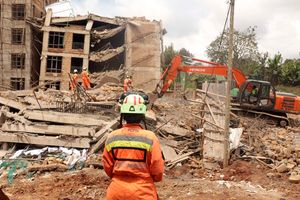
The approval of charges against embattled City Hall official Patrick Analo and 80 others over the South C building collapse has once again exposed a development approval system that insiders allege has long been manipulated by powerful interests.
The move by the Director of Public Prosecutions, Renson Igonga, marks one of the most significant attempts yet to hold planning officials personally accountable for building failures in Nairobi.
The charging of Mr Analo alongside more than 80 other suspects has signalled that the South C collapse was not merely a construction accident but the culmination of a chain of decisions, omissions, and regulatory failures stretching across multiple institutions involved in the approval and oversight of developments in the city.
Bulldozers comb through the rubble of the collapsed multi-storey building in South C, Nairobi on January 3,2025.
Photo credit: Billy Ogada | Nation Media Group
At the centre of the controversy is the Urban Planning Technical Committee (UPTC), the powerful body established under planning laws to scrutinise and approve development applications within the city.
The committee brings together representatives from professional bodies— including planners, architects, engineers and county officials— and is chaired by the County Chief Officer for Planning, a position held by Mr Analo until his recent suspension following investigations by the Ethics and Anti-Corruption Commission (EACC).
On paper, the process appears seamless. Developers usually submit architectural and structural drawings, which are circulated to various agencies and technical departments for review. The applications are then presented before the UPTC for consideration before approvals are granted.
But multiple investigations, county assembly hearings, complaints from residents and findings by oversight agencies suggest the process that exists on paper is very different from what has been happening in practice at the Nairobi County government.
Over the years, allegations have emerged that approvals were being issued outside the committee process, rejected applications revived without explanation and developments allowed to proceed despite violating zoning regulations and planning standards.
Kileleshwa Ward Representative Robert Alai says the illegal building approval process in Nairobi is a cabal of local administrators, planning officials and developers who have turned public participation into a mere formality by allegedly importing attendees from outside affected neighbourhoods to create the impression that residents had endorsed controversial developments.
South B MCA and County Assembly Minority Leader Waithera Chege (left) and Kileleshwa MCA Robert Alai speak to the media in Nairobi on November 07, 2024.
Photo credit: Francis Nderitu | Nation Media Group
Documents submitted by the MCA claim that six out of every ten participants appearing in audited public participation forums could not be verified as residents of the areas where the projects were proposed and that some individuals appeared repeatedly in meetings for unrelated developments across Kileleshwa, Kilimani and Westlands.
"The concern is that this is no longer about one development or one approval. What emerges from these documents is a pattern where the same actors appear repeatedly as projects move from public participation to Nema licensing and eventually to City Hall for final approvals," Mr Alai said, arguing that investigators should scrutinise the entire chain rather than individual projects in isolation.
Documents further allege that the same network was involved in processing projects that could collectively add thousands of housing units to the corridor, raising concerns that public participation, a critical safeguard in the planning process, had been reduced to a box-ticking exercise designed to facilitate approvals.
One of the most startling disclosures came from a junior county official at the assembly, the Acting Assistant Director for Development Control, who told members of the county assembly planning committee that he had approved close to 600 building applications.
His testimony stunned legislators because, under the Physical and Land Use Planning Act, approval authority rests with the Chief Officer.
Mr Ochanda, however, claimed that those powers had been delegated to him after his appointment.
"The powers belong to the chief officer but they were delegated to me through the appointment letter that I received from the office of the governor. The chief officer was present when I was handed over the appointment letter by the governor and informed about the duties I will be carrying out," Mr Ochanda told the committee.
The testimony immediately raised questions about who exactly controlled Nairobi's building approval process. Mr Analo, at the time, denied ever delegating the powers.
"I do not have such rights to the system and I cannot therefore give what I do not have. I cannot account for the building approvals that have been released by the county government because I do not have the rights to the system. The system has the records on who provides these approvals," he told the committee.
On several occasions, members of the Urban Planning Technical Committee accused officials within City Hall of approving developments that had already been rejected by the committee.
"We usually sit down as a committee and after probe we approve and disapprove buildings and give reasons. In some cases, we get surprised when we disapprove buildings and in the next meeting the building has already been approved without any explanation," said Ms Brenda Nyawara a member of the committee.
Interior view of the newly republished City Hall Annex during its handover and launch of the Nairobi City County Government Customer Service Center on December 14, 2023.
Photo credit: WILFRED NYANGARESI|NATION
The Architectural Association of Kenya has repeatedly accused the county government of deliberately weakening the digital approval platform that was intended to eliminate human interference and improve transparency. According to the association, the breakdown of the automated system forced developers to physically seek approvals from county officials, creating opportunities for manipulation and corruption.
Florence Nyole, then president of the association at the time, told the assembly that approvals that should ordinarily take 60 days were taking between nine and 12 months.
In 2024, the concerns eventually prompted the county assembly to establish a committee to investigate irregular approvals. The inquiry, however, collapsed before it could complete its work.
Ms Nasra Nanda, the nominated MCA who chaired the probe, said committee members encountered intimidation, missing documents and unexplained interference.
"We requested minutes of meetings approving buildings and files for developments approved over two years. A file was sent from the executive but it disappeared. We were threatened. We could not complete our mandate," she said.
The disappearance of records deepened suspicions that powerful interests were operating behind the scenes.
Nairobi Governor Johnson Sakaja at his office in Nairobi.
Photo credit: File | Nation Media Group
Mr Sakaja has said that corruption has no place in public service and emphasised that every public officer would be held individually accountable for their actions.
"This administration remains firmly committed to integrity, transparency, accountability and prudent stewardship of public resources. We will not shield any individual found to have engaged in corrupt practices regardless of their position or status," the governor said.
He has since announced the immediate reconstitution of the Urban Planning Technical Committee, effectively acknowledging concerns that the existing structure had lost public confidence.
The county has already sought fresh nominees from the Kenya Civil Aviation Authority, professional planners, architects, engineers, resident associations and Nairobi Water to constitute a new committee.
The administration has also proposed the inclusion of an EACC liaison officer to assist both the committee and members of the public on planning and development control matters.