A multi-agency team has begun inspecting buildings in Nairobi County, starting with the South C area, where two people recently died at a construction site.
This is according to the Assistant Inspector General of Police (AIG) Dr Duncan Onyango Ochieng, who heads the National Disaster Management Unit (NDMU).
In an exclusive interview with the Nation about the ongoing investigation into the collapse of a 14-storey building in South C, Dr Ochieng said that significant progress has been made.
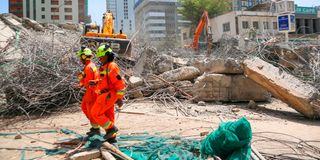
Search and rescue operations by National Disaster Management Unit, Nairobi City County, the National Police Service and the Kenya Red Cross at the site of the collapsed building in South C, Nairobi.
Photo credit: Billy Ogada | Nation Media Group
He revealed that no one has been arrested since the investigation is ongoing, with the aim of concluding it by next week, when the National Construction Authority (NCA) is expected to submit its report on the state of the materials that were used.
“Investigations are almost over, though we are waiting for just one report. We will be able to know why the building came down and who should be apprehended over the same,” Dr Ochieng said.
The Nairobi County Urban and Planning Department, the National Environment Management Authority (NEMA), and the developer of the collapsed building are among those who have recorded statements.
“Material testing that was done by the NCA is not yet out. If the report were out now, we could conclusively say who was responsible and who failed to do what, and then proceed to arrest those responsible,” Dr Ochieng said, adding that this time, the culprits who will be arrested will be arraigned.
The investigation is being led by the Lang’ata DCIO following a directive from the Office of the Director of Public Prosecutions.
He also refuted claims recently made by professionals from the built environment who stated that such investigations were not new and that they had never seen the reports.
“If you go to the National Building Inspectorate, which conducted this in a multi-agency set-up, the reports are there. They identified buildings that are not structurally sound and recommended action. What may be lacking is enforcement,” he said.
Search and rescue operations by National Disaster Management Unit, Nairobi City County, the National Police Service and the Kenya Red Cross at the site of the collapsed building in South C, Nairobi.
Photo credit: Billy Ogada | Nation Media Group
Additionally, Dr Ochieng said that the South C incident and a similar one that killed two people in Karen prompted a special meeting, which resolved to carry out investigations to establish the state of buildings in Nairobi.
“They are starting with South C, and once they have the report, it will inform where else they will go, because there is a big problem in the construction industry in terms of compliance,” he said.
This comes amid growing concerns from residents of South C, who have accused approval bodies, including Nairobi County, of ignoring them whenever they raise concerns over ongoing construction.
Recently, the county stated that some illegal buildings in the area had been flagged, but due to impunity, developers proceeded with the works.
The county has severally defended itself, saying its hands are tied since the arrest and prosecution of non-compliant developers or workers do not fall under its mandate.
According to Nairobi Governor Johnson Sakaja, the South C building had been flagged several times by the county, but weak enforcement allowed the situation to persist.
“This building did not collapse out of nowhere,” Governor Sakaja said when he visited the scene of the incident.
The governor added that some developers obtain initial approvals using qualified architects and engineers but sideline them during construction in favour of cheaper, unqualified alternatives.