Premium
Citizen power antidote to buildings collapse
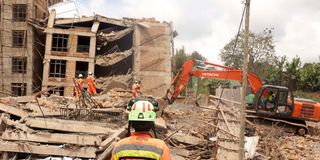
Emergency response workers at the scene where an 8-storey building that was under construction collapsed in Ole Nairi area of Oloolua, Kajiado County on May 10, 2026.
What you need to know:
- Other buildings have gone down this year in South C, Karen, Westlands, Shauri Moyo, Kericho, Siaya and Kajiado.
- Legal interventions by organised residents are a proven check on institutional failure in Kenya’s construction sector.
As delegates gathered in Nairobi for the second Africa Urban Forum in April to discuss how to build better, safer cities, a building collapsed in the city’s Highrise Estate in Kibera, killing three people and leaving several others injured.
Other buildings have gone down this year in South C, Karen, Westlands, Shauri Moyo, Kericho, Siaya and Kajiado, a grim pattern that points to a construction sector that has lost accountability.
A 2025 National Building Inspectorate report found that about 80 per cent of construction in Kenya proceeds without the involvement of any registered built-environment professional: no architect, no engineer, no quantity surveyor signing off on the structure above your head.
Institutional failure
So, what happens when institutions meant to prevent this keep failing? Citizens step in. And when they do so through the courts, they can force the system to change.
Legal interventions by organised residents are a proven check on institutional failure in Kenya’s construction sector. The Rhapta Road Residents Association demonstrated this when it moved to the Environment and Land Court to challenge a block of high-rise apartments being constructed in their neighbourhood in contravention of zoning by-laws.
Resident associations across Nairobi have gone to court to stop illegal developments, challenge approvals granted without public participation, and recover public utility land grabbed by private developers.
Regulatory accountability
Citizens are, in many ways, better placed to catch these failures. They see the cranes going up. They notice the cracks appearing in neighbouring walls. What they need are systems that allow them to act before a building comes tumbling down.
The government can achieve this by making development approvals genuinely accessible to the public through a digital register that any resident can consult to check whether the building going up next door has a legal nod. It also means creating a clear single point of regulatory accountability so that when something goes wrong, there is no question of which agency is responsible.
Also important is the need to build a functioning complaints system, where residents can submit photographic evidence of suspicious development activities and be able to track the complaints until they are resolved.
The author is a practising advocate of the High Court and an environmental law specialist at SK Chepkemoi & Company Advocates. [email protected]