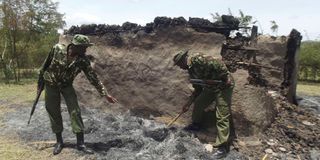
Tribal clashes in Trans Mara, Narok County, have left four people dead and more than 1,800 individuals displaced as the government announced a dusk-to-dawn curfew in the area.
However, earlier reports from the authorities had indicated that seven people have died from the violence. Security officials on Saturday imposed a curfew from 6pm to 6am to help manage the security situation.
Deputy Inspector General of Police Eliud Lagat, who toured the volatile region, stated that it will be gazetted as a disturbed zone.
Fresh fighting broke out about a week ago, pitting three communities against each other in the three wards: Ang’ata Barikkoi, Lolgorian, and Keyian.
"We are facing a situation here in Lolgorian and parts of Trans Mara South and East. This situation has been exacerbated and fuelled by ethnic clashes between the two communities," Mr Lagat said.
He added, "We are here to find out what the problem is. The biggest issue we are facing can be resolved if the leaders of the two communities sit together and work collaboratively. However, in the failure to do so, we are moving today to enforce security and conduct operations in some areas."
The police chief warned, "We are going to gazette some areas today as disturbed zones, and we are instituting a curfew from 6pm to 6am to control and manage the security situation. You are aware that so far, within the span of a month, we have lost four people. That is far too many."
He warned that all inciters, regardless of their status in society, as well as financiers and criminals, will be treated as offenders.
"We will arrest them and take them to court. We have already made some arrests this morning, and we will continue to do so. From 6pm to 6am, we will not allow anyone to walk around until order and peace are restored in this area. Those engaging in criminal activities better surrender starting today," the DIG warned.
He instructed all individuals in possession of illegal firearms to surrender them to the nearest police station, administrative offices, chiefs, or churches within 72 hours before action is taken against them.
"We are profiling and identifying them, and those who comply by Monday will receive amnesty. Otherwise, we will pursue them and deal with them according to the laws of Kenya," he cautioned.
Curfew areas include Nkararu in Trans Mara West, and Oldonyo-Orok, Siteti, Ololoma, Corner, Ratiki, Isokon, Kerinkani, Kondamet, Olkiloriti, Angata Barakoi, Kapkures, Lolgorian town, Mashangwa, and Sachangwan in Trans Mara South.
According to the Kenya Red Cross, the violence has resulted in the destruction of 253 households, forcing families to seek refuge in schools, dispensaries, and open areas, with some resorting to sleeping under trees.
The most vulnerable, children, women, and persons with disabilities, are bearing the brunt of this crisis, as food stores have also been ravaged by fire, exacerbating their plight.
"We are on the ground, conducting assessments, providing psychosocial support, and mobilising further assistance," the Kenya Red Cross said on Saturday.
Rift Valley Regional Commissioner Abdi Hassan had earlier stated that they are targeting about 20 individuals believed to be instigating the violence.
"We have lost seven lives. We are on high alert, investigating more than 20 people," said Mr Hassan while addressing the press after a security meeting with members of the warring communities on Friday.
Jane Kosgei, a mother of three, expressed her relief at being alive, stating that she, along with hundreds of other displaced residents, is camping at Oloitong Primary School. Other schools, such as Sankale Comprehensive Primary School, are also serving as temporary shelters for affected families.
"There is no security. We were chased after guns were fired at us," said Ms Kosgei from Rotik village, adding that other affected villages include Sachangwan, Lolama, Siteti and Kapkures.
Locals claim that powerful individuals are behind the continued takeover of land in the volatile region, leading to tribal clashes. Residents have been violently resisting these encroachments, leading to bloodshed before eventually ceding ground.
This cycle has repeated itself following the outbreak of fresh fighting. Locals allege that influential individuals in the country are pursuing more of their land, just months after surrendering another piece to them.
“The fact that we ceded ground and allowed those powerful individuals to take over Moyoi land is what is giving them the strength to pursue this particular one. They are now here again and want more land. It is now their daughters after it,” said Ms Agnes Chelang’at, a local activist.
She added, “The vast land here is up for sale to powerful leaders. What empowers them in this new acquisition is the fact that we surrendered the first piece of land. What hurts most is that we locals are being side-lined in owning the land. We see politics here—some people want our numbers to remain low for their own political benefit.”
Ang’ata Barikkoi Member of County Assembly Joseph Koech stated that the fresh fighting has left seven people dead.
“If you visit the piece of land that caused conflict in April this year, you will see a fence around it and sugarcane already planted there. We are no longer fighting over it,” said Mr Koech, adding that the renewed fighting involves land currently owned by tea factories belonging to members of one community, who had bought it from a neighbouring ethnic group.
On April 29 this year, angry residents told Inspector General of Police Douglas Kanja that some powerful individuals in government were behind the forceful takeover of their land. At that time, six people, including a student, had been shot dead by police as locals fought to retain what they termed as rightfully theirs: a 6,000-acre piece of land.
The residents vowed to fight for what they called justice, but seven months later, that land no longer belongs to them, and their quest for ownership has long been abandoned. It is now fenced, and sugarcane is being planted on it, with heavily armed police guarding it.
“That piece of land is no longer in contestation. Its issue was amicably resolved, and it now belongs to its owner,” said Ms Chelang’at.
Narok Governor Patrick Ole Ntutu, while addressing journalists in Kilgoris town, said they will hold a meeting in Narok with leaders from the Kipsigis, Maasai, and those from the Kisii community residing there.
“We have already contacted those leaders, and we will discuss the causes of this infighting. We know that for a long time, land has been an issue, but these communities have been living together peacefully without any problems,” said Governor Ntutu.
He added: “There is a small problem that we are trying to sort out: whether there are people coming from outside to incite those who have always coexisted without any problems. This issue escalated two weeks ago and has now heightened to a level that we do not want it to continue.”
Kilgoris MP Julius Sunkuli stated that the conflict has become intense, with locals now fighting with guns.
“In this area of Lolgorian, Nkararo, and Ang’ata, people are changing their warfare to guns. This is becoming a threat because they will use the guns against each other,” said Mr Sunkuli.
It now remains a wait-and-see situation as tensions continue to rise, with locals pressuring the authorities to end the chaos. For now, residents are calling on the government to provide immediate humanitarian assistance to the thousands of displaced people.