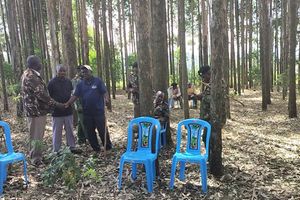
In the shadow of conflict, residents of Trans Mara are facing an uncertain start to the new year, burdened by what they describe as relentless police harassment amidst a 30-day security operation following the killing of five people and the displacement of 1,800 others.
As 2026 approached, the community's hope for a fresh beginning quickly faded under the weight of fear and tension.
Many voiced their grievances about arbitrary arrests, alleging that police are unjustly hunting for youths under the guise of recovering illegal firearms, getting criminals and restoring peace.
These alarming reports surfaced just a day before the new year, coinciding with the end of a police-imposed amnesty period for surrendering illegal weapons.
So far, only 31 guns have been handed over, a mere fraction of what authorities believe are circulating among unauthorised civilians.
In an effort to stabilise the area, the government, more than a week ago, enforced a strict dawn-to-dusk curfew, further complicating the lives of residents who seek both safety and normalcy.
As Trans Mara navigates this tumultuous landscape, the community stands united in its call for justice and accountability.
The 30-day security operation by the government followed fresh fighting that broke out about a month ago, pitting the Kipsigis, Maasai and Kisii communities against each other in the three wards: Ang’ata Barikkoi, Lolgorian and Keyian.
Deputy Inspector General of Police Eliud Lagat, who toured the volatile region instructed all individuals in possession of illegal firearms to surrender them to the nearest police station, administrative offices, chiefs, or churches within 72 hours before action is taken against them.
The Deputy Inspector-General of the National Police Service Eliud Lagat at the Bunge Towers, Nairobi on November 7, 2024.
Photo credit: Dennis Onsongo | Nation Media Group
Trans Mara South Police Commander Enrico Telewa said that even though they have recovered 31 firearms, they are calling on residents to surrender all of them.
"We want all those guns. So far, we have got 31 firearms, including 9 AK-47s, 1 G3 and 8 toy guns," said Mr Telewa.
However, some locals have criticised the manner in which the operation is being conducted, claiming that it is one-sided.
Speaking in Lolgorian, the residents said security officers were following them to the markets and arresting youths at random, noting that such actions ruin the good intentions of the operation and create fear and trauma.
"We were told we had firearms and were asked to hand them over; we did. Now, we are being oppressed," said Ole Yiagasi.
Another resident regretted that they had heeded calls to stop the fighting, but officers, mainly those from the Directorate of Criminal Investigations, were unfortunately following them to market areas.
"We have never heard of such a thing. We do not want this," said the angry resident, noting that a meeting held a fortnight ago in Narok has been their source of torment.
"We attended a peace meeting convened by the Narok County Commissioner about a fortnight ago, but some of those who spoke are facing hell. They are being intimidated and pursued by the officers," said Mr Musingo Mungasia.
He added, "The operation is no longer about security, but pure harassment of our people."
Even as the operation continues and residents feel its heat, police say they are fair, and their only aim is to restore peace and security, not aimed at any innocent individuals.
Police also called on residents living in displacement camps to return to their homes, noting that calm has returned.
"We would like those people camping in schools to return to their homes, because calm has been restored," said Mr Telewa, noting that schools are preparing to open next week.
The tribal clashes have left several people dead, dozens maimed and more than 1,800 individuals displaced, according to authorities.
Additionally, the violence has resulted in the destruction of 253 households, forcing families to seek refuge in schools, dispensaries, and open areas, with some resorting to sleeping under trees.
The most vulnerable among them are children, women and persons living with disabilities.
While the conflict stems from a land dispute, reports suggest that powerful individuals are taking advantage of the situation to stir up violence.
“The main cause of the incitement and chaos is a land issue, but some suspects are inciting residents on unrelated issues simply to cause chaos,” said DIG Lagat.