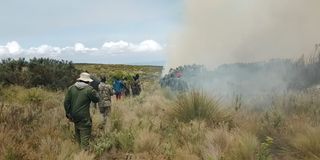
A raging fire in the Aberdare Forest has entered its fourth day, destroying wildlife habitat, trees and critical water catchment areas as authorities struggle to contain the inferno.
The fire is burning in Ndaragwa Forest, in the Shamata area of the Aberdares — a critical water catchment that feeds Lake Ol Bolossat, Ol Kalou and other areas of Ndaragwa.
Authorities suspect the fire was accidentally started by honey gatherers who had ventured into the forest in search of honey. However, residents say some communities deliberately light forest fires during prolonged drought, believing the smoke will attract rain.
Both the Nyandarua County Government and the Kenya Forest Service (KFS), which are coordinating efforts to contain the fire, say they are overwhelmed and urgently require additional support from other environmental conservation and national government agencies.
Nyandarua County Conservator Daniel Mkung said the fire was burning in moorland covered by dry vegetation, making it difficult for firefighters to contain it.
"We need all the support we can get, and we are working on the logistics to transport more firefighters into the forest. The area is accessible through Shamata town in Ndaragwa Constituency," Mr Mkung said.
A charred section of Aberdare Forest consumed by fire.
Photo credit: Pool
But as firefighters battle the flames, a long-held belief among some neighbouring communities has emerged as another possible explanation for the frequent forest fires during drought. Some residents believe smoke from burning vegetation forms clouds that eventually bring rain.
"Some people believe that the dark smoke produced by burning forest cover attracts rain. The clouds of smoke are believed to convert to clouds that bring rain a few days later. It is an old practice that is still held to date," said Mr Jackson Kieru, an 86-year-old resident.
He reckons the belief could explain why some fires start in the moorlands, where there is little likelihood of finding honey.
Millicent Wangui, 79, said she had heard of similar beliefs throughout her life, adding that rain was often reported days after such fires.
"Decades back, young men used to start fires in the farms in the hope that they would bring rain. That may be one of the reasons they have resorted to burning forests," she said.
However, Mr Mkung dismissed the belief as a dangerous myth, warning that destroying forest cover would have the opposite effect.
"Those are misguided myths. It can actually lead to delaying the rains through the gases produced by the smoke. Trees are known to attract rain, and we cannot get more rain by destroying forest cover," he said.
The conservator said firefighters were facing difficult conditions, with dry vegetation and strong winds helping the flames spread.
"Right now, we are unable to fight the fire in Aberdare due to dry matter in the forest and heavy winds. If our investigations reveal that the fire was intentionally started, then those who did it will face the law," Mr Mkung said.
Nyandarua County Kenya Wildlife Service (KWS) warden Paul Wambugu said firefighters from the Aberdare National Park had been deployed to help contain the blaze.
"We are still assessing the situation on the ground. We will only know the extent of the damage once the fire is contained and a survey done," he said.
Nyandarua Water and Climate Executive Wachira Mugo said the situation was getting out of hand, with county teams unable to access some of the affected areas because of the difficult terrain.
"The county government lacks the capacity to contain the fire, and our firefighting equipment cannot access the affected areas due to the rough terrain. Our staff are overwhelmed," Mr Mugo said.
He warned that the fire was spreading towards key water catchment areas that supply Lake Ol Bolossat and the Ol Kalou Water and Sewerage Company.
"The situation is bad because the fire is fast escalating towards the catchment areas...We urgently request the support of the Kenya Forest Service, Kenya Wildlife Service and Kenya Defence Forces," Mr Mugo said.
The fire has been fuelled by prolonged drought, which has left vegetation exceptionally dry, as well as strong winds affecting the western side of the forest.
Nyandarua County has previously reduced forest fire incidents through community beekeeping projects around the forest, which were intended to give residents an alternative source of honey and discourage them from entering the forest in search of it. But prolonged drought has caused a severe shortage of honey and triggered massive bee migration, according to the county government.
"We have not had fire incidents in the last three years, after deliberate interventions by the county government, which has heavily invested in climate-smart farming and other mitigation measures. But there is an acute shortage of honey due to prolonged drought, forcing honey scavengers into the forest," Mr Mugo said.
By Monday morning, the fire had become visible from the western side of Lake Ol Bolossat, according to local conservationists.
The escalating fire has prompted Nyandarua Governor Kiarie Badilisha to call for urgent intervention to prevent the destruction of the forest's critical water catchment areas.
He also renewed his call for Nyandarua to receive a share of revenue generated from the Aberdare Forest, arguing that the county spends substantial resources protecting and conserving the forest without receiving a corresponding benefit.
"Our teams, supported by ward climate change committees, were the first to arrive at the scene of the fire by Friday. We are involved in the protection and conservation of natural resources, but Nyandarua residents are not getting anything in return for their efforts," the governor said.