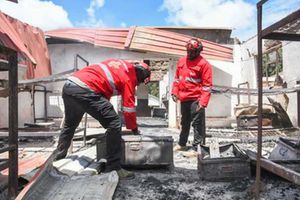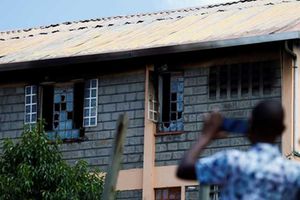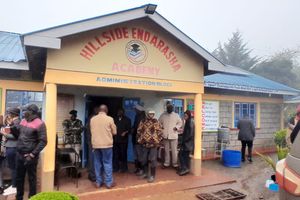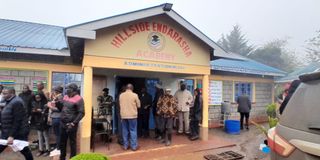
Parents at Hillside Endarasha Academy in Kieni, Nyeri County, in September 2024 following a fire tragedy that claimed the lives of 21 learners.

The electrical system at Hillside Endarasha Academy failed several safety standards, an inquest seeking to establish the cause of a dormitory fire that killed 21 boys on September 5 ,2024 was told on Monday.
An electrical engineer working with the Energy and Petroleum Regulatory Authority (EPRA), Allan Mogoli, said the system had undersized cables and circuit breakers and inadequate earthing cables.
Mr Mogoli told Nyeri Senior Resident Magistrate Mary Gituma that he conducted an assessment of the school’s power reticulation system on September 10, 2014 and found that its design and installation did not meet standards required for places of public use.
The inquest seeks to unravel the mystery of the fire that shocked the nation, with relatives of the 21 boys who perished saying they rely on its findings as they seek closure to the tragedy that shattered their lives.
The preliminary report, prepared by a team of five experts from EPRA, revealed that structures at the school, established in January 2012, consisted of a mix of stone structures and corrugated-sheet houses, accommodating classes from pre-unit to grade two.
Three years after its establishment, in January 2015, the institution was connected to the Kenya Power grid with a single-phase transformer that also served other customers in Endarasha area.
The report showed that the electrical installation was done by Vibrantor Contractors, an EPRA-licensed electrical contractor.
However, as the school had expanded over the years and more buildings constructed between 2013 and 2023, its electrical system was not upgraded.
“The extensions to the electrical system were carried out by an electrical worker identified as Richard Nderitu, who was not licensed by EPRA at the time of our investigations,” the engineer said.
He said that the school ought to have sought an assessment on the increase of its electricity load from the Kenya Power.
During cross-examination by lawyer Raphael Olieti, representing the victims’ families, the EPRA expert explained that the additional electrical overload posed a risk.

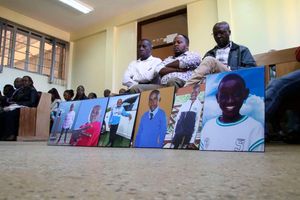
Pictures of the 21 children who died in the dormitory fire at Hillside Endarasha Academy.
“When Kenya Power supplies electricity, the initial load is estimated. If additional buildings are constructed, Kenya Power must reassess the load, as failure to do so may result in cables overheating and potentially causing a fire,” he said.
In his report, he held that the school owners, David Kinyua, Mary Wanjeri, and the Board of Management, be held liable for engaging an unlicensed electrical worker.
His testimony before the public inquest further disclosed that the electric cables supplying various buildings from the school’s main distribution unit, located in the administration block, were undersized.
He explained that EPRA regulations require a six-square-millimetre cable for the main supply line from the distribution unit to individual consumer units.
However, four-square-millimetre cables were installed, flouting the rule. The cable supplying the dormitory from the kitchen was even smaller, measuring only 2.5 square millimetres, instead of the recommended minimum of four square millimetres.
The supply arrangement consisted of a cable running from the administration block to a store, then to the kitchen, and ultimately extending to the boys’ dormitory, known as Mara, and the girls’ dormitory, dubbed the Nile.
He noted that the smaller cable was inadequate, even though the dormitory’s electrical load consisted mainly of lighting.
EPRA’s investigations also revealed shortcomings in the earthing system, which is intended to provide a safe path for electrical faults and minimize the risk of electric shock.
Also Read: Endarasha 21 - Who failed them?
Mr Mogoli explained that EPRA regulations require each building to have its own earth rod, yet the Mara dormitory did not have one.
“Only four blocks: the administration block, the kitchen, the meter box block, and the Grade three block had separate earthing. The earth connection at the Grade three block had been severed, while the kitchen’s earth rod had been buried in concrete, preventing our investigation team from establishing whether the connection was complete,” he said.
The electrical engineer also raised safety concerns on the school’s kitchen, noting that cables supplying the dormitory passed through the building without protective conduits.

Parents display portraits of some of the 21 boys who died in the Hillside Endarasha Academy fire of September 5, 2024, as the public inquest into the tragedy begins at the Nyeri Law Courts on November 20, 2025.
“The cables contained joints and were covered in soot. One of the cables running from the store to the kitchen was not armoured as required, its route was unmarked, and it passed through the school’s open assembly grounds,” he explained, adding that the electric system’s protective devices were inadequately sized and improperly graded.
“We had a 32‑amp single‑pole circuit breaker which was oversized, making it unreliable in the event of an electrical fault. As per our regulations, protective devices should be graded so that the one closest to the consumer is smaller, with sizes increasing progressively toward the main supply. This arrangement, however, had not been observed at the school,” he said.
EPRA’s report also showed that the investigating team had inspected a solar water pumping system that had been installed for irrigation before being repurposed to supply water at the school.
The report showed that the system had been poorly mounted on one of the roofs of the school’s buildings using rusty wires and had not been installed professionally.
It noted that fastening solar panels in such a manner posed a risk, as the roof and other conductive components attached to it could potentially become energized.
Despite the multiple safety hazards identified in the report, the electrical engineer said that the regulator could not conclusively establish that an electrical fault had caused the fire.

Local residents outside Hillside Endarasha Academy in Nyeri County where 17 children perished in a night fire on September 6, 2024.
“We did not find direct evidence that showed an electrical fault occurred. The electrical system in the boys’ dormitory had been severely burnt, making it impossible for us to determine whether an electrical fault had occurred or whether it had started the fire,” he said.
The inquest heard that cables supplying the dormitory were severely damaged by the fire, and EPRA did not find evidence of a short circuit in the portions that remained.
The regulatory body explained that the circuit breakers were also intact, and it could not determine whether they had tripped during the fire because they were manual circuit breakers that could have been reset after the incident.
A report presented to the court by the Kenya Power (KPLC) Central Regional Manager Engineer Mr Mutegi Mbai, showed that the company’s investigations did not reveal any fault within its network that could have caused the fire.
Testifying before the court, Mr Mbai stated that the transformer supplying electricity to the school and the surrounding community was intact, as were the meter, supply cable, and earthing system.
He explained that customers connected to the same transformer had not been affected.
During cross-examination by the school’s lawyers, Muasya Kiprotich and Mahianyu Mwaniki, the inquest was told that the KPLC report did not exclude the possibility of an electrical fault occurring within the school.
The court heard that KPLC’s responsibility extends only up to the meter, while the electrical installations within a customer’s premises fall under the responsibility of the customer and EPRA.
The court was told that besides the electricity supplied by Kenya Power, the school was also powered by a solar back‑up system installed in 2022.
The institution had a standalone solar power system: one located at the administration block and another at the dormitory, which was used to provide emergency lighting.
Witnesses testified that the solar power system was offline at the time of the fire. The hearing continues on Tuesday, August 4, 2026.
Follow ourWhatsApp channel for breaking news updates and more stories like this.