For many years, State House and State Lodges across Kenya were bastions of high security, reserved exclusively for senior government officials, diplomats and a select few invited by the President.
Even taking a photograph of such buildings could once provoke serious consequences. While stringent protocols still exist, a new era of openness is emerging.
President William Ruto joins artiste Bahati and Dagoretti South John Kiarie to dance when he hosted an economic empowerment forum at State House, Nairobi on August 9, 2025.
Photo credit: PCS
Today, it is not uncommon to see ordinary Kenyans entering the grounds of State House taking pictures and even enjoying moments of entertainment when music fills the air.
Such a moment unfolded on August 9, when President William Ruto welcomed over 1,100 young people for a forum on economic empowerment at State House Nairobi.
President William Ruto shoots pool when he hosted an economic empowerment forum at State House, Nairobi on August 9, 2025.
Photo credit: PCS
Just three days later, on August 12, President Ruto hosted more than 2,500 women at the Homa Bay State Lodge, in an event that blended dignity with celebration.
The women, drawn from Siaya, Kisumu, Homa Bay and Migori were received at a special gathering dubbed "Nyinam Presidential Luncheon."
At the generous buffet, guests sampled a sumptuous meal to their heart’s content.
"I was in Kakamega when I called Governor Gladys Wanga. She told me she was hosting women from Nyanza. I asked her to have them join me for lunch at the State Lodge,” President Ruto said.
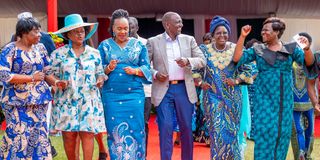
President William Ruto joins women leaders from Nyanza counties in a dance at Homa Bay State Lodge on August 12, ahead of the start of the Devolution Conference.
Photo credit: PCS
The visit followed a regional forum convened by Governor Wanga and other women leaders to address key challenges facing their communities, including gender-based violence, teenage pregnancies and sexual abuse.
Economic empowerment was also high on the agenda, with a shared belief that financial stability is key to overcoming such societal burdens.
The initiative was supported by the National Syndemic Diseases Control Council and other stakeholders. Inspired by its purpose and spirit, the President extended an invitation for the women to continue their engagement at the State Lodge.
Organisers initially expected 2,000 women but as the group made its way from the Governor’s Park to the State Lodge, the crowd swelled.
Some attendees were drawn by the chance to see the President in person while others hoped for financial tokens, that they duly received.
Entry was managed through Gate C where officials read names aloud to admit those formally invited. However, the overwhelming numbers soon strained security at the entrance, prompting complaints from women who felt excluded.
Interior Principal Secretary Raymond Omollo intervened to restore order, directing that the women be allowed into the compound before the President’s programme began.
In his address, President Ruto reaffirmed his belief that empowering women is key to national progress.
"When women are empowered, entire communities thrive. For the past three years, I have focused on strengthening our economy,” he said.
Among the dignitaries present were Governors Wanga (Homa Bay), Anne Waiguru (Kirinyaga), Kenneth Lusaka (Bungoma), Cecily Mbarire (Embu) and Ahmed Abdullahi (Wajir).
Governor Wanga stressed that tackling the triple threat of gender-based violence, teenage pregnancy, and sexual abuse requires extensive engagement.
“It demands economic inclusion. If women have money in their pockets, they can confront and overcome the challenges that make them vulnerable,” she said.