In January 2020, a rare migratory bird, the Western Osprey, flew over 6,900km from Finland to Usalo village in West Yimbo, Siaya County where it perched in one of the trees.
There was great excitement when it was discovered, as it had a ring around one of its legs, much to the amazement of the locals and people across the country.
Five years later, the same species was discovered again, having flown from the same zoo in Finland to almost the same place: a village near the home of Supreme Court Judge William Ouko.
On Tuesday, local fishermen made the discovery while casting their nets into Lake Victoria near Usalo Beach.
An osprey bird discovered by fishermen near Usalo Beach, Siaya County. The bird was found trapped in a net by Mr Walter Tende Oloo on June 3, 2025.
Photo credit: Rushdie Oudia | Nation
Mr Walter Tende Oloo, a fisherman from Usalo Village, found the bird trapped in a net.
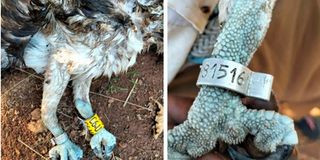
It had become entangled in the net and died before they noticed the identification rings on its legs.
The ring bore the mark: Museum Zool, Helsinki Finland, with www.ring.ac , C6.U, indicating that the bird, believed to be a fish-eating raptor, had been ringed in Finland.
The bird is historically known as the sea hawk, river hawk or fish hawk and is a bird of prey. It is a large bird of prey, reaching over 60cm (24 inches) in length and 180cm (71 inches) across the wings. It is brown on the upperparts and greyish on the head and underparts.
The beach is teeming with various species of birds, making it a great place for birdwatching. However, two recent events have prompted locals to demand recognition and the transformation of the area into a bird sanctuary.
Mr Tende, 77, whose land the birds have been using as a refuge, wants the government to protect the area, which is now becoming a bird sanctuary.
“Many species have been coming here but villagers who do not know their worth eat or injure them. This will open up this place and what it needs is proper care,” said Mr Tende.
“This is the second time, these people come, pick these birds and leave me with nothing. I want to be connected with the government of Finland or the zoo so that I and this village get the necessary recognition. If they do not, I will look for the government of Finland myself.”
He said that there are many species of birds and they would like the area to be designated a sanctuary.
He stated that the birds come to his land, which has been invaded by Lake Victoria waters.
Francis Onyango Mayeya, a Luo elder and resident of Usalo, is hopeful that the small village will be recognised.
“We are hopeful that good things will come our way following these mysterious migrations. The last time another osprey found its way here, things went silent after the KWS intervened. We are hoping the county government will do more than only witnessing this,” said Mr Mayeya.
He believes that the zoos from which the birds originate are also curious as to why they always make the long journey to this part of Africa and Kenya in particular.
“What has happened shows that there is a connection between Finland and this village of Usalo. There should be a token and special appreciation for this old man who usually takes care of these strange visitors,” said Mr Mayeya.
He also called on the Siaya County Government to recognise the significance of this area and develop it as a tourist attraction.
Mr Richard Kipng’eno, a birding officer at Nature Kenya — an environmental society that promotes the study and conservation of nature in Eastern Africa — stated that they are continuing to conserve such birds so that they do not become extinct.
“At some point, we had dinosaurs, but they no longer exist. This is why we are keen on such birds so that they do not become extinct. We usually have this ringing programme all over the world, which is used to monitor movement, lifespan and recoveries of the birds,” said Mr Kipng’eno.
Every Tuesday at the National Museum of Kenya, ringing is done on the birds by the Nairobi Ringing Team and Nature Kenya.
Scientific research involving biometric measurements is carried out to establish the height from the beak to the tail end, wing span, weight and age, depending on the condition of their feathers, before they are released.
“Before they set off on the long journey, they prepare well by feeding since they will have limited time while flying to their destination. We usually check the fat content and also check the skin, if it is red, you will know it has low fat content,” said Mr Kipng’eno.
According to the Birding Officer, birds either hibernate until the weather improves, migrate, or stay and die.
Some birds migrate over short distances, engaging in local movement triggered by food abundance, such as on rice and maize farms. Examples include Quelea birds and flamingos, which move between lakes within Kenya.
Then there are altitudinal migrants, which nest in high-altitude areas, and some which come to lower areas for breeding.
He stated that long-distance migrants include intra-African migrants moving within the tropics of this continent; Malagasy migrants who cross the Indian Ocean from Madagascar to East Africa during non-breeding seasons; and transcontinental migrants, who migrate from September to March.
“The ringing helps us track the navigation route of the birds. Some fly using landmarks, others use post lines, use features such as valleys, while others follow mountain ranges to migrate either during the day or at night to avoid being preyed on,” said Mr Kipng’eno.
In January 2020, the Kenya Wildlife Service (KWS) announced that they were in contact with Finland, who confirmed that the other bird had been ringed at the Zoological Museum in Helsinki with the code ‘www.ring.ac, M-68528’.
KWS received communication from Finland stating that the bird had been ringed in June 2017 and was ready to breed.
Experts advised releasing the bird no later than March to allow it to navigate back within the migratory period.
The osprey tolerates a wide variety of habitats and nests near bodies of water that provide an adequate food supply. It is found on all continents except Antarctica, although in South America it occurs only as a non-breeding migrant.
As its other common names suggest, the osprey's diet consists almost exclusively of fish. It possesses specialised physical characteristics and unique hunting behaviour. Due to these unique characteristics, it is classified in its own taxonomic genus and family: Pandion and Pandionidae , respectively.