The burial of former Prime Minister Raila Odinga, conducted within 72 hours in accordance with his final wishes, left many unable to attend the ceremony.
Days after the interment, mourners continue to arrive in droves, turning Kang’o ka Jaramogi , where he is buried, into a pilgrimage site.
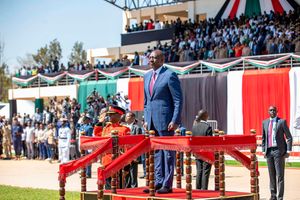
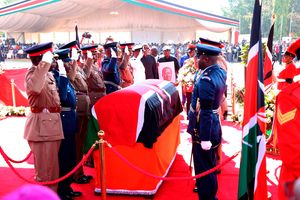
Military personnel during the funeral of former Prime Minister Raila Odinga at Jaramogi Oginga Odinga University on October 19, 2025.
Photo credit: Sila Kiplagat | Nation Media Group
Traditionally, the burial of leaders is coordinated by a burial committee, allowing sufficient time for planning and public participation. However, the late Mr Odinga's personal wish for a swift burial superseded convention, resulting in a ceremony that left out many who would have liked to attend the ceremony.
The burial took place on Sunday, October 19, drawing thousands of mourners from across the globe.
Since then, visitors have been making their way to his home at Opoda Farm and to Kang’o ka Jaramogi, where his father, founding Vice President of Kenya, Jaramogi Oginga Odinga, is also buried.
Former president Uhuru Kenyatta and his entourage at Kang'o ka Jaramogi in Bondo on October 20, 2025.
Photo credit: Alex Odhiambo | Nation Media Group
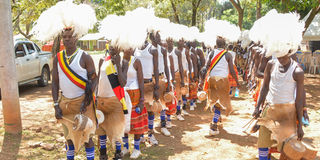
On Monday, October 20, former President Uhuru Kenyatta returned to the site , accompanied by some members of the Odinga family. That same day, a delegation from the Acholi from Northern Uganda, led by Ambassador Olara Otunnu, paid their respects. Their visit was marked by the performance of the buola dance, an honour reserved for individuals of the highest esteem within the Acholi community.
Clad in traditional regalia, the group moved in rhythm to the resonant beat of drums. The buola , a ceremonial dance performed only for those considered ‘Jowi’ (buffalo), ‘Thuon’ (warrior), or ‘Oteka’ (man of great standing), evoked ancestral spirits and carried with it a poignant mix of grief and celebration. The dancers, singers and drummers – all masters of their craft – circled the graveside, chanting praises and blowing whistles in tribute to Mr Odinga.
“We did not get sufficient time to mourn our icon. To the Luo community, by which I mean the broader Luo people across East and Central Africa, Raila Odinga was not just a leader, but a symbol of hope and unity,” said Prof Otunnu.
A delegation from the Acholi from Northern Uganda at Kang'o ka Jaramogi in Bondo, Siaya County.
Photo credit: Alex Odhiambo | Nation
The second day after the burial saw more leaders visit Kang’o ka Jaramogi, among them Nairobi Governor Johnson Sakaja. On the third day, a procession of leaders continued to arrive, including Migori Governor Ochilo Ayacko and County Assembly Speaker Christopher Rusana, who led a delegation to honour Mr Odinga’s legacy and mourn with the family. They came with cattle in accordance with Luo tradition
“We came to visit our mother, Mama Ida, who hails from Uriri Sub-County in Migori. The late Odinga was a titan; his legacy belongs to all of us,” said Governor Ayacko.
Bungoma Governor Kenneth Lusaka, accompanied by a delegation from Kimilili and a herd of cattle, also paid his respects.
“I had the privilege of working with Mr Odinga, first as a Permanent Secretary and later during my time as Senate Speaker. The best way we can honour him is by upholding the values he stood for,” said Mr Lusaka.
Ndia MP George Kariuki and a delegation of Kikuyu elders on October 22, 2025 say a prayer at former Prime Minister Raila Odinga's grave at Kang'o ka Jaramogi, Siaya County.
Photo credit: Alex Odhiambo | Nation
Significantly, a group of Agikuyu elders from Central Kenya, led by Ndia Member of Parliament George Kariuki, also visited the family, extending condolences and expressing unity.
“Raila Odinga was not only your leader; he was also ours in Central Kenya. Let it be known that recent remarks by certain leaders do not reflect the sentiments of the Mount Kenya region. We, too, mourn his passing deeply,” said Mr Kariuki.