As the echo of the 17-gun salute thundered through Kang’o ka Jaramogi on Sunday evening, followed by a military fly-past, a silence fell across the nation — the kind reserved for moments that define history.
Soldiers stood stiff in formation, rifles raised in precision. And in the middle of it all lay the body of a man who never sat on the throne, yet ruled the hearts of millions; ‘The People’s President’ — Raila Amolo Odinga.
It was a farewell like no other — part State ceremony, part spiritual closure, and part political reflection on one of Africa’s most resilient figures.
For over four decades, Mr Odinga had been many things to many people: a freedom fighter, a political prisoner, a reform crusader, a prime minister, a kingmaker — and to his supporters, the “People’s President.”
Kenya bids emotional farewell to Raila Odinga in grand state burial
But on this day, the State he had fought, shaped, and sometimes defied came together to honour him with full military honours — the same State that once jailed him for years without trial. The irony was profound, the symbolism even deeper.
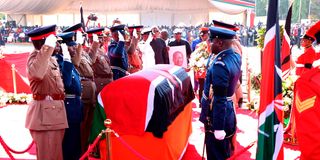
The day began early morning, when Mr Odinga’s body was escorted by the military from his Opoda Farm home to Jaramogi Oginga Odinga University of Science and Technology (JOOUST) grounds in Bondo town — draped in the national flag.
Military pallbearers, crisp in uniform, walked in perfect rhythm as the band played.
Military pallbearers position the flag-draped coffin of Kenya's former Prime Minister Raila Odinga during his burial at the Kang'o Ka Jaramogi home in Bondo, Siaya County, on October 19, 2025.
Photo credit: Thomas Mukoya | Reuters
At the venue and around the institution, thousands of Kenyans — from ordinary citizens to global dignitaries — watched in solemn silence.
Former Nigerian President Oluṣẹgun Ọbasanjọ pays tribute to long term friend Raila Odinga
The ceremony was full of grief as the family, leaders, and mourners fought back their tears in the process.
From the main dais where the dignitaries sat on the momentous day when thousands gathered to bid the former Prime Minister farewell, to the streets where some people followed the proceedings from mounted screens, anger filled the air.
With handkerchiefs that wiped tears and sweat from the scotching sun, the event solemnised a man who was celebrated as a political doyen in this part of the world.
As the family members eulogised the departed hero, their heavy voices elicited emotions which saw eyeballs swell with tears; eventually flowing through tiny streams down the cheeks.
Raila Odinga honoured with 17-gun salute in final farewell
Each speaker taking to the podium to address the people described the former immediate ODM boss as a colossus in the fight against injustice.
Mr Kenyatta eulogised the late former Prime Minister, terming him a statesman who put the country first.
Mr Kenyatta, who worked with the late Odinga during his sunset days at the country’s seat of power, gave glowing tributes to the man who once was his boss in the grand coalition government, later a rival and a partner in the ‘handshake’ government.
“Mr Odinga worked tirelessly to unite this country. We shall miss him as a friend and a leader, we shall miss his insights, wisdom and laughter, and his good deeds shall live long, and I pray we emulate those deeds as we live,” said Mr Kenyatta.
He went on, “I thank the people of Bondo and Siaya for allowing your son to come and serve the nation and Africa.”
Members of the public sat attentively. Some who had spent the night at the grounds showed no signs of fatigue and vowed to be witnesses to the last celebration of Mr Odinga on earth.
Mr Obasanjo noted that he had worked with Mr Odinga to strengthen the ties between Kenya and Nigeria.
“We have deepened our friendship and brotherhood with the late Raila over a period of 31 years. Over the years, I have come to know that one thing that you would not take from Raila is his love for his country,” he said. Obasanjo further noted, “I want to thank President Ruto for all that he did to make this day as it is. You working together with ODM and other parties is a lesson of love, accommodation, a lesson that nobody or a group of people is bigger than the nation.”
President Ruto described Odinga as both a mentor and a teacher, saying he considered himself one of his political students.
“I echo Mama Ida’s words that Raila was not just an engineer, but a political engineer,” he said, referencing Mr Odinga’s widow’s earlier speech. “Among his many political students is me. He has mentored me.”
Hundreds of buses that were packed at different areas within Bondo sub-County explained the greatness of a man who sought the presidency five times without success.
At the burial site at Kang’o ka Jaramogi where Mr Odinga was accorded a 17-gun salute and military fly-past, each shot rang out like punctuation in a long, unfinished story.
Seventeen rounds — for service, for sacrifice, for a man whose life was a chronicle of struggle and defiance.
Mr Odinga never became President, but few could dispute his influence on Kenya’s political destiny.
From the fiery streets of 1982 to the democratic dawn of 2002; from the divisive 2007 crisis to the handshake of 2018 and the 2023 broad-based framework arrangement with the Kenya Kwanza administration — Mr Odinga was the constant thread.
“Raila ruled this country without the instruments of power. He set the agenda, framed the debates, and forced governments to reform even when he was in opposition,” Dr Ruto said.
President William Ruto pays tribute to Raila Odinga
Siaya Governor James Orengo recalled how the ODM leader even led the “Second Liberation struggle” — a movement that broke the one-party stranglehold of KANU, paving the way for the multiparty democracy Kenyans enjoy today.
Mr Orengo also recalled how the late Odinga pushed for the 2010 Constitution that restructured governance and introduced devolution.
“And it was Raila who, even in defeat, transformed Kenya’s political culture — making opposition not an act of rebellion, but of accountability.”
Orengo's fiery speech at Raila Odinga's State funeral
Born in 1945 in Maseno, the ODM leader inherited both the privilege and the burden of a legacy.
His father, Jaramogi Oginga Odinga, was Kenya’s first Vice President and a fierce nationalist who fell out with President Jomo Kenyatta over ideological differences.
Mr Odinga’s political awakening came early. He studied engineering in East Germany, returning home to lecture at the University of Nairobi. But the young Raila was restless — his heart leaned not toward machines, but toward justice.
His wife Ida, said when she married Mr Odinga 52 years ago, she never knew she was marrying a political engineer.
Ida Odinga: "If I had a chance to marry, I would marry Raila again
In 1982, after the failed coup attempt against President Daniel arap Moi’s regime, the ODM leader was detained without trial for six years — accused of treason. The years in Kamiti and later in Nyayo House cells shaped the man he would become: patient, unbroken, and unyielding.
He would later recount: “You can imprison a man’s body, but not his ideas. I walked out of those cells with nothing to lose — and everything to fight for.”
Mr Odinga’s younger sister Ruth Odinga spoke of the immense struggles her brother endured in the fight for democracy and justice, often at the expense of his health and family.
“You have suffered for this country, and many could not see it. Go rest now, my brother. You have done your part.”
“Our family has suffered because he sacrificed himself for Kenya. He died still crying for the country.”
She described her brother as a strong man, one not easily shaken, but said it was painful to see him lying lifeless after years of tireless struggle.
Ida Odinga: Thank you, the people of Kenya for helping me mourn Raila
When Mr Odinga finally emerged from prison, he joined the clamour for multiparty democracy, aligning with veterans like Kenneth Matiba and Charles Rubia. It was a dangerous era to speak against Moi, but Mr Odinga’s voice only grew louder.
In 1992, he won his first parliamentary seat for Lang’ata, and from that day, the name “Baba” was etched in Kenya’s political vocabulary.
Perhaps no title defined him better than “The People’s President.” It wasn’t just a slogan — it was a declaration of belonging, having participated in a mock swearing-in ceremony following the disputed 2017 presidential election.
Ms Ida Odinga and her daughter Winnie Odinga lay a wreath on the grave of former Prime Minister Raila Odinga during his burial in Bondo, Siaya County on October 19, 2025. PCS
Photo credit: PCS
In 2002, his famous words — “Kibaki Tosha!” — changed Kenya’s political destiny. By endorsing Mwai Kibaki and uniting the opposition under NARC, he engineered the defeat of the 39-year KANU regime. It was a political masterstroke that elevated him from opposition rabble-rouser to national statesman.
Yet, true to his story, victory often came laced with betrayal. The post-election fallout with Kibaki in 2005 split their alliance, and the disputed 2007 election plunged Kenya into chaos, leading to the death of more than 1,000 people and the displacement of over 600,000 others.
But even in crisis, Mr Odinga found redemption. The 2008 power-sharing deal brokered by Kofi Annan made him Prime Minister — a title that allowed him to demonstrate leadership without the presidency.
“Even when his votes were stolen, he still agreed to sit and negotiate for the sake of the country.”
His tenure as Prime Minister saw major infrastructure projects launched, including roads, energy reforms, and the expansion of Nairobi’s commuter systems.
Still, every election that followed — 2013, 2017, 2022 — ended in controversy or defeat.
Yet his supporters never wavered. They called him “Agwambo” — the unpredictable one, the enigma. To them, Mr Odinga didn’t need the presidential seat to validate his leadership.
He ruled from the streets, from rallies, from the hearts of those who believed Kenya still owed him justice.
By 2018, Kenya was deeply divided following the disputed 2017 elections. His symbolic swearing-in as “People’s President” at Uhuru Park had thrown the nation into political uncertainty.
But in March that year, Mr Odinga stunned the world again — by shaking hands with his long-time rival, President Uhuru Kenyatta.
Former President Uhuru Kenyatta: "Jakom, I will miss you. Fare Thee well my friend"
The “Handshake” marked a new chapter of reconciliation and redefined his image from protester to statesman.
The Building Bridges Initiative (BBI), though later struck down by the courts, reflected his lifelong dream — to reform the system, not just win power.
“Raila believed in institutions,” recalls Prof Peter Anyang’ Nyong’o, Kisumu Governor and Raila’s longtime ally. “He taught us that leadership is not about position, but about purpose.”
Mr Odinga’s push for devolution transformed into engines of local governance. His advocacy for social justice inspired a generation of youth activists. His belief in dialogue shaped Kenya’s conflict-resolution ethos.
ODM co-deputy party leader Godfrey Osotsi yesterday urged President Ruto to consider implementing Mr Odinga’s dreams of the 10-point UDA-ODM agenda.
“We are asking you, Mr President, to endeavour to implement Raila’s legacy of the ten-point MoU agenda in honour of our party leader,” the Vihiga senator said.
The 10-point agenda underpinning the cooperation includes the full implementation of the NADCO report, inclusivity in appointments, protection of devolution, youth empowerment, and upholding constitutional freedoms such as the right to protest and press freedom.
At Mr Odinga’s burial on Sunday, the community was full of grief.
To the Luo community, he was more than a leader — he was the custodian of identity and pride.