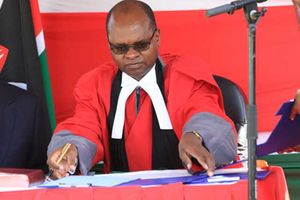
Eldoret High Court.

On a February afternoon in 2024, what began as a routine day for a prison officer in Kitale ended in gunfire.
Anthony Aerutum, a driver at Kitale Main Prison and a father of four, had been waiting to ferry remandees from court back to the facility.
Instead, he found himself at a wine and spirits outlet in town. Moments later, after a quarrel whose cause remains unclear, he was shot dead by a colleague.
This week, that colleague, 30-year-old prison warder Ali Mohamed, stood in the dock at the Eldoret High Court to hear his fate.
On Tuesday, Presiding Judge Reuben Nyakundi sentenced him to 30 years in prison after finding him guilty of murder, closing one chapter in a case that has come to symbolise a broader shift in how the justice system is dealing with crimes committed by those in uniform.
The court heard that Mohamed, who was armed with a pistol, opened fire at around 3.50pm during an altercation at the drinking joint in Kitale, Trans Nzoia County.
Aerutum, who was on duty at the time, died from the shooting. Court documents indicated he had been waiting to ferry remandees from Kitale Law Courts when the incident occurred. He was the sole breadwinner for his family.
Remourse
In court, Mohamed struck a subdued tone during mitigation, pleading for leniency, describing the deceased as both a colleague and a close friend.
“I am remorseful for the death of the deceased, who was my colleague in the profession and also a close friend. I pray that you grant me a non-custodial sentence, given that I was injured during the incident and currently use crutches,” he said.
But the court was not persuaded.
Justice Nyakundi rejected the plea, citing a lack of demonstrated remorse.
“There is no evidence before this court that you are remorseful or that you reached out to the slain officer’s family to seek mercy in connection with the murder of their kin,” the judge ruled.
With that, he dismissed the plea for leniency and the option of a non-custodial sentence, imposing a 30-year jail term.
In the packed courtroom, the victim’s family listened quietly but later spoke of mixed emotions of justice but not closure.
Eldoret High Court.
They said that although justice had been served, the sentence fell short of their expectations.
“When this matter started, we had faith in this court, but the sentence has come as a surprise. We expected a life sentence,” said Mr Elijah Aerutum, the victim’s father.
'Indisciplined forces'
Mohamed’s conviction is not an isolated case. It is part of a growing pattern that has placed Eldoret at the centre of a judicial pushback against impunity within the disciplined forces.
In recent years, the High Court in Eldoret has handed down a series of tough sentences against officers involved in killings, torture and misuse of firearms, decisions that are steadily reshaping accountability in the North Rift.
In December 2024, Police Constable Lilian Biwott was sentenced to 35 years in prison for killing her husband. In that ruling, Justice Nyakundi made it clear that state-issued weapons cannot be turned into tools for settling personal disputes.
Months later, in July 2025, the same court convicted officers Emanuel Wafula and Godwine Wekesa for the killing of 21-year-old Denis Lusava.
The two, who were based at Mbururu Police Post in Likuyani Sub-County, were found to have tortured the young man before killing him and dumping his body in River Nzoia. Lusava had reportedly been arrested for failing to wear a mask during the Covid-19 period.
Another case is already before the court. Police officer David Omondi faces charges over the murder of Delphine Mwangi and Humphrey Ochieng Otieno.
For years, critics have accused the justice system of shielding officers behind what is often referred to as the “blue wall of silence” which is an unwritten code that discourages accountability.
But recent rulings suggest that the wall is beginning to crack.
“This sentencing is meant to be a lesson to officers that the guns in their hands are meant to protect life, not to take it. Justice Nyakundi’s recent rulings have consistently prioritised the right to life over the ‘blue wall of silence,” said North Rift Law Society of Kenya chairman Oscar Oduor.
Nationally, the Independent Policing Oversight Authority (IPOA) is currently investigating 3,988 officers for misconduct. As of February 2026, 47 convictions had been secured, largely involving deaths, sexual offences and serious injuries.
Many of the recent cases stem from incidents between 2024 and 2026, including those linked to anti-Finance Bill protests, where officers have faced charges ranging from murder and manslaughter to excessive use of force.
Follow our WhatsApp channel for breaking news updates and more stories like this.