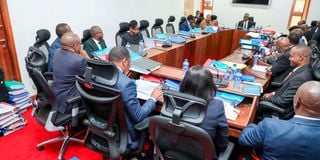
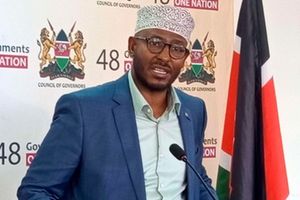
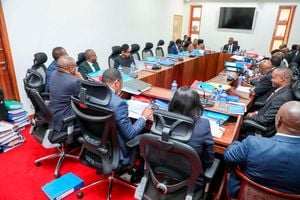
Turf wars between senators and governors over the management of county funds have escalated with at least 10 county bosses ignoring summonses and invitations by Senate committees.
Among the governors on the radar of senators are George Natembeya (Trans Nzoia), Hillary Barchok (Bomet), Joseph Ole Lenku (Kajiado), Anne Waiguru (Kirinyaga) and Irungu Kangata (Murang’a).
Others are Muthomi Njuki (Tharaka Nithi), Simba Arati (Kisii), Ken Lusaka (Bungoma), Mohammud Ali (Marsabit) and Gideon Mung’aro (Kilifi).
The county chiefs were expected to respond to various audit queries, including multi-million shillings unaccounted-for expenditures.
Consequently, the lawmakers are pushing for a tougher punishment, including a Sh2 million fine and arrest of county bosses ignoring their invitations.
Senate County Public Accounts Committee (CPAC) vice chairperson, Samson Cherargei, has raised concerns that governors are increasingly skipping the sessions.
He said a trend has developed where some governors have consistently failed to honour invitations by committees, requesting for postponement of meetings without justifiable reasons.
“The frequent request for postponement of meetings has greatly derailed the effective discharge of committees’ mandates, thus negatively impacting the oversight mandate of the Senate,” Mr Cherargei said.
Governor Arati, when he finally appeared before the CPAC, raised objections to the committee proceeding with consideration of audit reports for the financial years ending June 30, 2022, and 2023.
He cited a ruling by Justice Jairus Ngaah saying that the constitutional timelines spelt out in Article 229(4) and (8) of the Constitution are mandatory and must be complied with.
Already, a section of governors is challenging ongoing consideration of Auditor-General Nancy Gathungu’s reports on expenditure by county governments by Parliamentary watchdog committees betting on the ruling, a move that threatens to paralyse the oversight work of Parliament.
But senators have maintained that they will challenge the court ruling directing the auditing and consideration of such reports to be concluded within nine months after the end of a fiscal year.
The lawmakers have said they will seek a review of the court decision, describing the move as “judicial overreach”, adding that the scrutiny meetings will continue.
This is after Justice Ngaah quashed a 2023 report by Nairobi County Assembly’s Select Committee on the consideration of the auditor-general on Alcoholic Drinks Control and Licensing Board for the year ended June 30, 2020, saying it was considered out of the set timelines.
Article 229(4) of the Constitution states that within six months after the end of each financial year, the Auditor-General shall audit and report, in respect of that financial year.
Sub-section (8) adds that within three months after receiving an audit report, Parliament or the county assembly shall debate and consider the report and take appropriate action.
Consequently, Governor Arati argued that Ms Gathungu ought to have completed and submitted an audit report of the Kisii County government within six months, that is, December, and the Senate to consider the same report within three months.
Appearing before the committee chaired by Homa Bay Senator Moses Kajwang’, the county boss said going on with the meeting would amount to a breach of the Constitution.
“The fact that we came and brought in the documents, we were ready to continue with the report as it were, but the fact that there was that ruling, it is what we were taking precaution of so that we don’t offend the Constitution and the court ruling,” said Mr Arati.
Nonetheless, the governor later said he is ready to proceed by stepping down the preliminary objection.
He said the two reports were seized by Parliament on March 21, 2024, with the county government presenting documents outside Constitutional and statutory timelines.
This is despite the county executive presenting their documents to the auditor-general in January this year as opposed to the statutory timeline of September, three months after the lapse of a financial year.
“Parliament has acted properly within its timelines and therefore if there was to be a crisis, it would be a self-inflicted crisis by the Kisii County government,” said Mr Kajwang’.
It is good to have this conversation so that it can provide guidance to the other governors who might assume they can use a legal loophole to run away from accountability,” he added.
Senator Kajwang’ said they are seeking a review of the practical application of the ruling, saying there is no way the auditor-general and Parliament can adhere to the timelines when county executives fail to honour statutory timelines.
Nairobi Senator Edwin Sifuna also challenged the county to cite where in the ruling, the court said that all audit reports currently before Parliament should not be looked at.
“You cannot injunct processes of Parliament. It could not have been the intention of the court to allow governors and counties to escape scrutiny by representatives of the people,” said Mr Sifuna.
“I want to let you know that as MPs we will apply for a review of that position. It is not tenable and it does not make any sense,” he added.
Mr Cherargei called the ruling a judicial overreach trying to rewrite how the three arms of government operate.
“The decision that will come out of this directive by Justice Ngaah will have serious ramifications in the report writing and operations of the committee and the entire Parliament,” said Mr Cherargei.
The October 1, 2024 ruling by Justice Ngaah directed that where the Constitutional timelines are violated, any decision arising out of the same should be considered invalid, null, and void.
Mr Kajwang said whereas the Senate agrees with the foundation of the decision by Justice Ngaah, they will move back to court for a review and will be seeking a structural interdict to allow the processing of past reports that fell outside the constitutional timelines.
“While we agree with the ruling by Justice Ngaah, the Judge could have considered a transitional clause for compliance otherwise 10 years of audit reports would be declared null and void, to this end we shall go back to the High Court for a review,” said Mr Kajwang’.
Busia Senator Okiya Omtatah said the Senate should go back to the judge for structural interdict for him to pronounce himself on within what timeline the backlog can be cleared.