Hundreds of foreign traders were on Monday thrown into panic and uncertainty after President William Ruto last week ordered a crackdown on those engaging in small-scale trade.
The directive, issued on September 2 during a meeting with Kenyan small-scale traders, triggered a rush for travel documents, the closure of some businesses and reports of threats and harassment in parts of the country.
At the heart of the confusion is what foreigners say they understood as an order to leave, and the government’s subsequent clarification that the crackdown is aimed at those operating in violation of immigration, work permit and other regulatory requirements.
Across the country, there were reports of foreigners keeping away from their businesses, abandoning their homes and, in some areas, facing harassment and theft.
The government insisted that the crackdown is not a blanket order for foreigners to leave Kenya. Officials said the target is those operating businesses without the required work permits, licences or immigration status.
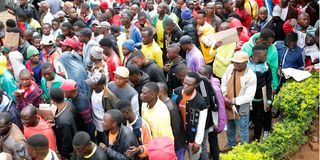
In Nairobi, anxious Burundians queued for hours outside their embassy, some seeking emergency travel documents to return home while others sought help to regularise their stay.
Burundians queue at the Embassy of Burundi Chancery in Nairobi on September 7, 2026 to regularise their documents.
Photo credit: Evans Habil | Nation Media Group
Some of the Burundians said they were preparing to return home because they no longer felt safe in Kenya. Long queues stretched outside the country’s mission as anxious traders sought clarity on their status.
For many, the uncertainty has come after years of building businesses, homes and families in Kenya.
Some Burundi nationals who spoke to the press said they had left their country in search of economic opportunities and had made Kenya their second home.
“Our country is small, faced with unemployment, and we don’t have many activities taking place there, and that is why we struggled to come to Kenya to make our lives better. We have known Kenyans as peaceful people and the best country in Africa, but I have not eaten for the last two days when it came to my mind that we are being kicked out,” said Erick Bizimana, who came to Kenya in 2022.
Mr Bizimana said the notice was too short to allow him and others to make travel arrangements, obtain documents and raise money for transport.
Burundians flock to Nairobi Embassy after Ruto directive on foreigners
Another Burundian alleged that some foreigners had been forced out of their homes after neighbours raided their houses and took their belongings.
“We have some of the rogue people in our places of residence who stormed into our houses, took some items and started distributing among themselves as we watched,” she said.
She appealed to the governments of Kenya and Burundi to find a solution that would allow foreigners to wind up their businesses safely.
Burundians queue at the Embassy of Burundi Chancery in Nairobi on September 7, 2026 to regularise their documents.
Photo credit: Evans Habil | Nation Media Group
“We are asking for one month or so to wind up the businesses that we are doing, and after that we will be on our way back home. We don’t have fare to take us home now, and even if we get travel documents, how will we get there without money?” she asked.
Some boda boda riders also said they were willing to return home but needed more time and financial assistance.
The rush was also evident at bus stations, where some foreigners sought transport to Tanzania and Uganda as they considered returning home.
The government has, however, sought to clarify that the directive does not amount to a blanket ban on foreigners doing business in Kenya. Trade Cabinet Secretary Lee Kinyanjui said some foreigners had been misusing visa and entry arrangements by engaging in business without the required work permits.
“There has been deliberate misuse of visa applications by some visitors, leading to persons on investor or tourist status engaging in activities contrary to the provisions of the grant. Owing to the high number of foreigners involved in the retail and local trade sectors, there is therefore a need to align their activities and ensure compliance with work permit provisions,” he said.
Mr Kinyanjui said foreigners found to be in breach of immigration requirements would have their visas revoked.
“Visa-free entry or exemption from eTA requirements does not in itself confer the right to engage in employment, trade or business in Kenya. Such activities remain subject to the applicable immigration, work permit and other regulatory requirements,” he said.
Foreign Affairs Principal Secretary Abraham Korir Sing’oei also sought to assure foreigners that President Ruto’s remarks should not be interpreted as a blanket order against all foreign traders.
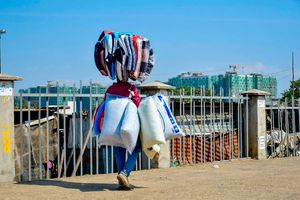
Burundians guard their personal effecta outside the Embassy of Burundi Chancery in Nairobi on September 7, 2026 where they flocked to regularise their documents.
Photo credit: Evans Habil | Nation Media Group
He said small and large traders and employees of all nationalities who have the requisite documentation, including work permits and licences, are legally protected to operate in Kenya.
“Burundian nationals and all East Africans and Africans for that matter are free to live in Kenya as long as they conduct their businesses or work according to the requirements of our law,” the PS said.
National Police Service spokesperson Michael Muchiri dismissed reports of widespread attacks against foreigners as propaganda, saying that Kenya remained a tolerant country.
Traders back Ruto's directive targeting foreigners in small-scale businesses
“We have not had reports of any such incidents in our police stations. Those are speculations, and sometimes some of these things can be hyped up,” Mr Muchiri said.
Government Spokesperson Charles Owino last evening announced that the government is preparing a formal registration and documentation window for foreign nationals, particularly those from Burundi, whose status is not regularised. He said the details of the registration exercise would be communicated after consultations with the respective high commissions.
Mr Owino explained that the exercise was linked to the proposed Local Content Bill 2015 and was intended to protect vulnerable sectors of the domestic economy, safeguard local livelihoods and strengthen the integrity of national identification systems.
“Due to regional dynamics, a number of East African nationals, including Burundians, reside and operate in Kenya without full documentation. This leaves them vulnerable to exploitation, health emergencies and unnecessary harassment by law enforcement,” Mr Owino said.
He acknowledged the contribution of East Africans to Kenya’s trade and socio-economic fabric, saying Kenya remained committed to maintaining its reputation as a haven.
Mr Owino urged East African nationals to present themselves to their respective high commissions or embassies. The Foreign Affairs ministry would then engage the relevant diplomatic missions to coordinate documentation and regularisation.
Crucially, Mr Owino said those undergoing registration would be presumed legally present in Kenya for the duration of the designated registration period. He also issued a warning against harassment and xenophobia.
“This window is designed to bring our brothers and sisters out of the shadows, ensuring they can access health, banking and legal protection without fear. The government maintains zero tolerance for any form of harassment, intimidation or xenophobia,” he said.
He urged national security agencies, local authorities and the public and business community not to harass or discriminate against foreign nationals who are documented or undergoing registration.
“Any element seeking to exploit recent directives to fuel xenophobic sentiments or mistreat our neighbours will face the law,” Mr Owino said.
Despite the government assurances, anxiety has spread to other parts of the country.
In Murang’a, Jean Niyonzima, 28, who has hawked coffee and mandazi for five years, said he was stopped by two police officers on September 6 and forced to surrender Sh3,000.
“They asked me whether I was Kenyan, and I responded that I am a Burundian. They asked me whether I knew I was supposed to be arrested on presidential order and be taken back to Burundi. They handcuffed me. I surrendered all my sales proceeds to them,” he said.
Another trader, Esperance Ndayishimiye, 24, who sells women’s clothes in Murang’a, said the environment had become hostile.
“All of a sudden, police are after us demanding bribes. The president should retract his words,” she said.
Emmanuel Habimana, a tuk tuk driver along the Murang’a-Sagana route, said passengers had begun teasing him that he would soon be forced to leave. He said three customers on Sunday refused to pay him a combined Sh150, claiming there was an executive order requiring foreigners to offer free services to Kenyans.
In Homa Bay, several foreign nationals reported break-ins at their businesses, with merchandise including phone accessories, shoes and clothes stolen.
Rwandan trader Zarubbabel Rusesabagina said he lost his merchandise, passport, ATM card, identification documents and Sh16,000 in cash.
Homa Bay DCI commanding officer Jimmy Kisobo said officers were investigating some of the reported incidents.
The uncertainty has also forced some foreigners from their homes, with several fleeing informal settlements for fear of attacks. Patrick Jarso said he fled Shauri Yako after receiving threats.
“I am stranded and do not know what to do. I have currently taken refuge as I figure out what to do,” he said.
In Kisii, many Ugandan, Burundian and Rwandan traders stayed away from their businesses yesterday for fear of arrest. A senior police officer said no crackdown had begun in the county.
Foreign hawkers in Narok, Kericho and Bomet also kept off the streets, with some reportedly travelling to Nairobi to petition the government.
In Mombasa, many foreigners who normally hawk products or work in barber shops, salons, hotels and car wash businesses were also absent.
But in Nyahururu, some local traders vowed to protect foreign nationals who have lived in the town for years.
“We have lived with them for decades; our children study in the same schools. Most of them were born and brought up here; it’s the only home they know, the presidential decree isn’t practical,” said businessman Philip Kahome.
The developments have also triggered criticism from activists who have threatened protests if foreigners continue to face harassment.
“If xenophobic attacks continue, whether physical, verbal, online, political, whatever form it takes, and if the threatened exercise against African migrants is carried out as we have already seen, we will mobilise all Kenyans and Africans across the continent to hold a protest against President Ruto,” activist Odhiambo Ojiro said.
Wiper Patriotic Front leader Kalonzo Musyoka criticised the government’s move to crack down on foreign traders, saying the exercise has been poorly handled and could have wider economic and diplomatic implications.
He said the government should adopt a more deliberate approach that protects Kenyan businesses while allowing foreign traders who meet legal requirements to operate.
Reporting by Kevin Cheruiyot, Daniel Ogetta, Jackson Ngari, Gitonga Marete, Mwangi Muiruri, Martin Mwaura, George Munene, George Odiwuor, Ruth Mbula, Kevin Odit, Waikwa Maina and Vitalis Kimutai.