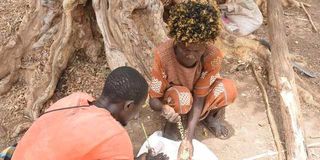
Images of starving families in Turkana County are back in the headlines, followed, as always, by a predictable political blame game. But the deeper story is rarely told: Turkana did not simply fall behind because of drought. It was pushed to the margins over generations, by policy and design.
Origins of that marginalisation can be traced to the late 19th Century when Britain and Ethiopia’s King Menelik tussled on who had the rights to govern that region.
In 1891, Ethiopia’s Menelik II circulated a note to European powers claiming territory from the southern tip of Lake Turkana northwards and demanding a frontier line stretching to the Indian Ocean. Britain initially dismissed the claim. But after Menelik’s 1896 defeat of Italy, British officials moved quickly to establish an administrative foothold in a region they had previously shown little interest in.
As Emperor Menelik II moved to assert control in the north, historical accounts say he sent as many as 30,000 troops into Lake Turkana belt, including the area now known as the Ilemi Triangle, and referred to the water body as the “Samburu Sea.” Unlike other parts of Kenya—where missionary activity often preceded formal colonial rule—Turkana entered colonial history as a militarised frontier. In 1898, Britain deployed an expedition under H. Austin of the Royal Engineers, using force and punitive operations to subdue Turkana communities in a zone valued primarily for strategy. The imperial goal was to block Ethiopian expansion and secure borders, not to build schools, clinics, roads or other institutions for Turkana residents.
By 1902, Turkana had been absorbed into colonial administration, largely in name. When Menelik renewed his territorial claim in 1903, Britain responded by demarcating the Ethiopia–Kenya and Kenya–Sudan borders, arrangements later ratified in 1907. But boundary-making did not translate into meaningful inclusion and there was no budget for development.
What followed was a governance model of control without investment. Colonial authorities put little into roads, education, healthcare, or water infrastructure, while relying on punitive expeditions, policing, and taxation to assert power. As firearms spread during and after World War I, frontier violence hardened into an arms race. Historical accounts suggest that Turkana groups had at different moments been armed in anti-British resistance, but later colonial disarmament policies left Turkana communities more exposed as neighbouring groups remained armed.
The colonial administration then deepened isolation by designating Turkana a “closed district,” requiring special permits for entry and movement. The policy cut Turkana off from the wider economy and state services, reinforcing underdevelopment as an administrative outcome rather than a natural condition.
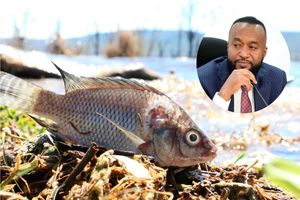
Fishermen with their catch at Kalokol area of Lake Turkana.
Photo credit: File | Nation Media Group
Even Lake Turkana’s fisheries, one of the few obvious economic opportunities, were left largely undeveloped. Up to 1961, commercial activity remained minimal. Fresh fish sales were limited, mostly to government officers in Lodwar. State participation was narrow and short-term, and largely confined to operations initiated by the District Commissioner in 1945 to supply famine relief at Kalokol. In effect, fisheries were treated as an emergency stopgap, not a sector for long-term investment and local growth.
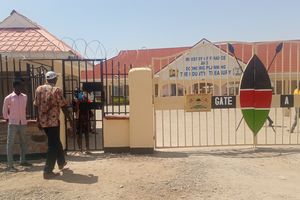
At independence, this structure of exclusion remained largely intact. By that time, Turkana District had only one government school—Lodwar Mixed School, opened in 1932—an illustration of how deeply the region had been left behind.
Lodwar Mixed Comprehensive and Integrated School gate on May 28, 2024.
Photo credit: Sammy Lutta | Nation Media Group
The new Kenyatta state inherited a region with very weak public services and minimal institutional presence. Then came another decisive turn: Sessional Paper No. 10 of 1965—African Socialism and its Application to Planning in Kenya—which prioritised investment in areas expected to produce high economic returns. In practice, that approach favoured high-rainfall, well-connected regions and sidelined arid areas such as Turkana.
For Turkana, Sessional Paper No. 10 of 1965 did not just shape planning, but institutionalised exclusion in independent Kenya. By directing public investment to areas with the fastest economic returns, good rainfall, and stronger infrastructure, the policy effectively placed arid districts at the back of the queue.
In practice, that meant Turkana received too little of what builds resilience: roads, schools, health facilities, water systems, and market links. The state’s message was clear, even if unstated—capital would chase “high potential” regions first, while places such as Turkana survived on thin services and periodic relief. Over time, this deepened a cycle in which drought shocks became humanitarian emergencies because the underlying public systems were never built.
So whenever there was drought in Turkana, it was not only a story of failed rains but a long shadow of a development doctrine that rewarded already-advantaged regions and treated pastoral margins as economically secondary.
“Closed district” may have been a colonial label, but in Turkana it survived as a living policy of exclusion. The region was treated less like a district (now county) to be developed and more like a national backroom—where underinvestment was normal, and even civil-service postings could feel like punishment.
That mindset produced a state that was present enough to control, but absent when it came to roads, schools, hospitals, water and opportunity. By 2003, much of Turkana still had no TV reception, an almost unbelievable marker of how completely it had been cut off from the country’s economic and information lifelines. This was not mere oversight.
It was only after the 2010 Constitution ushered in devolution that Turkana began receiving substantial public funds. But unlike counties that inherited roads, schools, hospitals and water networks, Turkana was forced to start almost from scratch. Official admission came even later: in 2012, Sessional Paper No. 8 acknowledged that the 1965 development model had perpetuated a biased pattern of public investment, leaving arid counties without basic social and physical infrastructure for decades.
Workers walk past storage tanks at Tullow Oil's Ngamia 8 drilling site in Lokichar, Turkana County on February 8, 2018.
Photo credit: Reuters
Then came the resource discoveries that forced the country to look north again. Tullow’s 2012–2013 exploration campaign put Turkana on the energy map: Ngamia-1, Twiga South-1 and Etuko-1 signalled that what had long been dismissed as a “barren periphery” sat on commercially significant petroleum prospects. The political message was immediate: the same landscape once written off as uneconomical suddenly became strategic. But not yet. More than a decade later, the oil is still not flowing.
Water discoveries reinforced that shift, though with a harder technical reality than the early headlines suggested. The 2013 aquifer announcements raised hopes of vast groundwater reserves, but subsequent tests showed uneven water quality and salinity challenges in some boreholes. More recent studies suggest a more nuanced picture: some shallower zones appear more usable, while deeper formations are often saltier. In other words, the issue is no longer whether Turkana has water, but where it is, how deep it lies, and at what cost it can be treated and delivered.
Now a third frontier is being pushed: infrastructure. LAPSSET is framed as a regional corridor linking port, road, rail, pipeline and airport systems. For Turkana, that reframing is important. It shifts the county from “end of the road” to part of an international logistics arc connecting Kenya to Ethiopia and South Sudan. But the real test is not the scale of the blueprint; it is whether roads, energy, markets and jobs reach ordinary households in Lodwar, Lokichar, Kakuma and the pastoral interior.
And beyond oil and transport lies perhaps the most enduring frontier of all: human origins. The Lake Turkana basin is globally recognised for fossil discoveries that shaped understanding of human ancestry and prehistory.
Already, a presidential taskforce is working on a giant museum and science park that might position Turkana as a hub of research. That gives Turkana a rare long-term asset—heritage, science and tourism potential that cannot be exhausted like an oil well. The county once treated as a buffer zone could yet be remade as a knowledge frontier.
The danger, however, is repeating history which witnessed extraction without inclusion, headlines without services, and wealth without local transformation. Pundits say that Turkana’s future will be decided by whether this new attention builds public goods for residents—or simply builds new routes out.
A century later, the past Turkana history still shadows the present and emerges in the form of starving communities. Today’s recurring humanitarian emergencies are not only about failed rains or climate shocks. They are also the long-term consequence of a political order that institutionalised neglect—and left Turkana community structurally vulnerable.