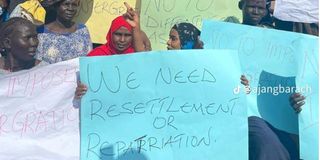
In the heart of arid Turkana West, a digital revolution is unfolding as young refugees in the Kakuma Refugee Camp and Kalobeyei Settlement turn to TikTok and other social media platforms to expose a worsening humanitarian crisis amid recent aid cuts.
Facing dwindling food supplies, inadequate shelter and a controversial aid program that has left many hungry, the youths are using their phones to broadcast the raw, unfiltered reality of refugee life.
From the dusty paths of Kakuma to the overcrowded corners of Kalobeyei, the short clips reveal what official reports often gloss over—families going for days without food, children forced into work, households selling their last possessions, and some refugees making the heartbreaking decision to return to conflict-torn homelands.
Among the digital activists is Jemo Emot who uses his motorcycle to travel between Kakuma (17 square kilometers) and Kalobeyei (15 square kilometers), about 20 kilometers apart.
On Monday, Daily Nation team found him documenting the impact of a new aid model—Differentiated Assistance—introduced in January by the Government of Kenya and the World Food Programme (WFP).
The program designed to improve food security and self-reliance classifies refugees into categories based on vulnerability.
But Mr Emot says many were wrongly categorised, plunging them deeper into hardship.
“It is heartbreaking that even after waiting so long, no corrections have been made. Some refugees are now returning to their conflict-ridden home countries. I saw children walking on foot to South Sudan,” he said.
Photos shared by Jemo Emot, a South Sudanese TikToker, showing families leaving the camp on August 25, 2025 due to hunger and starvation.
Photo credit: Pool | Nation
In one of his TikTok videos, Mr Emot interviewed 21-year-old Fiola, who left for South Sudan on Monday. She said she was not returning home because of safety, but because of hunger.
“There are 11 of us in my household and we were placed in category three despite having no stable income. We are not coming back. Many of our friends and neighbors have also left, some on foot, others by bus,” she said.
“We cannott wait any longer for help. Our priority is food and shelter. I don’t even care about continuing my education anymore. Home is better,” she added.
These accounts reflect a major shift from the past, when refugee voices were often filtered through aid agencies.
Digital activism has given young people in Kakuma a platform to highlight hunger, protest aid cuts, and demand global attention.
“On August 8, I met a boy selling his family’s utensil rack in Kalobeyei to buy food. His mother was sick, and they had gone to bed hungry. Some children are even selling mosquito nets, their only protection against malaria,” he said.
Families can often be seen walking along the Kakuma–Lokichoggio road trying to sell belongings. Clothing is no longer a priority, and once-busy shops sit empty as purchasing power collapses.
Community leader Odhieng Akway, 45, says social media has become a lifeline.
“In the past, we relied on barazas (public meetings) but bureaucracy delayed responses. Now, social media is faster and more effective. For instance, the water crisis in Kalobeyei Village 2 was widely shared in March, prompting quick action,” he said.
According to Kakuma Refugee Camp manager Edward Chebari, five people were injured and several food storage tents were damaged at the WFP compound in Kalobeyei during recent protests. Police dispersed the crowds with tear gas and rubber bullets.
“Donors require needs-based distribution. Not everyone has the same level of need,” he said.
WFP also acknowledged the growing tension, describing the protests as “deeply concerning and a sign of a wider humanitarian crisis.”
“We understand the frustration, but WFP condemns violence.Our operations in Kenya have been severely affected by funding cuts. From August, not all refugees will receive food or cash assistance. This is a harsh reality in long-term camps like Kakuma and Dadaab, where people have few livelihood options,” said Mercy Juma, Head of Communications at WFP Kenya.
“It allows us to direct limited resources to the most vulnerable—pregnant and breastfeeding women, children, people with disabilities, and new arrivals,” she explained.