The anticipated resumption of petroleum activities in the South Lokichar Basin from December is already fuelling a fresh property boom, with construction workers pushing for higher pay as investors race to position themselves for the expected return of oil-related business.
Construction activity is picking up in Lokichar town and its outskirts, with new rental houses, hotels, accommodation facilities and shops coming up along the Kitale-Lodwar road and the Lokichar-Lokori road leading to oil-rich villages.
The renewed activity has created fresh opportunities for construction workers from Turkana and neighbouring West Pokot and Trans Nzoia counties.
But as the construction boom gathers pace, workers are demanding better wages, saying the rates currently paid do not reflect rising living costs or the demands of working in an arid and semi-arid area.
Through the newly formed Turkana Fundi Association (TFA), general labourers, skilled artisans and foremen are pushing for higher minimum daily wages, whether they work on casual, short-term contract or project-specific terms.
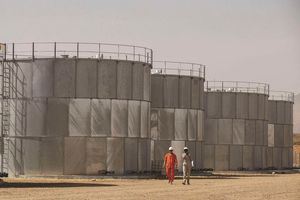
An oil rig at the Ngamia-1 well on Block 10BB, in the Lokichar basin, Turkana County. Gulf Energy Ltd has acquired a 1,500-horsepower rig from Abu Dhabi-based firm.
Mr John Ekidor, a skilled artisan, said the association has proposed raising the minimum wage for general labourers by 60 per cent, from Sh500 to Sh800 a day, while skilled workers should earn at least Sh1,500.
“A general labourer outside Lokichar town should be paid Sh1,000 while a skilled one should be paid Sh2,000. For the foreman, the association has proposed daily wages of between Sh2,000 and Sh2,500,” Mr Ekidor said.
The association said the proposed rates are intended to recognise the value of skilled labour, improve livelihoods and promote fairness and professionalism in the construction and technical sectors.
“It’s because of tough economic times that we seek better pay because prices of basic goods have gone up. When someone is paid Sh500, how is it possible for him or her to cater for meals at the site, savings, rent and still sustain the family?” Mr Ekidor questioned.
Mr Ernest Watenya, another association member, said construction material prices have also risen while workers’ wages have remained largely unchanged.
“We have had the same wages for years without an increase. Even before wages are constitutionally amended, it is logical for construction workers in Arid and Semi-Arid Lands counties like Turkana to have better pay because, due to water scarcity, they are sometimes forced to spend their daily wages on water alone,” Mr Watenya said.
Pushback from employers and residents
The wage demands, however, have drawn criticism from some locals, who want workers to improve professionalism alongside seeking higher pay.
They cited alleged cases of drunkenness at construction sites, lateness and a lack of National Construction Authority certification among some workers.
“As you adjust the rates, kindly also adjust working hours; from 6am to 6pm with a 30-minute lunch break for a fair game,” said Mr Evans Ngalla, a Lokichar resident.
Local contractor Mr Titus Ekadeli said contractors are guided by labour laws when recruiting construction workers, with the minimum wage currently at Sh484.
“They need to push for amendments through Parliament. At the moment, Turkana is not unique in the economic challenges in the country. Either way, the market is liberal,” he said.
An oil rig at the Ngamia-1 well on Block 10BB, in the Lokichar basin, Turkana County. Gulf Energy Ltd has acquired a 1,500-horsepower rig from Abu Dhabi-based firm.
Mr Joshua Loruwan, a Lokichar resident, urged construction workers to vary their proposed wages according to the type of client.
He warned that uniformly high charges could discourage middle-class earners from investing in real estate if they are subjected to the same labour costs as projects funded by private companies, organisations, county government and the national government.
Oil revival drives scramble for skills
The construction wage debate comes as anticipation of renewed petroleum activity is also prompting local professionals to organise themselves to secure a share of the expected opportunities.
Some buildings housing shops, rental units, offices and hotels established during the exploration phase by Tullow Oil and other companies following the discovery of crude oil in 2012 are currently vacant after petroleum activities were scaled down.
But investors are leaving nothing to chance following Gulf Energy’s takeover of the project, with renewed construction signalling expectations of increased demand for accommodation, commercial space and services once petroleum operations resume.
At the same time, skilled professionals have established the Turkana Upstream Petroleum Professionals Association, bringing together more than 60 local professionals with specialised skills in petroleum exploration and production, geology, geophysics, petroleum engineering, petroleum chemistry, energy and related disciplines.
“The upstream petroleum sector requires highly specialised technical competencies spanning the entire petroleum value chain. The association provides a coordinated platform for technical engagement, professional development, research collaboration and advocacy for meaningful local participation in petroleum operations,” said Mr Stanley Loter, the association’s technical adviser.
Mr Loter said the push for local expertise began after the discovery and initial exploration of crude oil by Tullow Oil, when local residents realised they had not prepared for an opportunity of that scale.
“That is why we saw an opportunity to go back to school and study these particular courses through various arrangements, with some directly supported by Tullow Oil. Today, we are very proud to have registered about 63 members who now represent the face of Turkana in the petroleum industry,” he said.
He said about 55 members, including 10 women, had expressed interest and applied for various positions advertised by Gulf Energy.
“We also believe that we have relevant stakeholders like the county government, Gulf Energy and national government departments that can invest in capacity building for our members in case they don't have the required skills or experience that can deny them opportunities for progress,” Mr Loter added.
The association believes that as Kenya transitions to commercial extraction, developing a strong local technical base, coupled with adherence to local content legislation, will help minimise tension and ensure host communities directly benefit from the petroleum industry.