A wave of community-led justice is sweeping across Turkana County where vigilante groups have taken it upon themselves to combat human trafficking along the porous Kenya–Ethiopia border.
These groups are targeting Public Service Vehicles (PSVs) suspected of facilitating smuggling operations, staging roadblocks and monitoring highways to intercept traffickers.
Authorities confirmed that traffickers displaced by a security crackdown in neighbouring Marsabit County have now shifted operations to Turkana.
Turkana County police boss John Tarus said a bus headed for Kitale was recently intercepted by members of the public and detained for investigation.
"After conducting a search, we found 59 passengers, all refugees from Kakuma, travelling to Nairobi without valid documents," said Mr Tarus.
He added that police have intensified surveillance at all checkpoints to ensure that refugees from Kakuma Refugee Camp possess the required documentation before travelling. Those found without proper papers will face legal consequences.
Mr Tarus urged residents to report suspected human trafficking activities and warned that public officers found aiding traffickers would face the full force of the law.
Turkana, which borders Ethiopia, has increasingly become a hotspot for cross-border criminal activity due to its porous frontier.
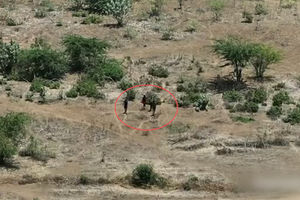
Bandits captured during an aerial surveillance mission as part of the KDF's Operation Maliza Uhalifu in Kainuk, Turkana County.
Photo credit: KDF
Local leaders say smuggling routes through Kokuro and Todonyang have become notorious for trafficking—whether of people, drugs, or counterfeit goods—especially involving Eritrean nationals.
Last month, 108 Eritrean nationals were arrested by Kenyan authorities along the Turkana–West Pokot border, underlining the region’s growing role as a trafficking corridor. Both Marsabit and Turkana border Ethiopia, a known transit route for illegal immigrants from Eritrea.
Local leaders have also accused some security officers of colluding with traffickers to facilitate the smuggling of Eritreans into Kenya via Lodwar town.
On July 16, Interior Cabinet Secretary Kipchumba Murkomen confirmed that Turkana has become increasingly vulnerable to human trafficking, previously rampant in Marsabit County, citing Lake Turkana as a key smuggling conduit.
Mr Murkomen attributed the shift in trafficking routes to the ongoing "Operation Ondoa Jangili" in Marsabit, which has disrupted established smuggling networks, forcing them to move to Turkana.
A bird’s-eye view of Moyale town in Marsabit County.
Photo credit: Joseph Kanyi | Nation Media Group
Local communities have responded by organissing vigilante groups to monitor PSVs along the Kakuma–Kitale highway. In one notable case, a bus was stopped at a roadblock in Lodwar town on suspicion of trafficking.
Turkana Governor Jeremiah Lomorukai said his administration would mobilise local networks—including county enforcement officers and village administrators—to help combat trafficking, drug smuggling and counterfeit trade.
“We will collaborate with honest and committed security officers by sharing credible information that can lead to the arrest of local leaders and officers enabling criminal activity through our porous borders,” said Governor Lomorukai.
He claimed the trafficking network is well-organised and supported by influential local leaders. Weak law enforcement and established trafficking routes have further enabled the crime.
"Over 100 foreign nationals are being transported through the county with security officers at border points and along highways aiding the syndicate. This is clearly an inside job. All security agencies must act decisively. Local leaders engaging in this for financial gain must be thoroughly investigated," he said.
CS Murkomen described human trafficking as a growing national crisis with Kenya being used as a transit route for victims sold into forced labor or extortion rackets.
“Some are trafficked to Libya, where they are locked in rooms and their families are called to pay ransom before release. Others are promised better lives in Europe only to be exploited,” he said.
He added that although a major operation is underway to dismantle trafficking networks, smugglers are adapting by shifting routes through Turkana, West Pokot, Isiolo and eventually the Kenyan coast.
“We will shut down all incentives because money is a key driver of this trade,” CS Murkomen declared.
Operation Ondoa Jangili, primarily focused on wildlife poaching in Marsabit County, has inadvertently exposed the scale of human trafficking in neighboring Turkana.
Mr Murkomen acknowledged that porous borders, poor infrastructure and alleged complicity by some public servants have enabled the crisis.
"We will construct roads at border points to strengthen security operations. Additionally, police officers who have overstayed at their posts—some for over 15 years—will be transferred," the CS added.