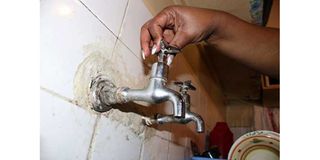
A bitter standoff has erupted between Marakwet communities in Elgeyo Marakwet and Eldoret’s main water provider, the Eldoret Water and Sanitation Company (Eldowas), following a controversial 300 per cent tariff increase.
Residents from the neighbouring county have vowed to block the flow of water from the Chebara Dam until their demands for fair pricing and local benefits are met.
Marakwet residents are now threatening to cut off the water supply from the Chebara Dam, which is located in Elgeyo Marakwet County, to Eldoret city in neighbouring Uasin Gishu County. They claim that they have been shortchanged and received a bad deal regarding the management and sharing of the resource.
The management and revenue-sharing of the Chebara Dam has long been a source of dispute between Uasin Gishu and Elgeyo Marakwet counties.
Although the dam and its water supply are located in Elgeyo Marakwet County, Eldowas, which is based in Uasin Gishu County, manages the resource.
However, more than 600 families living around the dam claim that they do not have access to clean, piped water in their homes.
“When the dam was constructed, we were encouraged to establish businesses in Eldoret and benefit from the water supply, but with a 300 percent hike in charges, that has become a pipe dream, a move we are prepared to resist at all costs,” said Ms Flora Chemweno, a local resident.
While Uasin Gishu Governor Jonathan Bii is calling for an urgent meeting of stakeholders on the new tariffs, Marakwet residents are arguing that the planned increase will harm domestic water consumption, cripple businesses and deter investors.
They have vowed to use all means necessary to halt the implementation of what they call 'punitive' charges and are demanding a review of the agreement signed by the dissolved local authorities, to determine how the community will benefit from the proceeds of the Chebara Dam.
“There is no justification for Eldowas to increase the water charges while the local communities surrounding the dam are yet to benefit in terms of infrastructure like roads, health centers, and water supply to their homes,” said a member of the Marakwet Council of Elders, Mr Andrew Chemweno.
Tension has been fuelled by a lack of clear communication from Eldowas regarding how residents in both counties might benefit from the dam’s piped water.
Residents also claim that they have seen few Corporate Social Responsibility (CSR) initiatives from Eldowas, despite their proximity to the dam.
“It is like living close to a river but only washing our hands with spittle. The two county governments need to renegotiate so the local community can benefit from the dam,” said Mr Edwin Kipkorir from the Chebara area.
They claim that residents of Uasin Gishu and Eldoret town benefit more from the water supply despite the resource being situated in their own region.
“We demand a review of the agreement signed by the dissolved local authorities to determine how the community will benefit from the dam’s proceeds,” added Mr Kipkorir.
However, Eldowas's managing director, Dr Lawrence Tanui, said that the firm is engaged in conserving the water catchment areas around the Chebara Dam and that most local communities have been connected to piped water.
“We have partnered with environmentalists to implement conservation programs and ensure that local communities benefit from the project,” he said.
Dr Tanui defended the tariff hike as reasonable, noting it aims to generate additional revenue for infrastructure development and to expand water supply to underserved areas.
“The revised water rates are reasonable, with consumers paying only Sh130 per 1,000 litres. There is also a provision for annual evaluation of charges, with a possibility of offering lower rates,” he explained.
Last week, the Environment and Land Court in Eldoret struck out a petition challenging the tariff hike, meaning Eldoret city residents will now pay higher charges.
Justice Emmanuel Washe ruled that the petition violated the Water Act, as the court lacked jurisdiction to hear it, and lifted the suspension orders issued on 25th March 2025, allowing Eldowas to implement the new tariffs.
Eldoret residents, represented by petitioners Mr Kipkorir Menjo and Mr David Chebet, have protested the move and vowed to appeal the ruling, describing it as inhuman and an abuse of the law.
The move triggered intense backlash from furious residents who accused their elected leaders of betrayal and silence, abandoning them in their hour of need.
They announced weekly street demonstrations planned to begin next week, even as a fresh legal appeal is launched to reverse the court ruling.
Faced with rising dissent, Governor Jonathan Chelilim Bii acknowledged that the tariff review has sparked public debate and called for a stakeholders’ meeting to address concerns and find a fair, lasting solution.
“As Governor, I will continue to emphasize the provision of clean, affordable water and sanitation services, as outlined in my blueprint. Additionally, I will facilitate expansion of water infrastructure to meet the growing population’s needs,” he said.
The governor issued a 21-day notice to all involved parties to submit a report outlining resolutions and the way forward regarding the disputed tariffs.
Meanwhile, Eldowas is reportedly losing Sh300 million annually due to non-revenue water (NRW), limiting its capacity to expand services.
The company, with an annual revenue of Sh1.3 billion, aims to raise over Sh2.2 billion from increased tariffs for infrastructure development and to extend its services, currently covering only 35 percent of the country’s newest city.
“Although we generate Sh1.3 billion annually, Sh300 million is lost through illegal connections and leakages from aging infrastructure. Revenue from the new tariffs will help improve service delivery,” said Dr Tanui.
He defended the October 2024 tariff increase, approved by the Water Services Regulatory Board (WASREB), emphasizing that it will help expand water and sanitation services in line with Eldoret’s city status.
The Chebara Dam, commissioned in 1999 by the late former President Daniel Arap Moi and funded by the Belgian government at a cost of Sh1.5 billion, was meant to resolve water shortages in Eldoret, Uasin Gishu County. However, nearly 26 years later, Eldoret still experiences recurrent water shortages.
The water company continues to lose an estimated 18 billion litres daily due to illegal connections, translating to losses of between Sh500 million and Sh1 billion monthly.
With a population exceeding 500,000, Eldoret is among the fastest-growing urban centers in Kenya after Nairobi, Mombasa, Nakuru, and Ruiru, and requires approximately 60 million litres of water daily, but currently lives on only 43 million litres.
According to the 2023/2024 Auditor General’s report, Eldowas is already debt-ridden, with an outstanding loan of Sh256,666,667 for the Chebara treatment plant.
The company’s total outstanding debts stand at Sh528,199,121 for water and cleansing services, compared to Sh597,404,809 in the previous financial year.