What happens when a billion-shilling energy project lights up the nation but leaves its host community in the dark?
In Turkwel, West Pokot County in North Rift Kenya, the answer is as stark as it is heart-breaking—abandoned clinics, jobless youth, closed schools, and a ghost town where hope once thrived.
Once hailed as a beacon of progress, the Turkwel Power Station now casts a long, dark shadow over the very communities it was meant to uplift.
Fourteen years ago, Turkwel was a bustling centre of opportunity, humming with power, music, work, and dreams. Today, wildlife roams through cracked buildings, weeds grow in empty pools, and a generation of youth stares at the ruins of what their parents once called progress.
The abandoned Turkwel Gorge Resort Club in West Pokot.
Photo credit: Oscar Kakai | Nation
Where laughter once echoed through busy clubs, classrooms and clinics, silence now reigns. In the place of promise stands a legacy of insecurity, neglect, and broken social contracts.
Commissioned more than 30 years ago by the late President Daniel Arap Moi, the Sh6 billion Turkwel Hydro Power and Multipurpose Project was envisioned as a transformative force for the West Pokot region.
Built with French expertise under the Kerio Valley Development Authority (KVDA) to supply electricity to the national grid and catalyse development in the arid region, and operated by the Kenya Electricity Generating Company (KenGen), it was officially launched in the early 1990s.
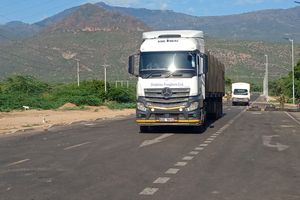
With a capacity of 106 megawatts, the Turkwel power station remains a critical energy hub, supplying nearly 10 percent of Kenya’s electricity and feeding the national grid via a 230-kilometre, 220kV high-voltage transmission line to Lessos. Yet the local communities that are its neighbours are left struggling for basic needs.
For a while, it brought jobs, electricity, modern housing, and a sense of pride. Turkwel was the beating heart of a bold new frontier.
The abandoned Turkwel Gorge Resort Club in West Pokot.
Photo credit: Oscar Kakai | Nation
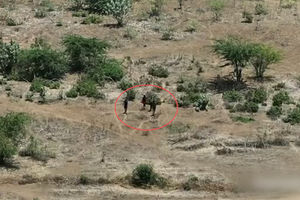
A spike in deadly bandit attacks in the late 2000s and early 2010s forced KenGen to suspend most of its operations. Staff were evacuated and relocated to Kitale, critical services were withdrawn, departments shut and shifted to other power stations across the country, and over 300 casual workers lost their livelihoods overnight.
And just like that, the once-thriving Turkwel township slipped into decay. Once vibrant and full of life, Turkwel town is now in a desolate state, and its residents are frustrated and abandoned.
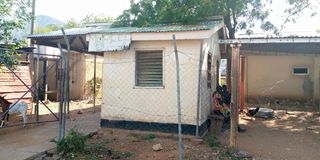
Today, the Turkwel Gorge Club, once a popular high-end recreational complex, lies in ruins, a ghost of its former self. Wildlife now roam the deserted compounds and buildings; the basketball court and shops are overgrown; toilets are broken; the swimming pool is dry; the roofs leak; and ceilings have caved in.
“Life was enjoyable here. The club operated 24/7. Inside the Turkwel Gorge Club, you could never believe you were in West Pokot. It was like paradise. But now, it is all gone; it is just a memory,” said Mr Dickson Soromuk, a long-time resident.
The decay is visible everywhere. Staff houses, once neat and gated, have been vandalised or taken over by squatters. Wild shrubs and rust now dominate where people once played and prospered.
While the Turkwel Power Station still hums with activity, outside its gates are communities that feel forgotten.
“It is heart-breaking. Turkwel was like Mombasa to us. Children from both Pokot and Turkana got bursaries; we had music, parties, water. Now there’s nothing,” said Ms Irene Cheyech, a resident.
The swimming pool at Turkwel Gorge Resort Club in West Pokot.
Photo credit: Oscar Kakai | Nation
Ironically, the station continues to power nearly 10 percent of Kenya’s electricity, yet the villages in its shadow remain quite literally and figuratively in the dark. Electricity poles march across their lands, but homes remain unconnected. Water flows through turbines, but not into their kitchens or clinics.
For locals like Ms Roselyn Rorikilim, Turkwel wasn’t just a power plant. It was a community built on energy, hope, and connection.
“Every Wednesday, KenGen gave us transport to Kitale and Kesogon for shopping,” she recalls. “We had bursaries, food, and tours to Olkaria, Nakuru, and Samburu. There was structure, dignity.”
Choir competitions once united the warring communities of Pokot, Turkana, and Marakwet, and sports events and youth programmes fostered peace and opportunity. KenGen funded schools, hired locals, built roads, and maintained security.
For many locals, KenGen’s exit wasn’t just a corporate decision; it was a personal tragedy. The gap between national benefit and local suffering is as wide as the Turkwel Gorge itself.
A bus once used by schoolchildren and the community was taken back. A clinic was moved to Kitale. The local health centre is left with only two clinical officers and four promoters for an entire region. Even the Tegla Loroupe Peace Race, once hosted at the Gorge, was discontinued.
The abandoned Turkwel Gorge Resort Club in West Pokot.
Photo credit: Oscar Kakai | Nation
For Lotuli Lolima, now 28, the collapse of KenGen’s community programmes not only marked the end of his education but also crushed his dreams of becoming an engineer.
He studied on the KenGen bursary at Turkwel Gorge Primary and later joined Chepkornisyo Boys High School. But in Form Two, he had to drop out after KenGen stopped the bursaries.
“My future ended right there. I wanted to be an engineer, now I herd livestock,” he tells the Nation .
For many others, the pain was medical.
The Turkwel Gorge clinic, once crucial for treating banditry victims, was shut down. The remaining dispensary is understocked, and residents often turn to herbs or walk long distances through unsafe terrain for treatment.
Ms Rose Chekana from Songok village walks over 10 kilometres to reach a dispensary that often has no medicine. Her home is within sight of the plant, but the energy, services, and development it promised have never reached her doorstep. She recalls how the closure of the Turkwel Gorge Clinic changed everything.
“We only have one dispensary, and most of the time, there are no drugs. We opt for private clinics, and sometimes rely on herbs. If someone falls sick at night, there’s no help. Pregnant women miscarry on the way to far-off health centres. We feel forgotten,” Ms Chekana says.
She says the clinic helped a lot during bandit attacks. “We had health workers who taught us first aid. Now, we suffer alone,” Ms Chekana adds.
The dilapidated basketball court at Turkwel Gorge in West Pokot.
Photo credit: Oscar Kakai | Nation
When KenGen left, everything collapsed, Turkwel Chief Joseph Siwa says.
“Sports, music competitions, bursaries, all gone. There used to be choir competitions between Pokot, Turkana, and Marakwet youth. They fostered unity. Children dropped out of school, and some turned to banditry. Even polytechnic students gave up,” he says.
Mr Siwa says KenGen used to support Turkwel Gorge Primary. “They gave books, uniforms, even health care. Now, there’s only a token subsidy for secondary school students. Shops are closed. The economy died.”
As if to emphasise the divide, KenGen recently erected a perimeter wall around the remaining facility. While inside there are renovated rooms, a hotel, and a swimming pool, outside, the community that once hosted, worked for, and supported it, feels locked out.
“And now they have fenced themselves off with a perimeter wall with a hotel, swimming pool, and staff rooms, but locals are not allowed in. It’s an insult,” Chief Siwa says.
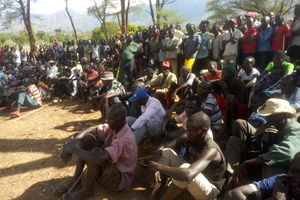
Residents and local leaders are now calling for a return of KenGen to Turkwel and the full revival of its operations.
While Governor Simon Kachapin feels peace has returned and KenGen should hence come back, Kacheliba MP Titus Lotee is more direct:
“KenGen began operations in worse conditions than we have now. They made millions, then left us to suffer. That is oppression. If outsiders feel unsafe, hire locals. We have trained engineers, plumbers, and people who are ready to work and stay,” the MP says.
Kapenguria MP Samuel Moroto, on the other hand, demands full restoration of the amenities that came with the power plant, including the abandoned State Lodge. He urged the government should fast-track their rehabilitation.
Reached for comment, Sigor MP Peter Lochakapong, who chairs the National Assembly’s Regional Development Committee, revealed that a government-led rehabilitation effort is underway.
“Turkwel has great potential. We want to attract tourists, rebuild this region, restore livelihoods, and give dignity back to this place,” he said.
When contacted, KenGen Managing Director Peter Njenga acknowledged the concerns and told the Nation that security has improved and discussions are ongoing for the revival of the KenGen projects in the region.
“Security agencies have set up GSU and police camps. We are assessing the possibility of relocating staff back to Turkwel,” he said.
Mr Sammy Naporos, the managing director of Kerio Valley Development Authority, confirmed that funds have been allocated to refurbish abandoned State-owned facilities in the region.