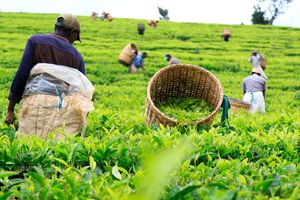
Shareholders of four factories in Bomet and Nakuru counties managed by the Kenya Tea Development Agency (KTDA) have voted for complete operational and managerial separation.
The small-scale tea growers supplying their produce to Kapkoros Plc have resolved to allow Kapkoros, Tirgaga, Motigo, and Olenguruene factories to operate independently.
During a Special General Meeting (SGM) held at Kapkoros tea factory last Friday, the shareholders authorised management to take stock of the assets and liabilities of the four companies.
“The small-scale tea growers who are shareholders of Kapkoros Plc have today voted for total separation of the four companies. This will facilitate the sharing of assets and liabilities between the companies,” said Mr Robert Kipngeno Rono, the chairman of Kapkoros Plc.
A seven-member committee has been formed to address the issues surrounding the delineation of boundaries for the four factories, drawing up a list of assets and liabilities and creating a roadmap for sharing them.
The meeting was attended by KTDA Holdings Vice Chairman Erick Chepkwony and the seven zonal directors David Korir, Simon Mutai, Benard Koech, Kipkorir Chepkwony, Robert Kipngeno Rono, Dickson Kipyegon Kirui and Benard Kipngeno Rono saw tea growers agreeing that the separation would enhance competition and productivity in the region.
In addition to the separation, it was agreed that the construction of a fifth factory in the Kamogoso area, which has already been licensed by the Tea Board of Kenya (TBK), will be supported by the other factories.
A gate at Kapkoros Tea factory in Bomet county where shareholders resolved to grant independence to four factories operating under it - Kapkoros, Motigo, Tirgaga and Olenguruone in a specil general meeting on April 2, 2025.
Photo credit: Vitalis Kimutai | Nation Media Group
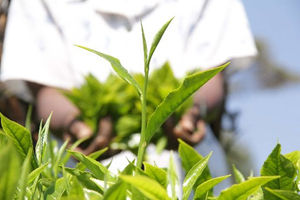
“Our focus is to enhance quality in production, starting from the farm to the factory. The plucking of two leaves and a bud will be our focus. The quality of our produce determines the price it fetches in the market,” said Mr Chepkwony.
He added, “We expect the government to help KTDA open new global markets, which will increase tea volumes sold, boosting foreign exchange earnings for the country and improving payments to farmers.”
The resolution to separate the finances of the factories was first passed on December 14, 2023, during the Annual General Meeting (AGM) at Olenguruone factory and reaffirmed on December 12, 2024, at Kapkoros. The decision was again confirmed on January 9, 2025.
KTDA is the custodian of all assets belonging to the 54 registered factories it manages across 21 tea-growing counties which include 680,000 small-scale tea growers.
For the past eight months, farmers supplying produce to the Motigo factory have been pushing for independence from Kapkoros resulting in two boycotts of green leaf plucking to make their point.
On April 8, 2025, Agriculture Cabinet Secretary Mutahi Kagwe convened a meeting with Kapkoros Plc directors at Kilimo House to discuss the stand-off. This led to the decision to hold an SGM on May 2, 2025.
The meeting at the Ministry headquarters was attended by Principal Secretary for Agriculture Paul Ronoh, KTDA Management Services Managing Director Collins Bett, Tea Board of Kenya (TBK) Chief Executive Officer Willy Mutai, and Bomet Senator Hillary Sigei.
It was confirmed that the resolution for the separation of the factories was supported by the government.
“The coding and issuance of smart cards to farmers in Motigo and Olenguruone will be processed as earlier planned,” Mr Kagwe said after the meeting.
He also mentioned that the government would assist the four factories in modernising their machinery to improve the quality of tea processed and introduced to the market.
Shareholders from Motigo and Olenguruone factories have long claimed they are burdened by low-quality produce from their sister factories which has led to lower prices at the Mombasa Tea Auction and declining annual bonuses.
For two years, there has been a backlog of 100 million metric tons of unsold tea at the Mombasa Auction. This led the government to scrap the reserve price that had been set with the enactment of the Tea Act, of 2020.
The government has been criticised for scrapping the reserve price without consultation, resulting in a price slump at the auction, which translates to poor pay for the farmers supplying green leaf to various factories.
There is now a special focus on the production of orthodox tea by KTDA-managed factories, with huge market openings in Japan, Russia, China, Germany, Iran, France, and countries in the Middle East and Eastern Europe.
For decades, Kenya has depended on black CTC (Cut, Tear, and Curl) tea to supply its traditional export markets, including Pakistan, the United Kingdom, Egypt, Sudan, Kazakhstan, and Poland.
New markets for Kenyan tea in China, India, Korea, Australia, Switzerland, Iran, South Africa, Ghana, Nigeria, and Morocco are now being targeted. KTDA and TBK, with the backing of the government and marketing agencies, have secured these markets to raise export volumes.
Many of the countries in Africa, the Arab world, and Asia with huge potential for Kenyan tea have not been targeted for decades.
The current government has directed marketing agencies to shift focus and engage trading partners to explore these available opportunities.
President William Ruto has also committed to supporting KTDA factories to add value and brand 50 percent of the tea produced in the country before exporting it to global markets.