Eritrea has once again withdrawn from the Intergovernmental Authority on Development (IGAD), accusing the regional bloc of undermining its own relevance and targeting Asmara in its operations.
The move marks the second time Eritrea has walked away from an organisation it helped establish.
A statement from the Eritrean Ministry of Foreign Affairs said it had formally informed IGAD Executive Secretary Workneh Gebeyehu of the decision.
“Unfortunately, over time and especially since 2005, IGAD has not only failed to meet the aspirations of the peoples of the region, but instead played a deleterious role, becoming a tool against targeted Member States; particularly Eritrea,” the statement said on Friday.
Regional peace and stability
“As will be recalled, Eritrea played a pivotal role when IGAD was revitalised in 1993, and subsequently worked, in collaboration with other Member States, for its transformation and effectiveness so that it would serve as the primary vehicle for enhancing regional peace and stability, thereby paving the ground for viable regional economic integration.”
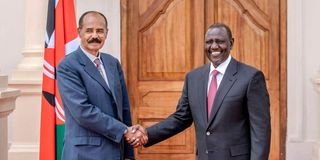
The decision dampens the much-publicised return to IGAD in February 2023. On a state visit to Kenya, Eritrean leader Isaias Afwerki and his host, President William Ruto, announced Asmara’s rejoining of IGAD. A joint communiqué said they had agreed to work with other member states to “re-engineer IGAD, make it fit-for-purpose and enable it to respond effectively to the needs of our region.”
Those aspirations now appear dead in the water, at least in Eritrea’s eyes. Eritrea was a founding member of IGAD when it was created in 1996 as an expanded organ dealing with regional integration beyond drought management, its original mandate when launched in 1988.
Asmara quit the organisation in April 2007, citing the same grievances it raised again on Friday. The Ministry said IGAD had failed to respond to calls for reform and “continues to renege on its statutory obligations, thereby undermining its own relevance and legal mandate.”
Quitting IGAD may be more of a political statement than a legal move: the treaty establishing the bloc contains no exit clause, as its founders did not envisage members leaving. In practice, withdrawal has meant self-exile.
Eritrea did so from 2007 to 2023 by refusing to contribute financially or participate in meetings and decisions. Sudan followed suit from January to December 2024 before resuming participation.
Eritrea's on-off participation
Eritrea had earlier accused Ethiopia of using the bloc to besmirch its reputation, claims Addis Ababa denied.
IGAD said Eritrea has been an on-off participant in the bloc and did not provide suggestions on what needs to be reformed.
“Since June 2023, the Secretariat notes with regret that Eritrea has not participated in IGAD meetings, programmes, or activities. During this period, the Secretariat exercised patience and goodwill, while remaining open to engagement,” a statement from the Secretariat said.
“The IGAD regrets that the decision to withdraw was taken without the submission of tangible proposals or engagement on specific institutional or policy reforms, for which the Organisation had remained available and patient, in line with its established consultative mechanisms.”
It said it will continue to reach out to Asmara “and encourages it to reconsider its position and to fully rejoin IGAD, in good faith, to advance shared objectives for the benefit of the region.”