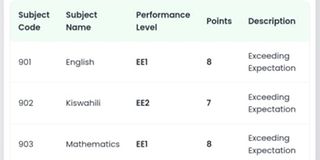
Thousands of parents, learners and teachers across the country were thrown into confusion when the Cabinet Secretary for Education Julius Ogamba announced the release of the 2025 Kenya Junior School Education Assessment (KJSEA) results. Many were in the dark asking whether their children had passed, and struggle to interpret the grading as well as anticipate the senior schools they will be placed in, as well as the academic/career pathways they will pursue.
The results are in a new format unfamiliar to many which is qualitative as well as quantitative. Rather than a simple grade or marks, the KJSEA results describe the abilities of the learners.
According to CEO of the Kenya National Examinations Council (Knec) Dr David Njeng’ere, the new way of reporting achievement of learners is in tandem with global best practices.
The grading system has four bands where learners’ performance in each subject are placed: (Exceeding Expectations (EE), Meeting Expectations (ME), Approaching Expectations (AP) and Below Expectation (BE).
The four bands have each been split into two to form an 8-point scale: EE1 and EE2, ME1 and ME2, AE1 and AE2 and finally ME2, AE1 and AE2 and BE2.
Those scoring between 75 and 100 percent fall under Exceeding Expectations (EE). EE1 is for marks ranging between 90 and 100 percent and earns a candidate 8 points while EE2 is for marks ranging from 75 to 89 percent, and a score of 7 points.
Under the Meeting Expectations band will fall marks ranging between 41 and 74 percent. Candidates with 58-74 percent are in ME1 and earn 6 points, while those with 41-57 percent are in ME2 and receive 5 points.
Candidates classified as Approaching Expectations will fall within a scoring of 21 to 40 percent. Within this band, AE1 is for marks ranging between 31 and 40 percent. It earns 4 points while marks between 21 and 30 percent are in AE2 and earn 3 points.
The lowest band is Below Expectations, for candidates who score below 20 percent. A score of between 11 and 20 is under BE1 and earns a candidate two points while 10 percent and below is put under BE2 and gets a candidate one point.
Candidates were examined in nine subjects (English, Mathematics, Agriculture & Nutrition, Kiswahili/Kenya Sign Language, Integrated Science, Pre-technical studies, Creative Arts & Sports, Social Studies, Religious Education.
Therefore, using this scoring matrix, the maximum points a candidate can score in 72.
It is important to note that the percentage scores have not been revealed by Knec. However, it is these marks that have been used to calculate the suitability of each candidate for the three pathways. These are the scores the Ministry of Education is using to place the learners to senior schools as they are more detailed.
The senior school pathways are Science, Technology, Engineering, Mathematics(STEM), Social Sciences, and Arts & Sports Science. Each pathway will have a set of subjects requirements and a minimum score.
To qualify for the STEM pathway, a candidate to have a composite score of 20 percent in the required subjects as indicated at the bottom of the transcript. Placement into the other two will require a similar score of 25 percent.
Mr Ogamba said that majority of the learners qualified for placement in the various pathways. “Seventy-five percent of learners performed at Approaching Expectations and above across all subjects. Creative Arts and Sports registered the strongest performance at 96.84 percent,” the CS said, adding that this level is adequate for progression into senior school pathways that require basic competencies in those areas.
“An Approaching Expectation grade (above 20 percent) is sufficient for learners to progress to senior school pathways that require basic competencies in the subject area,” he added.
However, placement will also be influenced by factors like the number of candidates who selected a particular school and pathway, their performance weighted against others from their sub-county, gender and their choices.