Agriculture experts have warned of a decline in crop production that could threaten the country’s food security as more farmers in the North Rift diversify from food crops to high-value cash crops.
Many farmers in the region, considered Kenya’s food basket, are venturing into coffee, sugar cane and horticulture production, lured by attractive prices.
In Uasin Gishu County, one of the leading maize-producing zones, the county government has distributed 383,000 coffee seedlings produced at its Chebororwa Agricultural Training Centre.
The seedlings are being sold at a subsidised rate of Sh30 each to meet growing demand from farmers shifting to coffee production.
“We believe coffee has the potential to thrive here, uplift livelihoods and reposition our county as a hub of premium agricultural produce.
The crop is well suited to our altitude, soil and climate,” said Governor Jonathan Bii, who said they plan to distribute one million seedlings.
The devolved unit has also begun constructing a coffee milling plant in Cheramei, Turbo sub-county, to add value and reduce post-harvest losses, while wooing more farmers to invest in the cash crop.
“Maize is part of our identity, but market demands call for innovation and coffee farming is one of the most impactful shifts in Uasin Gishu’s agricultural investment,” said the governor, adding that the county also plans to distribute pulping machines to help farmers harvest more efficiently and cut production costs.
However, agriculture experts are warning that the rapid shift to cash crops poses a food security crisis, particularly in traditional maize-producing zones such as Uasin Gishu, Trans Nzoia and Nandi.
An estimated 8,000 acres in Trans Nzoia is now under coffee and sugar cane cultivation.
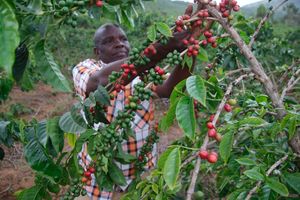
Coffee cherries at a farm in Nyeri town on October 26, 2022.
Photo credit: Joseph Kanyi I Nation Media Group
“The shift by cereal farmers to cash crops like coffee and sugar cane has resulted in a decline in maize and wheat production, posing a serious threat to food security,” said Mr Ezekiel Kosgei, an Eldoret-based agronomist.
Among the factors driving away maize and wheat farmers is high production costs and unsteady market for the produce.
“Maize production has proved to be an unprofitable investment due to erratic market prices caused by flooding by cheaply imported grains, especially during the harvest seasons,” said Mr Samuel Kosgei from Turbo who has five acres of coffee.
“Although it might take long before one earns profit from coffee, the returns are attractive as compared to maize, which drops to below Sh2,000 per 90kg,” explained Mr Kosgei.
Many coffee factories offer between Sh75 to Sh150 per kilo of coffee cherry depending on quality, prices that farmers consider to be profitable.
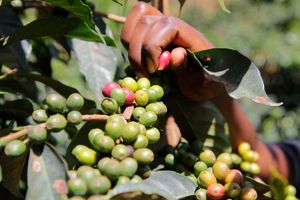
A farmer tends to her coffee in Nyeri town on October 25, 2022.
Photo credit: Joseph Kanyi | Nation Media Group
Mr Kosgei’s sentiments were supported by Mr Evans Kwambai, a wheat farmer from Elgeyo-Marakwet who has now invested in six acres of coffee.
“Wheat has been our traditional source of income, but market uncertainty has forced many farmers to diversify to the emerging coffee production,” said Mr Kwambai.
Millers are now offering Sh3,800 per 90kg bag of wheat, down from Sh5,600. But most of them have suspended purchasing the crop. Some farmers in the North Rift are still holding last season’s stock due to a lack of market for the crop.
In Uasin Gishu, wheat acreage is estimated to have dropped from 40,000 hectares to 18,000 hectares as farmers diversify into coffee and other high-value crops, according to a March 2025 report by the county’s department of agriculture.
Kenya currently produces an average of 365,600 tonnes of wheat annually, far below the national consumption of 8.4 million 90kg bags, forcing the country to rely on imports.
Last season, the Rift Valley produced an average of 4.5 million bags of wheat from 127,825 hectares.
Annual agriculture reports show that maize production in the Rift Valley has been on the decline—from 44 million to 33 million bags in the 2022/2023 period, dropping further to 21 million bags in 2024/2025.
The yield improved to about 70 million 50kg bags in the 2025/2026 period, but there remains an acute shortage of the grain in the market.
According to the Coffee Research Foundation (CRF), coffee production in the Rift Valley is on the rise due to favourable climatic conditions.
“The coffee-growing parts of the Rift Valley have ideal climate and soil that support higher yields compared to other regions,” states a CRF report released last month.
Last season, the Rift Valley produced 65,618 tonnes of coffee, up from 19,573.38 tonnes the previous season, as more farmers invested in the crop.
A sack of coffee beans.
Photo credit: File
Major coffee-growing areas in the region include Uasin Gishu, Trans Nzoia and Baringo in the North Rift, as well as Kericho and Bomet in the South Rift. The crop is also cultivated in parts of Nakuru County.
CRF data shows that demand for coffee seedlings has surged by 70 per cent, with more than six million seedlings distributed ahead of the last planting season in October.
“Access to credit and the high cost of farm inputs, including fertiliser, are some of the main challenges facing coffee production,” said Mr Duncan Mukhebi, an Uasin Gishu farmer who recently diversified into the crop. He sells his produce through CMS Mills Coffee Marketing Group.
Nationally, coffee is cultivated on about 170,000 hectares, mostly by smallholder farmers with less than two hectares each. In 2023, about 111,709 hectares were planted with coffee, producing an estimated 47,861 tonnes valued at Sh36.6 billion.
The government has rolled out reforms to boost production of the crop, which remains one of Kenya’s top foreign exchange earners. Kenya exported 4,077 tonnes of coffee in January, 6,218 tonnes in February and 7,036 tonnes in March.
Data from the Agriculture and Food Authority shows that the country exported 8,879 tonnes of coffee in the 2024/2025 season—an increase compared to previous years.