The blossoming coffee bushes on Gendever Wairimu’s farm in Laikipia County paint a picture of a reawakening in land utilisation in a semi-arid region traditionally known for livestock rearing.
Ms Wairimu, from Githiga Ward, is among dozens of farmers who have ditched traditional crops such as maize and wheat opting instead to venture into the high-yield cash crop—coffee—buoyed by promising returns.
“I began coffee farming in 2023 with 600 bushes of the Batian variety and started harvesting in October last year. As we speak, I have already earned about Sh500,000 in the past six months from the berries and I’m now energised to increase the bushes to 3,000 in the next one year,” Ms Wairimu said in an interview at her farm.
Her secret to the impressive earnings lies in proper crop husbandry and strategic marketing. Unlike most small-scale farmers in traditional coffee-growing zones in Central Kenya, she only sells parchment, not cherry.
Gendever Wairimu inspects her coffee bushes at Miteta village in Laikipia county on July 22, 2025.
Photo credit: Joseph Kanyi | Nation Media Group
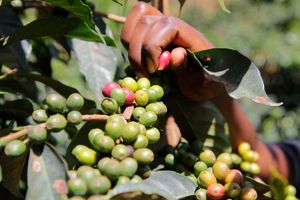
“I pulp, dry and sell the beans right here at home, with a kilo fetching between Sh400 and Sh500. Through this pilot coffee project, it’s dawned on me that the demand for parchment is so high that I have resolved to reclaim a rocky abandoned portion of my 30-acre land to expand my coffee investment,” she explained.
At her home in Muteta village, several newly dug three-feet-deep holes are filled with fresh banana stems where goat manure will be added to conserve moisture, given the area’s unreliable rainfall. She is also digging water wells and planning to install drip irrigation.
Planting 10 million coffee bushes by 2027
A few kilometers away in Tandare village is another farmer Peter Kimani with 850 Batian coffee bushes on his one-and-a-quarter-acre plot.
“For years, maize has been our cash crop but now it’s been replaced by coffee due to the high earnings. An acre of maize fetches a net profit of Sh30,000 annually while the same land under coffee can yield about Sh240,000 with minimal labour,” said Mr Kimani.
Mr Kimani planted his coffee in 2022 and harvested his first crop after 18 months earning Sh260,000. The following year, yields improved, raising his take-home to Sh320,000.
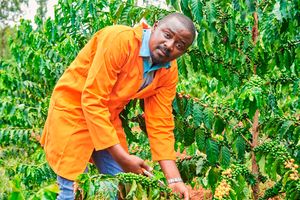
Peter Kimani inspects his coffee bushes at Tandare area in Laikipia county on July 22, 2025.
Photo credit: Joseph Kanyi | Nation Media Group
He also serves as the Secretary of the Ng’arua Coffee Farmers’ Cooperative Society. The society does not operate a factory; instead, individual farmers pulp their berries using portable machines, aggregate the produce, and sell it to the New Kenya Planters Cooperative Union (NKPCU).
“On average, we pay our members Sh330 per kilo of parchment and Sh200 for mbuni (dried berries). Since we don’t have a factory, members pulp and dry their produce independently, and we market it as a society,” he told the Daily Nation in a recent interview.
Last year, the 400 farmers affiliated with the society produced 152 metric tonnes of parchment earning Sh49.9 million—up from Sh30.6 million the previous year.
However, Kimani noted that many members still sell their produce to middlemen from as far as Nairobi, Kirinyaga, and Nyeri, who offer competitive prices ranging from Sh400 to Sh500 per kilo of parchment.
“We discourage selling to middlemen. Over time, farmers will realise that operating through a cooperative comes with benefits like advance payments, better bargaining power and access to training,” he said.
Data from the Laikipia County Department of Agriculture shows that the number of coffee farmers has risen from 398 in 2023 to 1,117 currently. The main varieties under cultivation are Batian and Ruiru 11.
“We are on the right path to making our county a top coffee producer in the country, with an ambitious goal of planting 10 million coffee bushes by 2027. We have partnered with New KPCU, the Coffee Research Institute (CRI) and the State Department of Cooperatives and MSMEs,” Laikipia Governor Joshua Irungu said on Tuesday, July 22, while receiving 20,000 seedlings from New KPCU.
Between 2022 and June this year, 23,000 seedlings have been distributed. Targeted areas include Sossian, Githiga, Marmanet, Igwamiti, Ol Moran, and Ngobit wards. Ten agricultural extension officers trained in coffee production and management at CRI are now assisting farmers with best practices.
The promise of coffee farming in an arid and semi-arid county has become so attractive that even investors are lining up to capitalize on the opportunity.
One such investor is David Cullen, a foreign farmer who has planted more than 4,000 Batian trees in Lonyiek village, Sossian Ward.
Coffee farmers dry coffee parchment at Miteta Village in Laikipia County on July 22, 2025.
Photo credit: Joseph Kanyi | Nation Media Group
“I started with a trial three years ago. After realising that the crop does well here I decided to go commercial. It’s a venture I won’t regret,” said Cullen during a recent visit by senior county government officials to his farm, located near the Baringo-Laikipia border.
The push for coffee farming also has the potential to reduce long-standing conflicts between farmers and migrating pastoralists in regions like Ol Moran where maize farms are often grazed on or raided.
This local initiative dovetails with national government efforts to reverse the sharp decline in coffee production and reclaim Kenya’s position as a global coffee leader.
In the 1970s, Kenya was a top global coffee producer, earning millions in foreign exchange. Today, the country ranks 20th, trailing East African neighbors like Ethiopia, Uganda and Tanzania, as well as Côte d'Ivoire.
“At independence, Kenya led Africa in coffee production. But now, we’ve fallen behind. The government has launched a deliberate three-year plan to increase coffee acreage, targeting both traditional and new growing regions,” said Wycliffe Oparanya, Cabinet Secretary for Cooperatives and MSMEs during a recent visit to Laikipia.
Mr Oparanya made the remarks at a coffee stakeholders’ meeting held at Kinamba Market in Githiga Ward, where he also disclosed that 33 of Kenya’s 47 counties are suitable for coffee farming.
Among the government’s new strategies is encouraging farmers to adopt the crop, setting aside Sh500 million for seedling purchases and introducing smart farming to boost yields from 2.5 kilos to 10 kilos per bush.
The New KPCU has been tasked with establishing coffee nurseries across target counties, the CS said.
Demand for Kenya’s Arabica coffee remains high globally due to its rich flavour often used for blending with other varieties such as Brazilian coffee—the world’s top producer.
Gendever Wairimu inspects her coffee bushes at Miteta village in Laikipia county on July 22, 2025.
Photo credit: Joseph Kanyi | Nation Media Group
“We were recently in the United States where we were asked if we could supply 200 million tonnes monthly. Our annual production is a paltry 50 million tonnes. That’s why we’re committed to rolling out a workable plan to boost output,” Mr. Oparanya said.
New KPCU managing director Timothy Mirugi noted demand is so high they have already sold all last season’s coffee deliveries.
“Our coffee is high quality and sought after worldwide. Farmers should never worry about market availability. I recently received a call from Malaysia expressing interest in our coffee,” said Mr Mirugi.
To support the expansion, the government plans to recruit 200,000 new farmers annually and distribute 20 million seedlings each year.
Currently, Kenya’s coffee sector is burdened by political interference, mismanagement of cooperatives—the main marketing platform for rural farmers—and spiraling debt, which has pushed many farmers to abandon the crop.