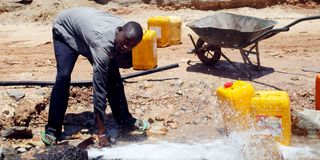
At least 70 water companies risk shutting down as they grapple with debts and losses of more than Sh25 billion.
A damning report laid bare how the utility firms are deep in debt amounting to Sh20.3 billion, a situation that has left most of the total 87 firms technically insolvent.
Painting a grim picture of the financial mess, the report by the Parliamentary Budget Office (PBO) revealed that 86 percent of the 87 water companies are in financial distress as they grapple with debts.
Parliament in a past session.
Photo credit: Jeff Angote | Nation Media Group
According to the report, the utility companies lost Sh5.1 billion in a year in water produced but not billed to customers in the financial year ended June 30, 2024, putting the financial sustainability of most of the county water service providers in a precarious position.
The report says the prevailing situation points to governance lapses, fiscal indiscipline, and operational inefficiencies.
The PBO report indicates that an overwhelming 86 percent of water companies operated under financial distress, largely due to negative working capital as they are unable to recover Sh15.3 billion they are owed.
This, according to the report, was exacerbated by persistent non-revenue water losses, outdated tariff regimes, and high recurrent costs.
On the flipside, it is only 12 water companies that recorded positive working capital positions with no indicators of financial distress.
According to the report, Nairobi City Water and Sewerage Company accounts for the lion’s share of the debts amounting to Sh5.3 billion.
Mombasa Water and Sewerage Company is next with Sh2.2 billion followed by Malindi Water and Sewerage Company.
Tavevo Water and Sewerage Company (Sh965.35 million), Nakuru Water and Sanitation Services Company (Sh683.6 million), Kakamega County Water and Sanitation Company (Sh671.9 million), Kwale Water and Sewerage Company (Sh618.6 million) and Kilifi Mariakani Water and Sewerage Company (Sh506 million) are next in line in terms of debt distress.
Some other 14 water companies are in more than Sh200 million debt, while another 20 are grappling with more than Sh100 million debts.
Ten more water utility firms have made losses ranging between Sh51 million and Sh98 million, exposing the precarious nature of most of the companies.
It gets even worse as 16 more companies have debts of between Sh21.7 million and Sh45 million with another six having debts of more than Sh10 million.
It is only Cherang’any Marakwet Water and Sanitation Company limited, and Marsabit Water and Sewerage Company limited which have debts of less than Sh1 million.
“The inability to recover operational costs poses a threat to the continuity of service and undermines the constitutional right to water,” reads the report.
The mess has seen most of the companies fail to honour statutory obligations such as pay as you earn, and national social security fund deductions, exposing the companies to penalties and legal risks.
The report showed that water companies consistently recorded water losses averaging 46 per cent of total production.
For instance, some 76 companies produced a total of 440,389,854 cubic meters of water of which only 235,984,081 cubic meters were billed.
Consequently, a total of 204,405,773 cubic meters, equivalent to 46 percent of total production; significantly exceeding the regulatory benchmark of 25 percent. Taking the lowest charge of Sh25 per cubic metre, the total loss is more than Sh5.1 billion.
According to the report, the losses are majorly fueled by illegal connections, aged infrastructure, faulty meters, and reliance on flat-rate billing.
“The magnitude of lost water volumes points to both weak enforcement and inadequate investment in infrastructure rehabilitation,” reads the report.
Interestingly, nearly half, 44 percent, of the water firms are still using obsolete tariffs, constraining their revenue mobilisation and impeding their ability to cover costs, thereby worsening their financial instability.
The report also revealed that some water service providers irregularly appropriated customer deposits—totaling Sh245 million—to fund recurrent expenditures without board approval.