Hello

Your subscription is almost coming to an end. Don’t miss out on the great content on Nation.Africa

Ready to continue your informative journey with us?

Hello

Your premium access has ended, but the best of Nation.Africa is still within reach. Renew now to unlock exclusive stories and in-depth features.

Reclaim your full access. Click below to renew.

Tobias Okello
Caption for the landscape image:

How a Kenyan ‘accidentally’ found a job in Luxembourg

Scroll down to read the article

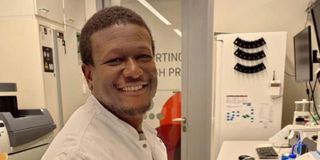
Histologist Tobias Okello at a working station at the Luxembourg Institute of Health in Luxembourg in 2025.

Photo credit: Pool

Tobias Okello, 42, accidentally found a job online in a country he did not know existed about nine years ago.
Like him, not many Kenyans can point to Luxembourg on the map.
“Some people still think it is a city in Europe, and I don’t blame them. I also had not heard of the country before my job application process,” says Okello.

The Bachelor of Science in Biology graduate from the University of Eastern Africa, Baraton, was scrolling the internet one Saturday afternoon about eight years ago out of curiosity and not because he was seriously looking for a job.

“That was the first time in my life that I tried applying for a job online. I wasn’t even serious. I was just scrolling,” he says.

He didn’t think much about it when he submitted his application.
“The requirements looked like the things I had been doing in Kenya, and I said, ‘Why not?’”
Mr Okello would later come to learn that the job he applied for had been looking for a candidate to fill the position for seven years.
“This job had been waiting for me, I guess. It had not been filled for as long as I had been working in Kenya”.

At the start of the following week, the hiring company called.
“The number looked very strange to me. So, I ignored it,” he says.
At the time, stories of phone scams were circulating widely, and he treated foreign numbers with the suspicion they called for.

However, the calls kept coming. “I told myself, let me just check the country code”. His quick search online revealed the surprising result: Luxembourg. “That’s when I said, okay, let me pick it”.

Tobias Okello

Histologist Tobias Okello at a working station at the Luxembourg Institute of Health in Luxembourg in 2025.

Photo credit: Pool


On the other end was a recruiter from the Luxembourg Institute of Health. “She told me, ‘We already sent you an email in the morning. We have gone through your papers, and you are qualified.” They wanted to schedule an interview immediately. It would be online, via Skype. There was only one problem. “I didn’t even have Skype. I had to ask someone to help me register”.
The interview went well, followed by close to a month-long silence, to the point he thought he had not scored it. “For almost a month, they said nothing. I started asking myself what was happening. My friends told me that European institutions often go silent once they make a decision”.

After the long wait, Mr Okello sent a brief email to inquire about progress, to which he received an instant response requesting him to plan for an in-person interview.
“I did not have a passport; I had never even processed one. It wasn’t like I had pictured myself out of this country for anything, not work or even leisure.” The institution, unaware that Kenyans require visas to enter Europe, had already booked his flight.
Luxembourg does not have an embassy in Kenya, so the Belgian Embassy handles its visa processing. The institution coordinated directly with the embassy, guided him through documentation, fingerprints, and appointments, while he rushed to acquire a passport.

“Most of the time, I was just being told, ‘Please come here. Please bring this.’ They handled almost everything,” he says. “Everybody kept telling me this kind of thing does not happen”. When he finally travelled to Luxembourg, there was no second interview waiting for him.

“They just wanted to see me. The interview we did on Skype was enough, they told me”.
He was shown around the laboratories, introduced to the research teams, and taken through the systems.
The institution booked him a hotel, gave him transport money, and after a week, he flew back to Kenya.
“The next day after I landed, they sent me an email saying I had qualified for the job”.
Mr Okello works as a histologist, locally referred to as a pathology assistant, at the Luxembourg Institute of Health, a research consortium that handles human tissue samples for advanced medical research. His role involves preparing tissue for immunohistochemistry, fluorescence analysis, cytometry, and DNA-RNA extraction.
One of the major projects he has worked on focuses on Parkinson’s disease by analysing brain tissue obtained through autopsy.
“It is not a hospital diagnosis per se; we carry out this as research that informs future treatment”.

Tobias Okello

Tobias Okello, the 42-year-old Histologist in Luxembourg City, Luxembourg, in 2025.

Photo credit: Pool

His path into histology began a decade before he went to Luxembourg. After completing a Bachelor of Science in Biology at Baraton, with a biomedical option, he interned at Kenyatta National Hospital.
“I was advised by a friend to take histopathology since I had already done histology in college.”

He undertook six months of specialised training, then worked under a private pathologist for the rest of his Kenya-based career.
Leaving was not easy since he had helped build the business. “I was the first employee and helped build that place”. After serving his three-month notice at his job, he packed his bags and left for Luxembourg.
“It is a very tiny country with a population of around 700,000. But it is also one of the most expensive places in Europe. Rent was my first reality check. A one-bedroom apartment outside the city was around €1,700. That is more than Sh200,000”.

When he arrived in 2018, the institution helped him secure shared accommodation, common for single professionals.
“I was paying around €800; now those same places are €1,000” Like many people living in the country, he has learned to survive the system. Food and other essentials are cheaper across the border, so he takes advantage of the lower prices across the border.

“We cross to Germany to buy food; onions that cost €4 in Germany will cost €15 in Luxembourg. So, you stock your fridge”. He buys his clothing in Belgium or France. “You only buy in Luxembourg if you have missed something. Otherwise, it is too expensive”.

Transport, however, is free. “Bus and train services across the whole country are free.”
They introduced nationwide free public transport in 2020, two years after Mr Okello’s relocation.
“It is one of the major attractions for many immigrants. You just plan your time because travel here is time-based as opposed to Kenya’s on-demand basis,” he says.
To escape the high rent, cross-border commuting has become normal.
“During weekdays, nearly two million people work in Luxembourg, most of them living in France, Germany, or Belgium. In the evening, when people leave, it goes back to around 700,000”.

Difference


For Mr Okello, the biggest difference between Luxembourg and Kenya is not income, but systems.
“In Kenya, we can do a lot. The problem is not money. The problem is the system. In Luxembourg, taxes are collected locally and remain local. If money is not used, it is returned. That is something Africans don’t believe”.
Culturally, the adjustment was just as stark. “Everyone here is equal. Whether you are a billionaire or a cleaner. Bosses are addressed by their first names. It is easier to say, correct your boss here than back home and later you sit with them at the same bar”. The other thing he wasn’t prepared for before relocating was the language difference. French dominates daily life, followed by German and Luxembourgish. He is currently studying Luxembourgish as part of the process toward long-term residency and citizenship. “One of the requirements to acquire citizenship is learning the language, and you must pass it; there are no shortcuts”.

Family life

Family life has been the hardest balance. He was not married at the time of relocation. That has since changed. His wife lives and works in Kenya. “It is a good thing and a bad thing at the same time. When you meet, you value each other more. But sometimes you need your partner, and they are not there”. Travel between the two countries is expensive, but love calls for sacrifice, as Okello observes.

Recent policy changes in the country have made it easy for family members of skilled workers to join them, live and work in Luxembourg on the account of the sponsor (principal member). “I am in the process of applying for my citizenship. My family can, however, join me here whenever.” The country has experienced an influx of other nationalities recently, thus reducing job opportunities across industries. “The competition has intensified, especially after European countries welcomed Ukrainian refugees. Some jobs are still open, but a majority require skilled workers. Remember, my job was advertised for seven years before I applied. Nobody was applying. There are still many opportunities for skilled workers”.

With the high standards of living, is relocating to Luxembourg worth it? “I would say it is, with a pay of between 5,000-12,200 Euros (Sh760,000-1,800,000), one can do a lot if they are prudent managers of their money. Does he plan to return to Kenya permanently? “We always want to come back, but life interferes. For many families, Europe offers dignity, protection, and systems that work. Who doesn’t want a good life?”

One thing he misses is the sense of community he left in Kenya. “The downside of relocating is that the community is no longer freely accessible as in your home country. Most people relocate for greener pastures, which is to say, they are constantly working. In Kenya, weekends are easy; you can meet family and friends, travel up country, etc. Here, you operate on a schedule. Even leisure meetings must fall within plans. I miss the ease with which you can do that in Kenya.”
Follow our WhatsApp channel for breaking news updates and more stories like this.
[email protected]