Solar innovation tackles avocado export crisis

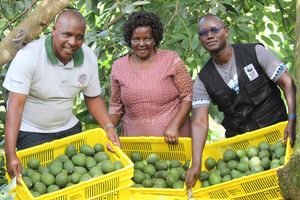
Kinyua Nkanata, an avocado farmer from Meru County who uses solar pest traps to reduce the use of chemicals in fruit production.

What you need to know:
- Export fruits fetch between Sh100 to Sh140 per kilo, but when attacked by the moth, a kilo is sold for Sh30 in local markets.
When Kinyua Nkanata's avocado waste jumped from 500 kilogrammes to 2.2 tonnes in a single season, the farmer from Meru knew he was facing more than just a bad year. The False Codling Moth (FCM) had arrived, threatening not only his livelihood but Kenya's position in the global avocado market worth billions of shillings annually.
"Export fruits fetch between Sh100 to Sh140 per kilo, but when attacked by FCM, a kilo is sold for Sh30 in local markets," explains Nkanata, who has been growing avocados since 2009 primarily for export markets.
The crisis extends far beyond individual farms. Kenya, ranked as Africa's leading avocado producer and the world's sixth largest, faces a critical threat to its agricultural export earnings as the European Union and other major markets increasingly reject shipments contaminated with this quarantine pest.
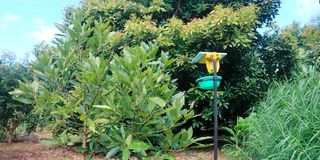
A solar pest trap installed on Mr Kinyua Nkanata’s avocado farm in Meru.
The moth presents farmers with an impossible choice. Traditional chemical pesticides powerful enough to control FCM often leave residues that violate Maximum Residue Limits (MRL) in export markets, particularly the European Union, which represents one of Kenya's largest avocado consumers.
According to Nkanata, who chairs the 1,000-member Abogeta West Avocado Cooperative Society, "the moth cannot be controlled using ordinary pesticides." The cooperative links smallholder farmers to exporters, making compliance with international standards crucial for market access.
The pest began manifesting seriously in Nkanata's farm in 2022, transforming what was once manageable waste into a devastating loss that threatens the economic viability of avocado farming in the region.
"The quarantine pest, once discovered in a container, leads to the produce being returned to the country of origin," Nkanata notes, highlighting the high stakes involved in pest management decisions.
Managing FCM often requires pesticides with high residue levels, creating health concerns for both farm workers and consumers. International markets are particularly stringent about chemical residues, reflecting growing global awareness about food safety and environmental sustainability.
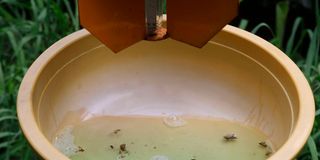
Some of the trapped pests, including the False Codling Moth.
Against this backdrop of mounting challenges, 29-year-old Mutuma Muriuki has developed what many farmers are calling a game-changing solution: solar-powered pest traps that target FCM without chemicals.
"When I came up with the idea, I wasn't chasing a trendy tech dream or the allure of flashy apps. I was literally chasing after moths," says Muriuki, founder of Eco Bristo Ltd.
His innovation comes at a critical time for Kenya's horticulture sector. The country's avocado industry has been gradually overtaking tea in some regions like Meru, representing a significant shift in agricultural priorities and export potential.
Muriuki's background in agroecology and experience working in sustainable agriculture across East Africa, India, Colombia, and Mexico provided him with firsthand insight into the challenges facing smallholder farmers.
"Exports, particularly in fruits such as avocados, are increasingly being rejected due to pest infestations. Chemical pesticides, once a solution, have become costly, harmful, and increasingly ineffective," he explains.
In 2021, armed with Sh150,000 from personal savings and consultancy work, Muriuki began developing his solution from a small shared room in Meru that served as office, workshop, and dispatch centre.
The technology he developed uses solar energy to power Light-Emitting Diode (LED) lights that emit a specific blue wavelength known to attract harmful moths while leaving beneficial pollinators like bees and butterflies unharmed.
Solar energy
"The concept is simple: use solar energy to power LED lights that emit a specific blue wavelength known to attract harmful moths," Muriuki explains.
Once attracted to the trap, pests either fall into a soap-water basin or are electrocuted, depending on the model. The soap changes the water's surface tension, preventing moths from escaping once they fall in.
"The use of solar traps is a natural way to control pests," confirms Nkanata, who has adopted the technology on his farm.
Eco Bristo has developed multiple trap models to serve different farm sizes. The Kifaru model targets small farms up to two acres, while the more robust Ndovu trap uses electrocution to manage heavier pest infestations on larger farms. A smaller Chui model for one-acre farms is currently under development.
"The technology is simple, but it has been a long journey," Muriuki reflects. "We spent over three years making it unique. The LED sensors we use are specific, and we have built this from scratch through trial, error, and feedback from real farmers."
The timing of pest control is critical as FCM lays eggs inside fruits, creating white powder and brown spots that indicate infestation. Some attacked fruits fall off trees prematurely, making management most effective at the pupae, larvae, or adult stages.
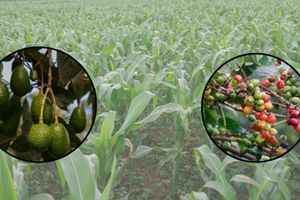
Beyond avocado farms, the traps are now used across maize plantations, flower farms, and greenhouse setups, indicating broader applicability across Kenya's diverse agricultural sector.
The development addresses a significant gap in pest management options for Kenyan farmers. "Farmers lack affordable, non-chemical pest control options," Muriuki observes, noting that "European markets, for instance, do not tolerate avocados with residues, yet avocado is one of the most promising industries."
Fruit flies and FCM are categorised as quarantine pests in both European and Chinese markets, making effective control essential for maintaining Kenya's export competitiveness.
What began as a one-man operation now employs a core team of six, with field technicians deployed across various counties. Muriuki works closely with farmer cooperatives in Meru, Tharaka Nithi, and Nandi, building credibility through constant feedback and device refinement.
Eco Bristo, formally registered in 2022, follows a reinvestment strategy where every sale goes toward improving design, sourcing better local materials, and building the team.
However, like many young agripreneurs, Muriuki faces significant challenges, particularly around financing expansion. In 2023, he received a Sh1 million grant from Heifer International, providing crucial support for scaling operations.
Beyond pest control, Eco Bristo is pioneering biochar-based soil amendment products to address soil fertility challenges. Biochar, a carbon-rich substance made from organic material, helps retain water, balance pH, and build soil organic matter, supporting long-term crop productivity essential for organic farming systems.
This diversification reflects a comprehensive approach to sustainable agriculture that addresses multiple challenges facing Kenyan farmers simultaneously.
The solar trap innovation represents part of a broader trend toward sustainable pest management in Kenya's agricultural sector. As export markets become increasingly stringent about chemical residues and environmental impact, technologies like Muriuki's offer pathways for farmers to maintain market access while protecting environmental and human health.
The success of such innovations could prove crucial for Kenya's agricultural competitiveness, particularly as climate change and evolving pest pressures create new challenges for traditional farming methods.
For the avocado industry specifically, effective FCM management without chemical dependence could help Kenya strengthen its position in global markets, where food safety and sustainability increasingly drive consumer and regulatory decisions.
Muriuki's vision extends beyond individual farm solutions. "His vision is clear: to power pest-free agriculture across Africa for a healthy continent," reflecting ambitions that could transform agricultural practices across the region.
For farmers like Nkanata, who have witnessed dramatic improvements in crop quality since adopting solar traps, the technology represents hope for sustainable farming that meets both economic and environmental objectives.