‘I am hoping God will do wonders’: The mothers fighting childhood cancer
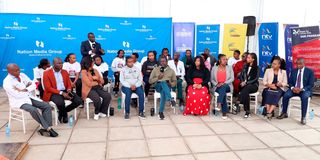
Medics, caregivers and key stakeholders in the childhood cancer space during the Nation Leadership Forum: Childhood Cancer Spotlight and Baraza at Kenyatta National Hospital in Nairobi on September 11, 2026.

Mama Graduel no longer asks doctors what comes next. She already knows.
Her daughter was diagnosed with brain cancer in 2023, after Mama Graduel noticed the girl staggering, unable to hold her posture.
At the hospital, doctors first found water on the brain and drained it. In the process, they found something worse: a tumour sitting on a vein doctors described as untouchable. Surgery was never an option. Radiotherapy was.
Her daughter went through 30 sessions, but the cancer did not clear. By 2025, the symptoms had returned, and this time the doctors had nothing left to offer: no further radiotherapy, no more medication, just time.
Since February, her daughter has not been on any medication, and her condition has not improved. All the mother can do now is manage the symptoms and the pain.
"I am hanging on to the hope that my child will be healed, because if the doctors have said there is nothing they can do, that is science. I am hoping that our God will do wonders and my child will be healed," Mama Graduel said, weeping, as she narrated her daughter's journey.
She spoke to the Nation during the Nation Leadership Forum on Childhood Cancer, held in partnership with Hope for Cancer Kids, an organisation dedicated to supporting families affected by childhood cancer.
The forum took place at Kenyatta National Hospital on Friday, September 11, 2026.
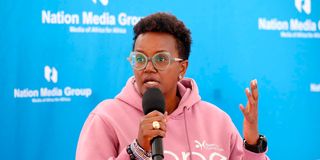
Hope for Cancer Kids Board Chair Kanyi Ohawa addresses participants during the Nation Leadership Forum: Childhood Cancer Spotlight and Baraza at Kenyatta National Hospital in Nairobi on September 11, 2026. The forum brought together medical experts and other stakeholders to highlight the challenges facing children with cancer and the need for early diagnosis and timely treatment.
A few seats away sat Mama Benson, still fighting a battle Mama Graduel has already lost.
Her son was diagnosed with blood cancer in July 2024, after weeks of headaches that no amount of medicine would touch.
A local hospital found his blood count dangerously low and referred him onward. Further tests confirmed leukaemia, high-risk, with his platelets so depleted he had begun bleeding spontaneously and developing joint pain.
They moved him to Kenyatta National Hospital, where doctors started him on standard treatment. But standard platelet transfusions were not raising his counts fast enough, and a fellow parent on the ward told her about directed donation: finding someone willing to give blood specifically earmarked for her son.
She searched and eventually found a volunteer. Her son stabilised and began chemotherapy, in and out of hospital for months, home in between, the family holding its breath each time.
Then, in 2025, he relapsed.
The medical team moved him onto salvage chemotherapy and called a family conference, the kind of meeting oncology and paediatric teams hold when a case has reached its hardest point.
They told her that if the round of treatment worked, her son would need a bone marrow transplant. The procedure is not done in Kenya. Patients who need one are sent abroad, and families are expected to raise the money themselves.
The illness has already cost her a marriage and a family. "Not all men endure," she said quietly.
Also Read: WHO global report: Cancer cases set to double by 2050 amid deepening treatment inequities
When she needed support most, an aunt told her she had brought the suffering onto her own child, claiming there was no family history of cancer, she said. She does not know why this happened to her son. She only knows that when she needed people to stand with her, most of them did not.
She has been going door to door trying to raise money for the transplant her son may still need. She has not succeeded.
"I could wish the government to help us," she said. "Kenya is a rich country. I can say it's a rich country because they usually do so many things."
Her son remains on maintenance chemotherapy, returning to hospital every month, while she waits, still hoping the money and the transplant slot will come before it is too late.
Both women's stories were echoed, from a clinical vantage point, by Dr Irene Nzamu, a paediatric haematologist-oncologist at Kenyatta National Hospital, where she and her colleagues see 350 to 400 new childhood cancer cases every year, on top of children already in treatment.
The unit runs two wards: one with 80 beds, where children stay alongside their parents, and another with 28 beds for children without a parent present, plus an outpatient and day-care programme.
"The most common cancer we see is acute leukaemia, making up about a third of cases, followed by retinoblastoma, a cancer of the eye, then lymphoma and kidney tumours," Dr Nzamu said.
Medics, caregivers and key stakeholders in the childhood cancer space during the Nation Leadership Forum: Childhood Cancer Spotlight and Baraza at Kenyatta National Hospital in Nairobi on September 11, 2026.
The single biggest problem, she said, is how late children arrive. More than 70 to 75 per cent of her patients are already at stage four by the time they reach her, meaning many begin treatment on a palliative footing rather than curative.
"You're starting from a disadvantaged point of treatment," she said, and mortality follows accordingly.
The delay, she said, is not one failure but a chain of them. It starts in communities and in the health system itself, where childhood cancer is rarely the first thing anyone suspects.
"These are patients who have been through our healthcare system for months, back and forth," she said, "but nobody is picking up on or suspecting it could be childhood cancer." She described it as a gap in both knowledge and awareness, since childhood cancer is not a condition most healthcare workers encounter often, and said health workers need continual sensitisation to recognise persistent symptoms early and refer them onward.
Even once a referral happens, she said, the pathway itself can take unacceptably long before a family ever reaches a facility equipped to diagnose the child properly.
Diagnosis brings its own bottlenecks. Kenyatta has some of the machines needed, she said, but not always the reagents to run the tests. Flow cytometry, the test used to determine exactly what type of leukaemia a child has, requires reagents that are frequently unavailable, forcing families to outsource testing elsewhere at their own cost and on their own time.
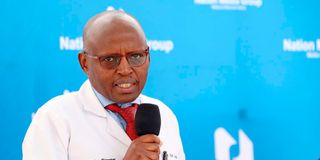
Kenyatta National Hospital (KNH) Senior Director of Clinical Services Dr. Joel Lessan follows proceedings during the Nation Leadership Forum: Childhood Cancer Spotlight and Baraza at KNH in Nairobi on September 11, 2026.
A PET scan, needed at the end of treatment for most children, is not available at Kenyatta at all; patients are sent elsewhere in the city to get one. "A lot of delays sometimes are really within the system," she said. "It's a systemic issue."
Some treatments simply do not exist in Kenya yet. Bone marrow transplant, the very procedure Mama Benson's son needs, is not offered locally. Families must fundraise and travel abroad, and children can wait months for that opportunity.
"They can wait for months, and sometimes the children will die while waiting," Dr Nzamu said.
Medicine availability is its own crisis. The Social Health Authority may be designed to cover cancer medicines, Dr Nzamu noted, but it can only cover what is available within the facility. Parents are sometimes told to buy chemotherapy drugs from outside pharmacies, only to return with the medication and find their child had already died waiting.
"The disease is not waiting; it is increasing," she said. Consistent, uninterrupted access to essential medicines, she said, would be "a game changer."
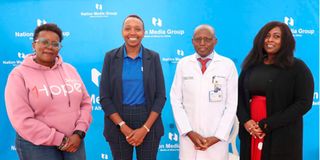
Hope for Cancer Kids Board Chair Kanyi Ohawa, Nation Media Group (NMG) Chief Corporate Affairs, Marketing and Partnerships Officer Monicah Ndung’u, Kenyatta National Hospital (KNH) Senior Director of Clinical Services Dr. Joel Lessan and National Cancer Institute of Kenya Assistant Director, Cancer Prevention and Control, Dr. Joan Ritho during the Nation Leadership Forum: Childhood Cancer Spotlight and Baraza at KNH in Nairobi on September 11, 2026.
Then there is treatment abandonment, the term clinicians use when a family simply stops returning for scheduled chemotherapy cycles. It is rarely defiance, she said. It is usually money, and it is usually distance.
Of all the challenges, Dr Nzamu said, the shortage of workforce is the biggest hindrance to treatment. Kenya has only around 15 paediatric oncologists in the entire country, and the majority of them, nine, are concentrated in Nairobi, leaving vast stretches of the country, especially the rural areas that need them the most, without a specialist anywhere nearby.
Every delay in diagnosis, referral and treatment is compounded by how few hands there are to catch a case early.
For Mama Graduel, that shortage has already closed a door. What is left is hope of a different kind, not medical, but the only kind still available to her. For Mama Benson, the door has not yet shut, but it depends on money she does not have, on a procedure her country does not offer, for a son she is not ready to lose.