‘I don’t care how you report it:’ Inside Aden Duale’s pattern of deflection when faced with tough questions on his Health docket
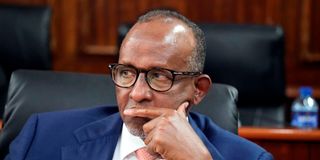
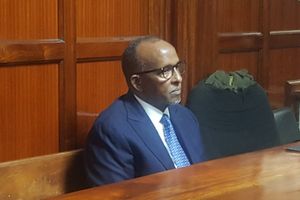
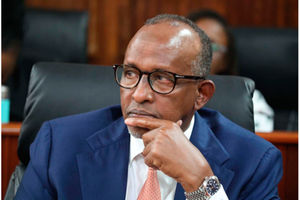
Cabinet Secretary for Health Aden Duale when he appeared before the Senate Committee on Delegated Legislation at Bunge Tower in Nairobi on June 18, 2026.

Journalists who cover the Ministry of Health have learnt to brace themselves before they type out a question to Cabinet Secretary Aden Duale. Some no longer bother at all. Across newsrooms, reporters admit they now avoid raising certain questions with him, even at press briefings, for fear of the rude response that might follow.
It was not always this way. When CS Duale was appointed Health Cabinet Secretary on March 25, 2025, he was, by the account of journalists who covered the ministry in his first year, relatively accessible. He picked up the phone, responded to messages and engaged with questions, seeming to understand that speaking to the press was not a favour but a basic function of public office.
That Duale is gone. Now in his second year in office, what has replaced him, documented across six months of WhatsApp exchanges, press conference confrontations and public interviews, is a Cabinet Secretary who has cultivated an aura of deliberate unpredictability. Nobody in the press corps knows which version of him will show up when they ask a question: the one who sends a substantive response, the one who answers a question with another question, the one who tells a reporter to turn their media house into a health facility, or the one who simply says "I don't care how you report it" and ends the conversation.
That unpredictability does not appear to be accidental. It looks like a tool, and it is working.
Nation has documented a series of exchanges with CS Duale across some of the most serious public health stories of 2026: the Laikipia Ebola facility, the Social Health Authority (SHA) financial crisis and the hospital payment scandal.
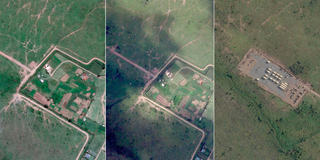
A satellite image shows the Laikipia Air Base (left) at the start of construction work on the Ebola quarantine facility on May 19. A fresh image (right) shows tents erected and vehicles parked at a new field hospital at the venue on June 6, 2026.
A pattern runs through all of them. First, he denies the premise of the question. Second, he asks whether the journalist has personally verified what they are asking about. Third, he deflects to a different subject. Fourth, he attacks the messenger. Fifth, if none of that works, he refuses outright and cites legal authority. These are not characterisations; they are his own words, on record, with dates.
"Which construction is going on?"
The pattern began to take shape on June 8, 2026, when a Nation reporter contacted the CS on WhatsApp to ask why construction of the Laikipia Ebola quarantine facility was ongoing despite a High Court conservatory order. His first response denied the premise entirely. "Kenya has not confirmed any Ebola case and has not received any Ebola-exposed persons," he wrote, answering a question about construction by pivoting to a different one altogether.
When the reporter pressed him specifically on the construction, he replied: "Which construction is going on?" When she specified the Ebola quarantine facility at Laikipia Air Base, he asked: "What about it? Which construction is going on? Have you been there?"
By then, the High Court had already issued its conservatory orders. Satellite imagery reviewed by Reuters showed tents erected and vehicles at the Laikipia site. Duale's position was that there was no construction, and that if the journalist had not personally visited the site, they had no basis for the question.
"So?"
On July 13, the New York Times reported that an American citizen working for a humanitarian group in the Democratic Republic of Congo had tested positive for the Bundibugyo strain of Ebola. Nation sent Duale the report and asked whether the patient would be brought to the Laikipia facility. His response to the context was a single word: "So?"
When Nation explained it wanted to establish whether the patient would be brought to Laikipia, he replied: "Which facility?" The reporter specified the quarantine facility at Laikipia Air Base, and he responded: "The one court stopped." The reporter responded in affirmation, and he went silent. There was no further response that evening.
Reuters would two days later confirm that the facility he described as "the one court stopped" was hosting seven American aid workers.
"Ask them?" Then "Ask Reuters."
On July 17, Reuters published its report confirming that seven Samaritan's Purse DART staff members were quarantining at the Laikipia facility, the same facility Duale had told the High Court in June had been stopped. Nation sent him the link and asked: "Reuters is reporting that Laikipia Ebola quarantine facility is operational and has Americans already admitted there. What is the true situation?"
His response, at 12.11pm, was: "Ask them?" He followed up with: "From where I sit as the MoH, I don't react to what Reuters write. I react to facts." Nation called him. There was no answer.
Nation then pointed out the contradiction directly: "But you said the construction of the facility had been halted. How are Americans being quarantined in a closed facility?" His response, at 1.57pm, was: "Ask Reuters." At 9.04pm that night, after hours with no substantive engagement on a story of significant national and international consequence, he sent one final message: "Thank you."
"I don't care how you report it"
On July 22, Duale agreed to take questions from Nation while receiving Ebola equipment from India at Jomo Kenyatta International Airport. Asked to confirm whether seven Americans had been admitted to the facility, as the US government had indicated, he responded: "I made a commitment when I said I will respect the rule of law, we stopped construction, and we are only building the other 22 sites."
Asked whether construction was ongoing, he said: "If you can go there and come and report to me whether the construction is ongoing, then I will answer that question. For now, I don't respond to stories written by Reuters but facts."
Asked about the Americans inside the facility, he said: "I don't know why you are only asking about Americans. The way you are so busy about the Americans, you should also be busy and ask about Kenyans who have been quarantined. Many Kenyans, including the President's staff, were quarantined for 21 days. I don't see why you people are so concerned about Laikipia."
On the location of the 23 Ebola quarantine centres he had said were spread across the country, he cited the Public Health Act as giving him authority not to disclose it. That may be legally defensible, but it leaves an unanswered question: if Kenya identifies an Ebola case and the government will not reveal where the isolation facility is, how is a sick Kenyan supposed to know where to go? The Public Health Act provision he cites was designed to prevent panic, not to deny patients access to care. "We will not disclose where our isolation and quarantine are, based on the Public Health Act, which allows me not to, and I will not announce this," he said. "I don't care how you are going to report it."
"Turn Nation Media into a health centre"
The Laikipia exchanges are not isolated. Earlier this year, CS Duale's response to accountability questions about the Social Health Authority's (SHA) finances followed the same script: dismissal, deflection and personal attack.
When a Nation journalist confronted him at a press conference about a letter showing that private hospitals had not received the promised SHA payments, he denied that the letter existed. "We do not have that letter. The person who wrote that letter has not told us; he has given it to you," he said, interrupting the journalist mid-question.
Pressed for a clearer answer on the SHA financial shortfall, he turned on the media house itself. "You are bringing patients to your media house. Please turn Nation Media into a health centre. We will register you. We will give you a SHA portal. And we will deal with your claims."
The Rural and Urban Private Hospitals Association of Kenya (Rupha), which had been waiting for answers to the same financial questions the journalist was asking, responded to the exchange. "The CS Health has resorted to attacks on the private health sector and the media as the scapegoats for the flawed SHA model," RUPHA said. "In panic, they have decided to attack everyone instead of addressing the mistakes in the model."
Last April, Duale also threatened one reporter that he would report to the sponsors of the health desk that the journalists were criticising the government. "We have written to your sponsors, and you will soon lose the funding. We will escalate the matter," he said.
Taken together, the exchanges point to a Cabinet Secretary who treats public accountability as an inconvenience and journalists as adversaries rather than as the public's legitimate line of inquiry. Days after Reuters confirmed the Laikipia facility was operational, the government has facilities, but refuses to say where they are, so a Kenyan who thinks they've been exposed to Ebola has no official way of knowing where to seek isolation or treatment.
Follow our WhatsApp channel for breaking news updates and more stories like this.