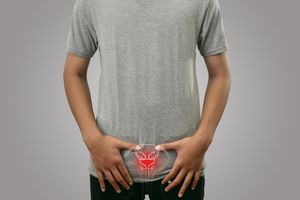
An enlarged prostate is often called benign prostatic hyperplasia (BPH).

James Gitau* thought nothing of it at first. Standing at the toilet, he would push and push, but his bladder never quite felt empty. At 50, and in otherwise good health, he brushed it off.
"I had a feeling that whenever I went for a short call, my bladder didn't empty properly," he recalls. "I didn't take it seriously. I thought I could just go again soon afterwards, but then it became a problem."
At first, he could simply excuse himself and go again an hour later. But soon it crept into his nights too. "It started happening at night. It was like I'd just been to the toilet, and then I needed to go again," he explains.
For months, he kept it to himself. When he finally told his wife, she urged him to get a prostate-specific antigen (PSA) test, a routine blood test to check prostate health. The results came back within the normal range, and relieved, he put the matter out of his mind. But the symptoms persisted through 2025.
"I'll stand there, then I'll try to push. It won't be painful, but then it stops. While I'm still there, I feel like more is coming, but it doesn't really finish. I feel like I haven't emptied," he says.
The turning point came on a work trip to Addis Ababa, where James developed a severe fever the night before his flight back to Kenya. On landing, he went to the outpatient department of his hospital, and this time, he finally mentioned what he had been experiencing all year.
"I told myself, 'let me explain this to this doctor.'" A second PSA test told a different story. "Your PSA shows that your prostate is slightly enlarged," the doctor told him, before booking him in to see a specialist.
Given his family history of prostate problems, the news was hard to take. "I was just a bit nervous," says James.
At his specialist appointment, a uroflowmetry test revealed a significant blockage. "He said, 'Hey boss, you're really blocked, and it can affect your kidneys and cause infections.'"
Also Read: 18 crucial medical tests for middle-aged men
The good news was that scans had ruled out cancer. His urologist then laid out two options: surgical removal of the prostate, or Rezūm treatment. "I opted for Rezūm; at least I'll remain a man," says James.
He was booked in for the procedure the next day and underwent it under sedation, remembering nothing of it. He was discharged the same evening and had to manage a catheter for a week. "It's just something foreign inside you. You don't have that comfort," he says.
A week later, the catheter was removed. He experienced some light bleeding, which was expected, but this cleared up within two weeks. "It's empty," he says of his restored flow. At his three-month review, his doctor could see the change before he said a word.
Now 52, James describes his urinary function as completely normal, and says the procedure has boosted his energy and sexual function. "It hasn't affected it. In fact, it has improved it," he says with a laugh.
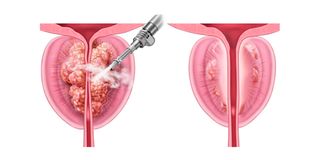
An illustration showing how Rezum water vapour therapy is conducted.
The procedure cost around Sh700,000, only partly covered by his private insurance. "It's really expensive for the average person," he says. "Not everyone can afford that." His one regret is that nobody warned him earlier that an enlarged prostate can develop silently. "Men of this age should make this part of their routine."
James's own path to treatment is the exception rather than the rule. According to the Kenya Demographic and Health Survey (KDHS), more than 14,400 men aged 15 to 54 were diagnosed with a prostate-related condition in 2022. Yet only 14 per cent of them said they were undergoing treatment, leaving most living with symptoms for years before seeking care.
Prostate cancer remains the most prevalent cancer among Kenyan men, while awareness of and screening for benign prostatic hyperplasia (BPH) lag well behind. A study of the Ariaal, a pastoral community in northern Kenya, found that almost half of the men surveyed (49 per cent) reported moderate to severe lower urinary tract symptoms linked to age and lifestyle rather than genetics.
Globally, men face an average lifetime risk of around 27 per cent of developing BPH after the age of 40, with prevalence among those over 50 ranging from 20 to over 60 per cent. In Sub-Saharan Africa, autopsy-based studies suggest BPH is present in over half of men in their 60s, rising to almost 90 per cent in those in their 80s.
Access to modern treatments such as Rezūm in Kenya remains limited but is growing. The Aga Khan University Hospital (AKUH) in Nairobi introduced Rezūm Water Vapour Therapy in June, becoming one of a small number of private clinics offering it, alongside the Male Wellness and Urology Clinic and the Advanced Urology Clinic. These remain among only a handful of facilities providing the treatment nationally since it was approved by the United States Food and Drug Administration in 2015. Clinical studies cited at the launch reported symptom improvements of up to 50 per cent within weeks, with roughly 90 per cent of patients avoiding further surgery.
In Kenya, Rezūm is provided at the Advanced Urology Clinic and the affiliated Male Wellness and Urology Clinic, at a cost of around Sh600,000. URO-CARE in Nairobi also offers the treatment.
What doctors say about BPH and Rezūm
Nation spoke to Dr Amadadin Alhlib, a consultant urologist at Aga Khan University Hospital in Nairobi, who treats a wide range of urological conditions, including cancers, kidney stones, sexual dysfunction and fertility issues.
He explains that an enlarged prostate can press on the bladder outlet and interfere with normal urination. "Men will start experiencing infrequent urination, waking up at night, a strong urge to urinate, a weak urine flow or stream, and an inability to empty their bladder," he says. "Most men over 40 will start to experience prostate enlargement, but not all of them will experience symptoms."
The condition can be hereditary, he adds, and is linked to metabolic syndrome, obesity, diabetes and hypertension. Upon diagnosis, there is a clear pathway to follow: an ultrasound to check the size of the prostate, a uroflowmetry test to check whether urination is obstructed, and a cancer marker test to rule out malignancy before treatment can proceed.
Of these, the ultrasound is the most accessible, costing roughly Sh1,500 to Sh4,000 at a private hospital. Uroflowmetry needs specialised equipment found mainly in dedicated urology units, so not every hospital offers it. If either test raises a cancer flag, the next step is a prostate biopsy with transrectal ultrasound.
"Traditionally, they performed an open prostatectomy, but this procedure is no longer used. Nowadays, transurethral resection of the prostate using electrocautery is used, and after that, we started using a laser to enucleate the prostate. Recently, Rezūm has emerged as an additional treatment option," the urologist says.
However, he is clear that Rezūm's scope is narrow: "It's only for benign enlargement of the prostate. We cannot use Rezūm for prostate cancer or prostate-cancer-induced urinary symptoms."
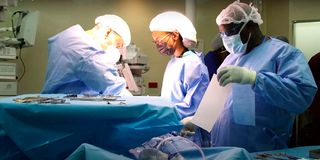
Ahmed Yousef, consultant urologist, conducts a surgical procedure at Aga Khan University Hospital (AKUH) in February 2022. He is supported by an anaesthesiologist and a theatre nurse.
"Rezūm is actually a thermoablation of the prostate adenoma. We insert a small scope through the urethra and inject water vapour at around 70 degrees Celsius into the prostatic parenchyma. This causes thermoablation, destroying the prostatic tissue through heat," he explains. The tissue then shrinks, opening the prostatic urethra to allow urine to pass through. The procedure can treat prostates ranging from 30 to 120 grams, up from an earlier limit of 80 grams, under general or local anaesthesia or mild sedation. As no tissue is surgically removed, sexual and ejaculatory function is usually preserved.
Not everyone can undergo the therapy, Dr Alhlib notes. "Patients with prostate cancer, an enlarged prostate of more than 120 grams, or urinary symptoms caused by something other than the prostate should avoid it, as should those with active infections," he says.
"The procedure takes five to ten minutes, which means less exposure to anaesthesia and fewer side effects during the operation." Patients can get up and about almost immediately and are discharged the same day in 98 per cent of cases. As soon as the catheter is removed, he says, patients start to see improvements within three to four weeks. "They will see an improvement in their urinary symptoms, with full benefits developing over two to three months."
The procedure costs around Sh700,000, though patients with private insurance would pay less. The Social Health Authority (SHA) does not offer any benefits for the treatment.
"There is a possibility of recurrence with all treatments, not only Rezūm," Dr Alhlib says. "The recurrence rate is comparable to that of other treatments; it's not higher." What sets Rezūm apart, he adds, is that it comes with fewer complications and side effects and is a safer procedure. Temporary after-effects are common but mild, including some bleeding in the urine, painful urination and frequent urination, all of which improve with time.
He advises all men experiencing disruptive urinary symptoms to see a urologist for an assessment, as urinary symptoms can be broad and must be categorised for treatment. Ignoring the symptoms, he warns, puts a man at risk of kidney damage, among other complications.
When urine backs up, it can cause hydronephrosis, a condition in which one or both kidneys swell because urine doesn't fully empty from the body, if left untreated. "Urine sitting in the bladder also breeds bacteria, causing recurrent urinary tract infections, while the bladder muscle straining against the blockage can weaken and stretch, sometimes forming stones or pouches," he says.
Dr Rajan Ayub, a consultant urologist based in Nairobi, adds that in advanced cases, the blockage can become complete urinary retention, a painful emergency needing immediate catheterisation.
"This is why we tell men not to ignore these symptoms and normalise them as just part of getting old," he says. "The earlier you come in, the less damage is done."
So where does a man start? "A PSA blood test can be ordered at most public and private hospital labs, usually without a prior specialist appointment," says Dr Ayub. Kenyatta National Hospital runs a urology clinic treating prostate patients, and most level 4–6 county hospitals can draw the sample, though not all can do the follow-up ultrasound or uroflowmetry on-site. Private labs charge between Sh1,500 and Sh2,500 for a standalone PSA test, while public facilities are generally cheaper.
Kenyan clinical guidance recommends men aged 40 to 69 discuss PSA screening with a doctor, earlier for those with a family history or higher genetic risk.
Men who can't afford private testing can watch for free outreach screenings run periodically by the Ministry of Health and county governments, one in Kirinyaga County, for instance, screened 5,000 residents in February.
Follow ourWhatsApp channel for breaking news updates and more stories like this.