Nurses during a joint procession in Kisumu CBD on August 27, 2026, in solidarity with the ongoing nurses’ strike, while (right) passengers leave Kisumu International Airport after airport strikers went on strike.

When aviation workers abandoned their stations on August 30, disrupting flights at major airports, the government negotiated a return-to-work agreement in just two days, but a nurses’ strike that has paralysed hospitals drags on 40 days later.
By September 1, the Kenya Aviation Workers Union had called off its strike, which had delayed flights at Jomo Kenyatta International Airport and grounded operations at Moi, Eldoret and Kisumu airports. Planes were back in the air. Passengers were rebooking their flights.
Nurses have been on strike for 40 days. Laboratory officers, public health officers, nutritionists, pharmaceutical officers, clinical officers and Universal Health Coverage (UHC) workers have been on strike for nearly 50 days. In that time, mothers have died in labour wards. Babies have died before they could take their first breath. And the government has not signed anything.
The contrast has not been lost on the health workers themselves. Collins Ajwang, president of the National Nurses Association of Kenya (NNAK), pointed to the government's swift resolution of the aviation dispute as proof of where its priorities lie, even as demands from healthcare workers captured in a Collective Bargaining Agreement (CBA) have gone unmet for close to nine years.
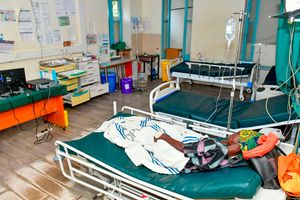
A patient lies unattended in the emergency unit at Kisumu County Referral Hospital on July 29, 2026, after being admitted overnight before the nationwide nurses' strike began. Most patients had yet to receive nursing services following the commencement of the industrial action at midnight.
"We started the push for the CBA with the doctors and the clinical officers. Theirs were signed, and even doctors got paid. They (the government) are saying that doctors are few, and clinical officers are few, but we are many, so they do not have that budget. This doesn't make sense because our large number is exactly what has helped hospitals run effectively. We have reduced maternal mortality; we are the ones making sure theatres are running; we cannot be few. We are at dispensaries where there are no doctors. Let them tell us how few they want us to be so that they can pay us this money," said Ajwang.
Kenya National Union of Nurses (KNUN) Secretary General Seth Panyako put it more bluntly, tying the disparity to money and power.
"It is interest. Probably, they have no interest in the health of the common mwananchi, because the airport is a portal and exit of all serious businesses in Kenya, East Africa, and largely Africa... these people who are in charge of making decisions do business through the airport. So, they can't afford the airport to stop even for a minute. For health, they can go to private hospitals. There is an alternative for them. So, it simply shows that they really don't care about the common mwananchi, and it is very disheartening," said Panyako.
The scale of what is being lost is laid bare in the Every Woman, Every New-born, Everywhere (Ewene) Dashboard, the tracking tool used by governments and health organisations to monitor maternal and new-born health indicators.
Between Monday and Thursday this week alone, the dashboard recorded eight maternal deaths, 16 new-born deaths under one month old, and 55 perinatal deaths. The maternal deaths occurred across seven hospitals nationally, the neonatal deaths across 10 facilities, and the perinatal deaths across 15, a rising toll compared with the previous week, when 22 maternal deaths, 44 neonatal deaths and 130 perinatal deaths were recorded nationally. Last month alone, 75 maternal deaths and 458 perinatal deaths were logged.
The mothers who died this week were recorded at Meteitei Sub-District Hospital in Nandi County (2), Tinderet Sub-County Hospital (1), Jaramogi Oginga Odinga Teaching and Referral Hospital in Kisumu County (1), Ambira Sub-County Hospital (1), Coast General Teaching and Referral Hospital (1), Kenyatta National Hospital (1), and Rapha Medical Centre and Tigoni District Hospital (1 each). Their deaths were attributed to complications of labour or delivery, obstetric haemorrhage, maternal disorders predominantly related to pregnancy, and infection following childbirth.
The neonates who died were lost to respiratory disorders specific to the neonatal period, disorders related to length of gestation or foetal growth, infections, and haemorrhagic or haematological disorders. Their deaths were recorded at Butere Sub-County Hospital (4), Maragua District Hospital (4), Jaramogi Oginga Odinga Teaching and Referral Hospital (1), Kitengela Sub-County Hospital (1), Kerugoya County Referral Hospital (1), Loitokitok Sub-County Hospital (1), Port Florence Hospital (1), Iten County Referral Hospital (1), Karatina District Hospital (1) and Makindu Sub-County Hospital (1).

Nurses from Kisumu, Siaya, Homa Bay and Migori counties take part dancing, chanting and singing during a joint procession in Kisumu on August 27, 2026, in solidarity with the ongoing nurses’ strike.
The perinatal deaths were driven chiefly by asphyxia, respiratory disorders, birth injury, infections and complications tied to gestation length, alongside cardiovascular, neurological, haemorrhagic and temperature-regulation disorders, developmental anomalies, neonatal hypoglycaemia and skin-related disorders — with a share of deaths where the cause or timing was never even specified. These were recorded at Jaramogi Oginga Odinga Teaching and Referral Hospital (4), Kitengela Sub-County Hospital (4), Naivasha District Hospital (4), Alpha Hill Medical Centre (3), Kitui County Referral Hospital (3), Mbagathi District Hospital (3), Nakuru Provincial General Hospital (3), Kerugoya County Referral Hospital (2), Consolata Hospital Gitoro (2), Garissa Level 5 Teaching and Referral Hospital (2), Ntunyigi Medical Clinic (2), Wajir County Referral Hospital (2), Butere Sub-County Hospital (1), Loitokitok Sub-County Hospital (1) and Port Florence Hospital (1).
Ajwang said the counties reporting the highest number of deaths are Kisumu, Nakuru, Kakamega and Kajiado.
"These are not signs that the crisis is easing. Far fewer women are reaching our facilities at all, and those who do face much higher risk. We are working to obtain updated facility data so that we can show the full picture of the mothers who are now delivering outside the healthcare system and our facilities, which are unrecorded and still unsupported," said Ajwang.
He said nurses under NNAK held mega demonstrations across the country on Thursday, when the parallel walkout by laboratory officers, public health officers, nutritionists, pharmaceutical officers, clinical officers and UHC workers entered its 50th day, piling pressure on national and county governments to resolve the standoff. Health professional associations have warned that every additional day of delay is "measured in the number of lives impacted."
"Clinical training has also been impacted, with nursing, medical and clinical students who need functioning facilities for their placements. These prolonged closures are delaying their studies, putting at risk the next generation of healthcare workers the country will need once the strike ends. Nurses make up nearly 70 per cent of Kenya's health workforce and are central to service delivery across all 47 counties. Their continued absence from the wards is no longer just a labour dispute. It is now a matter of public health and patient safety," said Ajwang.
The associations also pointed to the erosion of specialised nursing capacity in critical care, renal and neonatal services, areas that require years of focused training, warning that sustained absence from the wards risks weakening the country's ability to deliver complex care long after the dispute is resolved.
"Maternal, new-born and child health services depend on coordinated teams of healthcare professionals. We urge all stakeholders to find common ground and resolve the current impasse in a way that protects continuity of care and safeguards mothers, new-borns, children and families," the associations said in a joint statement, describing the strike's consequences as extending "beyond individual facilities to service delivery, patient safety, clinical training and the sustainability of the healthcare workforce."
Unlike the aviation dispute, which centred on delayed pay reviews and a CBA suspended since 2015, the nurses' fight traces back to 2017, when a six-month strike ended with a return-to-work agreement that promised a signed CBA within a month of the deal being reached that November. Nearly a decade later, according to union officials, neither that CBA nor the broader return-to-work formula has been fully implemented.
Nurses returned to duty in 2017 believing the CBA process would be concluded swiftly. Instead, years of engagement followed, first at the county level, eventually consolidated into a single national process, without the agreement being finalised. Even after nurses completed that national process, officials say the Salaries and Remuneration Commission (SRC) has yet to issue the letter of no objection required to register and implement it, a step they accuse the Council of Governors, the SRC and the Ministry of Health of repeatedly stalling.
While demonstrating at the SRC offices, Panyako said SRC officials locked their offices at 9am and disappeared.

Kenya National Union of Nurses Secretary-General Seth Panyako.
"We are very peaceful. SRC has run away. They should have come to tell us their part of the story, because the Council of Governors keeps telling us that whoever is standing between us and our rights is SRC. We came today for SRC to address the nurses, but they ran away. The strike is on; it has not stopped. Waiting for over nine years is a very long time. Nurses have been very patient. We cannot have a situation where the government signs concessions with us, then they run away from those concessions, yet nurses do 80 per cent of the work in most health facilities in this country," said Panyako.
Panyako said some progress has been made on career guidelines and the absorption of UHC nursing staff. "We have discussions ongoing. Yesterday, we held a meeting with about nine members of the Council of Governors. Some good things have come out of it.
We are going to form a committee between the union and COG to domesticate the career guidelines that were made by the Public Service Commission. The national government is charged with policy, and career guidelines are policy.
So once it is formed by the national government, it is incumbent upon county governments to domesticate those policies for operationalisation," he said. "We have also agreed on UHC staff. They are supposed to have started receiving their letters of permanent and pensionable employment from last Monday, so we hope that by the end of next week, all UHC staff will have their letters. The only issue in the house is the issue of the CBA," he added.
Clementine Kithuka, a nurse from Machakos County, said the SRC has become the last remaining obstacle.
"Yesterday, the SRC said that we are not exposed to a lot of risk. On the contrary, a nurse will stay with a patient until they are either discharged or die. Many other cadres may not see the patient, but the nurse will admit them, administer drugs, and nurse them back to health. We have been exposed to very many infections. We only need a no-objection letter from the SRC. We demand our CBA, and as long as it is not signed, we are not going back to work. Why are nurses outside Kenya appreciated more than the Kenyan nurse?" said Kithuka.
Panyako said the friction lies in how human resources are managed at the county level. While national referral facilities can resolve labour disputes rapidly, he cited a previous nurses' strike at Kenyatta National Hospital that was resolved in five hours, county-level health administration continues to face governance hurdles, with governors resisting national intervention even as they cite financial limitations.
"Even if the President wanted to intervene, I understand the governors are telling the President he should stop; he should leave them to handle the issue of health alone. But when you talk to them, they start saying they don't have enough money. So, clearly, you can see there's a problem. With this setup, you find that in County A there is a strike, in County B there isn't, in County Z they have promoted, and in County E they have not promoted. This kind of thing cannot yield universal health coverage," said Panyako.
To achieve UHC, Panyako wants health workforce management centralised through a joint authority, rather than left strictly to individual county governments.
"I'm not saying I'm going back to the national government. I'm saying centrally managed. A body that can have representatives from the county government and national government so that the entire health system in Kenya can have a central management body. And that is the only way you can achieve universal health coverage. Universal, in my own understanding, should be available to all citizens at every corner of the country. It should have proper equipment, proper technology, medicines, medical supplies, well-distributed health workers, and also well-educated health workers. You cannot achieve universal health coverage if you do not manage human resources properly," he explained.
Ajwang's appeal, made even as the death toll climbs by the day, was simple.
"Our appeal as fellow health professionals is simple. We call on the national government, county governments, unions and other stakeholders to come together and resolve this urgent matter immediately. Every additional day of delay is measured in the number of lives lost. Nurses want to return fully to the bedside so that Kenyans can once again get the care that they need," said Ajwang.
Follow ourWhatsApp channel for breaking news updates and more stories like this.