‘I will not lose hope’: An orphan’s battle with kidney disease and broken education dreams
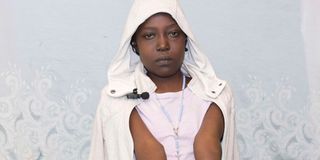
Elizabeth Kerubo, 19, a kidney patient during the interview at her aunt's residence on Eastleigh Estate in Elburgon, Nakuru County.

What you need to know:
- Elizabeth Kerubo was a high-performing student with dreams of becoming an engineer until kidney failure struck while she was in Form Three. Frequent dialysis, missed lessons and financial strain disrupted her education, forcing her to repeat a year and ultimately score below her expectations in KCSE.
- An orphan living under her aunt’s care, Elizabeth has spent three years battling with chronic kidney disease amid rising medical costs and limited health insurance support. Despite fatigue, missed schooling and emotional distress, she remains hopeful of a transplant and a chance to rebuild her future.
- Her experience highlights gaps in healthcare coverage and the urgent need for government support for chronically ill patients.
When Elizabeth Kerubo, 19, sat her Kenya Certificate of Primary Education examination in 2019 at Orthodox Primary School in Elburgon, Nakuru County, she was pleased to score 311 marks out of 500. The result earned her admission to her dream school: Elburgon DEB Secondary School. Her dream was to pursue a degree in engineering. At that time, her health was stable and she was physically strong.
On this day, Elizabeth, the firstborn in a family of two, sits beside her aunt, who is clad in black trousers, a white hood and a light-blue rosary around her neck, but Elizabeth appears visibly lost in thought. During the interview at her aunt’s residence on Eastleigh Estate in Elburgon, she says she had been progressing well academically, particularly during her first two years of secondary school.
“My problem started in July 2022 when I was in Form Three. I fell ill after my kidneys failed. In December that year, one of my teachers helped me with Sh2,000 for transport, and I was admitted to Moi Teaching and Referral Hospital in Eldoret for dialysis. A biopsy was conducted and tissue samples were taken to India for examination,” Elizabeth recalls.
As a result, she missed lessons and was unable to sit her term-end exam. She was hospitalised for one month. The biopsy results confirmed that both her kidneys had failed and she required a transplant. Before receiving the full report, Elizabeth was discharged. Overwhelmed by the diagnosis, it took her more than a month to come to terms with the condition, which affected her both physically and psychologically.
“I was the class representative, and my classmates visited me frequently to encourage me and assure me that everything would be fine. I remember one of them telling me they had worked hard and succeeded in one of the projects even in my absence, which made me happy,” Elizabeth says.
She adds that her academic performance began to decline in Form Three as she was frequently absent from school, especially for regular dialysis sessions. Teachers and support staff continued to encourage her, reassuring her that she had a bright future. Elizabeth returned to school and decided to repeat Form Three to recover the lessons she had missed the previous year.
However, her performance did not improve significantly even after repeating the class. She admits that at times she felt her ambitions were slipping away following frequent absenteeism, but encouragement from fellow students, teachers and family members helped her remain hopeful. She often missed early-morning remedial lessons as walking to school became difficult. As a result, she had to be ferried by motorcycle to and from school each day.
“The disease continued to affect my studies, especially my night studies at home. Eating also became a challenge because I required special meals, which were difficult for my aunt to afford. I used to attain a mean grade of B plain and above in Form One and Two before my grades began to drop,” Elizabeth says.
She adds that she scored a C minus in her KCSE examination but was satisfied with the result given the circumstances. She thanked God for the outcome, although she had hoped to score a B plus to realise her dream of becoming an engineer. Elizabeth is now in her third year of kidney treatment. She says living with a non-communicable disease is difficult, citing the high cost of medication, special diets, fatigue, high blood pressure, blood shortages and persistent financial strain.
An orphan, Elizabeth remains optimistic about her recovery and hopes to find a donor for a kidney transplant. She also dreams of securing employment in the future to support her family, particularly her aunt and uncle, who have shouldered the burden of her education and medical care since her mother died when she was in Grade Four. She praises them for the love and care they have shown her and her younger sister. They treat them as their own children and even wake her early twice a week to take her for dialysis at a private hospital in Nakuru.
“My aunt books a public vehicle to take me to hospital, but due to inadequate fare for both of us, I sometimes travel alone. I am grateful to well-wishers and drivers who voluntarily help me get to and from hospital,” Elizabeth says, pointing to the catheter attached to her chest.
According to her aunt, Ruth Moraa, Elizabeth was a disciplined and respectful girl who was loved by everyone in the family. “She performed well throughout her primary education until the illness began. Her legs started swelling, and her blood pressure rose. At some point, we even suspected she was pregnant, but tests came back negative,” Ruth says.
After further medical examinations, Elizabeth was referred to Nakuru Level Five Hospital. From then on, her schooling became irregular. Fighting back tears, Ruth recounts that on several occasions her niece was hospitalised for up to a month and prescribed a single medicine costing more than Sh1,600, which they could not afford. As a casual labourer, Ruth says it has been extremely difficult to raise money for medication, special foods such as green apples, transport and other necessities.
“The government should consider such patients and provide free medicine, as well as monthly stipends, just as it does for the elderly,” Ruth says. “I rarely get enough sleep. The kidneys react badly when a patient eats food not authorised by the doctor. I spend more than Sh4,000 every week on injections, medication and transport.”
She adds that the Social Health Authority (SHA) only covers the dialysis machine, and accessing these funds remains a major challenge. A casual worker may earn as little as Sh300 a day, with no guarantee of daily work. Ruth says she paid Sh3,441 to register Elizabeth under SHA. “The National Health Insurance Fund used to cover dialysis tests, but SHA does not. I now rely on well-wishers in my village who contribute through WhatsApp groups to support my niece,” she says, wiping tears from her eyes.
Elizabeth remains hopeful about regaining her strength. She says she will never lose hope and urges the government to support patients with chronic illnesses, particularly by covering the cost of pressure injections and dialysis tests, as many families cannot afford such services. “When patients go for a long period without injections, they become weak, urination becomes difficult, the knees become painful and headaches persist because of high blood pressure,” Elizabeth explains.
She adds that public education on kidney transplants is necessary to reduce stigma and prevent unnecessary deaths. Elizabeth says she has never received counselling. The condition has caused deformities in her hands and legs, and her bones have weakened significantly.
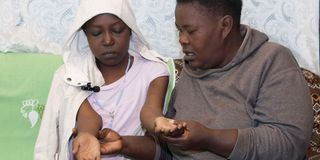
Elizabeth Kerubo, 19, a kidney patient, with her aunt, Ruth Moraa, during the interview on Eastleigh Estate in Elburgon, Nakuru County.
According to a doctor who runs a private hospital in Molo and requested anonymity, patients with chronic illnesses are severely affected and increasingly required to pay cash for medical services. “The government has reduced capitation disbursements to hospitals, making it difficult to offer such services. Many patients suffering from high blood pressure, cancer and kidney disease, among others, are most affected, as SHA does not adequately cater for such conditions, especially for outpatients,” the doctor says.
Efforts to reach a nephrology specialist based in Nakuru for comment were unsuccessful, as calls and text messages went unanswered.