'It's just tents': Exclusive interview with Trump official sheds more light on Ebola facility
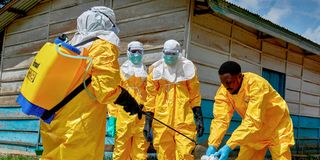
Red Cross workers disinfect after handling the body of a person who died of Ebol in Bunia, Ituri province in the Democratic Republic of Congo, May 21, 2026.

What you need to know:
- The US official said the protocol on who is going to use it, and when they’re coming in are discussions that are still ongoing.
- The bureaucrat spoke just hours after President Ruto admitted that the setting up of the facility had his express permission.
By the time the High Court was issuing an order barring the establishment of an Ebola quarantine facility at the Laikipia Air Base, flights carrying equipment and healthcare workers from the United States were already airborne.
According to a President Donald Trump administration official in Nairobi who spoke on condition of anonymity due to the sensitivity of the matter, foundation work was also underway at the air base.
“The United States is a democratic, rule-abiding country. It will respect the court’s ruling,” said the official.
“No American infected with Ebola has been brought into Kenya. Not yet. And no one can be brought in when the facility is not ready. The only confirmed exposure was an American doctor who was evacuated directly to Germany for treatment and has since recovered,” the official added.
The official also clarified the nature of the facility, offering details that have been absent from Kenyan government statements.
“There’s no permanent physical construction. It’s just tents on a plot of land that was being cleared. Gravel was put on it,” the official said. “The idea would be that it would be a place where people who are exposed would be able to quarantine.”
When pressed on who would actually use the facility, the US official said the protocol on who’s going to use it, and when they’re coming in are discussions that are still ongoing.
“We have not identified anybody yet, but certainly, if there is, then we would eventually use the facility if it is ready,” the official said.
This statement contradicts the urgency with which both governments have described the facility.
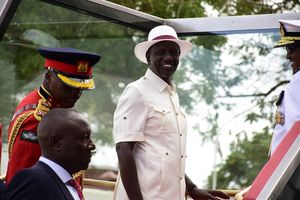
The bureaucrat spoke just hours after President William Ruto admitted that the setting up of the facility had his express permission and that he had talked with President Donald Trump over it.
“Our partnership with our friends, the American government, is a partnership that is mutually beneficial to us and to them,” he said on Monday night.
The Trump administration official also that there is no large American population in DRC, raising questions on the need for the facility.
On why Kenya was chosen for the facility, the officer was not sure, but thought it was partly because of the physical infrastructure, the development relationships and the environment.
“From what I understand, capacity to land an aeroplane, get it out. It’s pretty limited in some of the areas that we’re talking about. The environment, like the idea that you would bring somebody in and move them, I think that would just not work in the DRC environment and Uganda. As I said, I don’t know why Kenya was specifically chosen, but we do have a very significant military relationship with Kenya.”
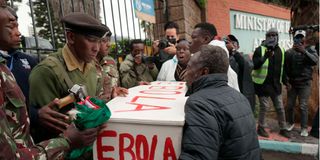
Police officers block demonstrators outside Afya House in Nairobi on June 2,2026 as they protested against the US-backed Ebola quarantine facility at Laikipia Air Base in Nanyuki County.
Asked whether Kenya was cornered, the officer said: “It's in our interest to make sure that Kenyans don’t get Ebola and no one is bullying the other here. ”
The official also confirmed that there are talks on the technology, equipment and supplies being left behind for the benefit of the country. Further, the official disclosed that discussions about the Laikipia facility began only two weeks before the arrangement became public.
At the same time, the officer made it clear that the Ebola facility is not connected to the Kenya-US Health Cooperation Framework that President Ruto signed in Washington six months ago.
“This is purely a response to a health emergency. They’re not related, and there’s no connection to the framework,” said the official.
The scope and size of the emergency, the official said, is driving the urgency.
“This is all about prevention, as part of this larger response, where you’re looking at the capacity that’s available here. Because of the large size of the international community here, you have got the UN, you’ve got all the international organisations, you’ve got people who may be coming to work in DRC and Uganda on Ebola and come back here,” the official said.
What this means is that Kenya is being positioned as a hub for international health workers. Having isolation capacity here, the argument goes, serves not just Americans but the entire international response infrastructure.
“So having multiple capabilities, I think, is really going to be important for Kenya going forward,” the official said. “It’s smart to be prepared and smart to have things in place. So if we do need to respond, we’re ready. Hopefully, we never have to use the facility for anybody.”
When asked what it would take to stop the deal, the official said it is up to the Kenyan government to make the decision.
Follow our WhatsApp channel for breaking news updates and more stories like this.