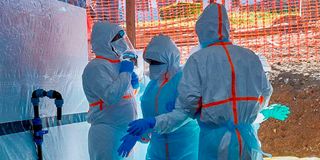
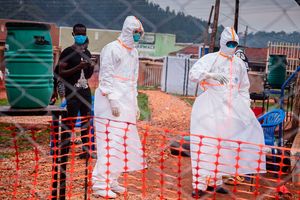
The Kenyan government is proceeding with plans to establish an Ebola quarantine and treatment facility in partnership with the government of the United States, ignoring a court order in a classic case of Executive impunity.
The decision to bulldoze the controversial project also goes against a widespread public backlash, including from Kenyan medical professionals, who have questioned the capacity of the country’s health system in dealing with the deadly virus.
With vague communication from the government regarding the facility, CNN – an American multinational news channel – has reported that Americans set to run the facility already landed at the Laikipia Air Base on Saturday.
The news channel quoted a US government source, who confirmed the development. It has become common for the Kenyan government to ignore court rulings, especially the ones touching on its pet projects.
The development comes barely a day after Katiba Institute wrote to the United States Department of State to notify the country of Kenya’s High Court decision suspending establishment of the Ebola facility.
“We write to formally notify the US State Department and US Health Department of binding interim consecratory orders issued by the High Court of Kenya on May 28, 2026. These orders immediately halt the proposed establishment of any US-backed Ebola, quarantine, isolation or treatment facility within Kenyan borders,” said Katiba Institute.
In the letter signed by its Executive Director Nora Mbagathi, the institute said the orders forbid the admission, transfer, or recipient into Kenya any persons exposed to or infected with the virus.
The facility is intended to isolate and treat Americans potentially exposed to or infected with the virus in the Democratic Republic of Congo (DRC).
Succumbing to deadly virus
More than 1,000 cases of Ebola have been reported in DRC, with at least 246 people succumbing to the deadly virus. Uganda, which borders Kenya has since reported nine cases and a death.
In planning to establish the facility, the US government intends to have its citizens treated closer to the outbreak zone rather than being flown back home, that comes with the risk of possible spread that could expose more of its citizens to the virus.
However, it is the same risk of further exposure that has triggered resistance to having the facility in Kenya. Kenya has not recorded a single case, but is now staring at a possible exposure through borders with Uganda, and the proposed facility.
Democracy for Citizens Party (DCP) party leader Rigathi Gachagua on Sunday asked the US to respect the rule of law by halting establishment of the facility.
Mr Gachagua claimed that he was aware that despite the court order equipment were being brought to Nanyuki. He claimed that some members of the military had reached out to him and asked him to protest on their behalf.
DCP leader Rigathi Gachagua addresses journalists at the party's headquarters in Nairobi on May 25, 2026.
Photo credit: Billy Ogada | Nation Media Group
Mr Gachagua further claimed that the military personnel have raised fears of possible exposure to their families who live in the barrack.
“Solders are very unhappy but they have no voice. The people of Laikipia have asked us to hold a meeting in Nanyuki to give them an opportunity to express themselves so that the American government can know what the people of Laikipia feels,” said Mr Gachagua.
He said Kenyans were not consulted in putting up the facility in the areas, warning of plans to stage a major public gathering for the locals to air their grievances.
“If America, that is known to have the best health system in the world are not sure that they can handles that outbreak, what about Kenya that we are unable to handle malaria? Where we have no equipment to deal with kidney failure? Where SHA is not working?” he posed, while describing the decision as reckless with potential of endangering the lives of Kenyans.
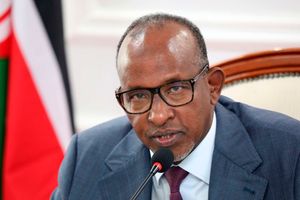
The government through Health Cabinet Secretary Aden Duale on Saturday confirmed that Kenya was partnering with the US government to establish a quarantine facility at the military installation to ‘strengthen monitoring, isolation, and emergency response capacity.’
Mr Duale, in the statement, also revealed that the government has established other dedicated isolation and treatment facilities. The facilities include specialised units at Kenyatta National Hospital, the Kenya National Police Hospital, and Moi Teaching and Referral Hospital (MTRH).
Cabinet Secretary for Health, Aden Duale addresses the media at Afya House in Nairobi on May 22, 2026.
Photo credit: Wilfred Nyangaresi | Nation Media Group
The ministry said additional sites have been identified in more than 10-high risk border counties to ensure a rapid and coordinated response should a case be detected.
A total of 18 samples from Ebola Virus Disease (EVD) alerts have been tested as of Saturday across various regions including Nairobi, Kiambu, Uasin Gishu, Nyeri, Nakuru, Nyamira, West Pokot, and Kisumu. They all tested negative.
Risk assessment has identified 25 high-risk counties, with 12 classified as very high risk and 13 as high risk.
The very high-risk counties include Nairobi, Mombasa, Uasin Gishu, Busia, Kisumu, Bungoma, Trans-Nzoia, Siaya, West Pokot, Turkana, Homabay, and Migori.
While the high-risk counties are Vihiga, Kakamega, Nakuru, Kericho, Nandi, Kiambu, Machakos, Makueni, Kilifi, Taita Taveta, Isiolo, Elgeyo Marakwet, and Garissa.
Kenya opened her doors to the setting up of research and isolation facilities for diseases classified as biological threats in July 24, 2015 when it signed biosecurity agreement with the US.
The agreement gave the US control over projects that would be spawned from it, including selection of contractors and tax exemptions for imported goods and for American workers.
The deal also blocked either country from suing the other in the event of death, injury or property damage arising from projects under the agreement.
The 2015 agreement was signed by former Health Cabinet Secretary James Macharia and former US ambassador to Kenya Robert Godec, before being ratified by the National Assembly on November 22, 2016.
On April 5, 2022 then Health CS Mutahi Kagwe and US Charge D’affiares Eric Kneedler signed a seven-year extension of the agreement, which elapses on April 5, 2029.
Some Kenya Kwanza politicians on Sunday asked retired President Uhuru Kenyatta to come clear on details signed by Kenya and US over disease threats, including Ebola incubation in Kenya.
Led by Kakamega Deputy Governor Ayub Savula, the leaders said the deal signed in 2015 had exposed Kenya to the risk of Ebola. He said it is Mr Kenyatta’s administration that committed Kenya to be a United States Center for Biological Threats Research and Isolation points.
“We are at risk and we should prepare to control the disease instead of blaming Ruto” said Mr Savula.