'Nairobi birdman': The man who shares his home with birds, and the risks experts say come with it
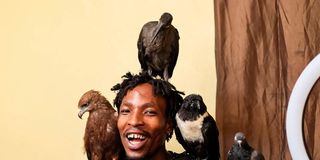
Rogers Magutha, popularly known as "Birdman," poses with several rescued birds perched around him during an interview at his home in Kayole, Nairobi, on June 30, 2026.

What you need to know:
- Magutha's bond with birds began more than a decade ago in his home city of Nakuru, famous among birdwatchers for the flamingos that gather at Lake Nakuru National Park.
Inside Rogers Magutha's house in Nairobi’s Kayole, a black kite perches on the armrest of a chair, watching the room with sharp, unbothered eyes. A pigeon sits at the edge, another perches on top of his ring light, while an African pied crow rests on his television stand beside a raptor glove. Nobody shoos them away. This is simply how Magutha shares his house with the birds that have become his favourite company.
Magutha's bond with birds began more than a decade ago in his home city of Nakuru, famous among birdwatchers for the flamingos that gather at Lake Nakuru National Park. As a boy, he would sneak into the park during his free time. One day, walking far from the shoreline, he spotted a flamingo that had wandered away from the water and was stuck and thirsty. Without thinking it through, he picked up the bird and carried it back to the lake, setting it down safely at the edge.
"That's where my passion for birds started. I kept returning to the park whenever I could, and at home, I began keeping pigeons and rearing chickens. While other boys hunted birds with slingshots, I tried to talk them out of it," he says.
Everything changed when he turned 13. His mother, who had raised him and his brother alone, died suddenly. Left without a stable home, they were taken in briefly by a relative, but he felt uneasy and like a burden.
"There were two of us, my brother and I. We parted ways, and I went to the streets to fend for myself. I survived by asking for help or collecting scrap metal and plastic to sell. I eventually ended up in Nairobi," he recalls.
It was while living on the streets that Magutha rescued an African kite that changed the course of his life. He remembers receiving chips and chicken one evening from a good Samaritan and eating near a roadside spot when he noticed the bird lying on the kerb, frail and alone. He offered it pieces of the meat. The bird ate, then climbed onto his hand and stayed there.
"After that, the bond grew stronger. I later named the kite Johnson. His arrival in my life mattered. Like many street dwellers, I was lonely and depressed, but I realised I had found a companion. Caring for the kite gave me something to focus on, a reason to stay busy and away from the things that often consume street life. Once it recovered, I tried several times to release it back into the wild, but it kept finding its way back to me," he says.
Now, he has five birds, all of which he has named, including one after his mother. He says he has rescued and released more than 20 birds, including marabou storks, cattle egrets, African sacred ibises, crows and a barn owl.
"I started rescuing birds while living on the streets, without recognition. I wasn't looking for fame. I do it because I love it. It is my passion. It's my gift. The fame has not erased the instability of my daily life. I still spend my mornings collecting recyclable plastic to sell at the dumpsite, earning barely enough to feed myself and the birds," he says.
It is videos of him sharing a plate of food with the birds that have brought public scrutiny, with some demanding that he release them. However, he notes that without a dedicated raptor rehabilitation centre to hand the birds over to, calls to release them solve nothing.
His ultimate goal is to establish a permanent rescue centre in Nairobi where recovering birds can be properly housed and where street children can find structure, purpose and belonging through caring for them.
The public scrutiny has also attracted the attention of public health specialists, who warn that close, prolonged contact with wild birds carries real risks.
Dr Samoel Khamadi, director of the Centre for Virus Research at Kenya Medical Research Institute (Kemri), says his team's work spans both routine viral surveillance and frontline outbreak response.
"We go out there and collect samples from the field to check whether any new viruses are circulating. When an outbreak does occur, my team supports the Ministry of Health directly in responding to it," says Khamadi.
He says Magutha's situation concerns health experts because it goes beyond ordinary pet-keeping.
"This person is not just dealing with domesticated birds but is also handling birds that are normally found in the wild. That is not right because there are regulations governing the handling of animals that come from the wild," says Dr Khamadi.
Many outbreak-prone illnesses, he explains, are zoonotic and can spread from animals to humans. This means that someone living in close contact with wild birds risks not only infecting themselves but also passing the disease on to everyone he interacts with afterwards.
Kemri's research has documented several bacterial illnesses that birds can transmit to people, including salmonella and cryptococcal meningitis, the health expert says. His greater concern, however, is viral disease.
"More importantly, especially in this era of outbreaks, we have diseases like avian flu that can actually be transmitted from birds to human beings. When such viruses jump from their natural host into humans, they have the potential to cause severe disease or outbreaks. Wild birds frequently carry these viruses without falling ill themselves because many have developed a degree of natural immunity that humans simply do not have. When they come into contact with hosts that have not developed immunity, they have the potential to cause disease," says Khamadi.
The Kemri official notes that although Kenya has not recorded a human outbreak traced to birds, the potential exists. He links the broader risk to climate change and the shrinking distance between people and wildlife, pointing to rising mpox cases in countries such as the Democratic Republic of the Congo and outbreaks of avian influenza in Australia.
"We have seen an upsurge in these zoonotic diseases because of climate change and because people are increasingly inhabiting areas that were previously occupied by animals," says Khamadi.
The early symptoms of zoonotic infection, he warns, are easy to dismiss.
"If somebody is exposed to birds carrying the avian influenza virus, that person may start exhibiting symptoms similar to normal flu, such as muscle aches, fever, diarrhoea or a throat infection. Because the presentation mimics an everyday cold, it may be very difficult to tell that the person is suffering from a viral infection of a zoonotic nature."
The lead researcher, however, stresses that exposure does not automatically mean infection. A bird can appear perfectly healthy, and a person can come into contact with wildlife without ever falling ill. But the longer the exposure continues, the higher the risk becomes, even if a bird shows no outward signs of carrying a virus.
He draws a sharp distinction between birds like Magutha's and conventional pets such as parrots bought from licensed sellers with a known, disease-free history.
"In cases where you're collecting wild animals from the wild, you do not know their history. They may be carrying viruses that you cannot see at the moment, but these viruses can actually be transmitted to this person later on."
"We have regulations that have been put in place through the Kenya Wildlife Service that prevent people from handling wild animals and wild animal products such as eggs and feathers because of disease and poaching concerns. In my view, the birds should be returned to their natural habitat, and Magutha should not be allowed to keep wild birds in a domestic setting," he says.
Khamadi says the country's defences have strengthened considerably since Covid-19 and that Kenya now has rapid response teams in different counties, dedicated containment and treatment facilities, and early warning systems that include sampling sewage and waterways for emerging pathogens, as well as molecular laboratories capable of detecting viral mutations.