Raw milk, raw meat and rising risk: Marsabit’s war on zoonotic disease
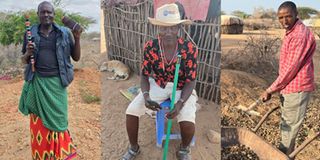
Lkiyeyan Lekoyan, whose goats and sheep have had several abortion; Daudi Dokhole, a CDR and CHP; and Abdulai Galgamar, Laisamis sub-county animal health assistant officer, during the interview on August 1, 2025.

What you need to know:
- Pastoralists in Marsabit County are shifting long-held cultural practices as brucellosis continues to devastate both livestock and families.
- Community disease reporters and health promoters now use mobile surveillance tools, while residents are being trained on safer food handling, animal birthing and carcass disposal.
- With one in seven people infected, experts warn that behaviour change remains central to defeating the neglected zoonotic disease.
Friday evening, Daudi Dokhole is sitting on a plastic chair outside his temporary home in Laisamis, Marsabit County. His dusty feet are evidence of the long distance he has covered today. Besides being a pastoralist, he also serves as a community disease reporter (CDR) and community health promoter (CHP), covering 79 and 81 households, respectively. His work?
“I collect information about animal and human health within the households. I report to veterinary officers who then visit the households to offer specific health services needed. For human beings, we refer to hospitals,” Mr Dokhole tells Healthy Nation.
Wearing both CDR and CHP hats came as a calling after he suffered a tremendous loss of part of his livestock from a health condition he had no idea about. “My camels have had abortions several times at different times. The occurrence continued until one day my four camels had abortions the same day. At that time, I used to have many camels that would be pregnant at once, but with their continued death, now, I only have 15,” he says.
Mr Dokhole, like many pastoralists in Marsabit County, depends on animal products for food. He says that without being aware of the health risks that come from consuming raw animal products like milk and meat, for a long time, his family consumed them raw, a traditional behaviour that they inherited from their ancestors.
“When pregnant, a camel gives birth after 12 months. After that, I can milk it for another 12 months, getting at least six litres of milk per day. We also used to drink a lot of raw camel milk, and that was dangerous to our health because we would get infected with diseases,” he shares with Healthy Nation.
He learned of humans getting infected by zoonotic diseases when his wife became so ill that traditional medicines could not heal her. He later took her to Laisamis Sub-County Hospital, where she was diagnosed with brucellosis.
“My wife has suffered from brucellosis. During those days, she used to feel pain in her joints; she could not walk. She also used to suffer from headaches. As a caregiver, taking care of my sick wife was not easy. I sold a goat to cater for her treatment; she was treated as an outpatient for two weeks until she got cured,” recalls Mr Dokhole.
Scientists define brucellosis as a life-threatening but neglected bacterial zoonotic disease caused by multiple species of bacteria in the genus Brucella. It occurs in humans and species of domestic and wild animals and affects people of all age groups, with about 2.4 billion people at risk.
Human brucellosis in Kenya is ranked the fourth zoonotic disease, with a higher burden among pastoralists. The bacteria enter the human body through the mucous membrane or skin abrasions when in direct contact with infected aborted foetuses, uterine contents and discharges.
Lkiyeyan Lekoyan is another pastoralist and resident of Laisamis in Marsabit County who has also suffered losses due to brucellosis. “I used to have camels in the past but stopped keeping them because of brucellosis. Most of my sheep and goats have had multiple abortions. Their skin used to shrink as if the animals had been rained on; some had tears flowing in their eyes, some had mucus running through their noses. Walking was also not easy; they would sleep under the tree most of the time when the other livestock were running,” Mr Lekoyan recalls.
Mr Lekoyan, who is also a CDR in Laisamis, tells Healthy Nation that abortion in animals is common in the region and for a long time, pastoralists like him took it as a normal occurrence. It was until a section of residents underwent training in enhancing health surveillance and bio risk management in pastoral communities, that they learned about brucellosis.
“I used to drink raw blood for many years but stopped, and I am now campaigning in my community so that we stop this culture. I teach people that they must boil milk and blood if they want to take it,” he says. “People say that when you boil blood, it looks like ugali but I tell them that the most important thing is to kill bacteria, but the energy they need from blood is still there.”
His sentiments are echoed by Mr Dokhole. “We no longer eat raw meat; we cook it properly unlike in the past. Even with livestock nowadays we do not touch when they are giving birth; we call veterinarians to do it for us instead. In the past, we used to be the ones helping them to give birth without any protective gear. That was dangerous to our health,” Mr Dokhole tells of his family’s changed lifestyle.
Mr Dokhole and Mr Lekoyan use Kenya Animal Biosecurity Surveillance (Kabs), a mobile application, to report data on animal health status. Through this technology, zoonotic disease surveillance has become easier as they work as a team to cover the entire county. They submit data daily to researchers by using smartphones that have the Kabs tool.
“Private and government vets all coordinate and attend the seminars, building the capacity for ourselves and giving back to the community,” explains Mr Abdulai Galgamagar, the animal health assistant from Laisamis.
Mr Galgamagar, who is also a veterinary officer, participates in daily activities by attending extension work with the CDRs and CHPs during which he advises them on prevention and control of zoonotic diseases. “Most of the disease surveillance in the sub-county is being conducted under the same umbrella. That way, even when I’m not around, I get a call either from the CDR, area chief or the community members then I attend to the case and we post it on the Kabs platform.
To remain safe while preventing zoonotic diseases, even as they create awareness, CDRs, CHPs and veterinary officers have been undergoing intensive practical training, according to Edith Koskei, a research scientist at Kemri’s Centre for Virus Research.
Risk assessment tools
“The training covers risk assessment tools for zoonotic pathogens, infection prevention and control. How to dispose of animal carcasses and decontaminate any materials used to handle these carcasses, safe sample collection procedures, the personal protective equipment (PPE) to use for different scenarios and effective donning and doffing of these PPE to prevent cross-contamination,” she says. “We also train them in how to prepare de-contaminants in terms of type and concentrations to ensure effective decontamination.”
According to the 2025 community human brucella seroprevalence survey report, released in July, by Washington State University Global Health Kenya, about one in every seven people in Marsabit is infected by brucellosis. The report shows that 17 per cent of those infected are male, while 14 per cent are female. The report shows that it has affected residents within different age groups: 3.0 per cent of children aged 0–5; 13 per cent of those aged 5–14; 19 per cent of those aged 15–49; and 22 per cent of those aged 50 and above.
“In a pastoralist community, most of the infectious diseases that human being suffer from are actually jumping from animals to human beings and sometimes it has a critical component of behaviour and practices that have been practiced over many years which expose us to disease risks,” says Dr Dismas Oketch, a research scientist with Washington State University Global Health Kenya.
The report, which had 759 residents and 3,451 livestock from the region, adds that 51 per cent of animals in Marsabit are infected by brucellosis, with only 42 per cent of animals not infected. At least 9.0 per cent of camels and 9.0 per cent of goats are infected, while sheep being the least animals infected at 3.0 per cent. “The way we dispose of wastes whether it is human or animal carcasses and the way we consume our products including milk in many cases is not pasteurised and that is how we have been used to. We are beginning to learn that things like milk carry a lot of disease risks,” Dr Oketch adds.
“If their livestock dies and they do not know the cause of death, they bury the dead remains of the animal. Previously they would sell the meat of the dead animal even when they do not know the cause of death which exposes them to a lot of high risks,” says a health researcher, Monya Konneh, from the West African One Health Actions for understanding, preventing and mitigating outbreaks in Sierra Leone, Liberia, Guinea and Nigeria.
He was speaking during the Conference on Public Health in Africa held in South Africa in October where the Deputy Incident Manager for Africa CDC co-led Incident Management Support Team, Prof Yap Boum, noted that brucellosis remains difficult to detect. This he said is because of lack of capacity and unpreparedness to make proper diagnosis combined with the cultural practices of consuming raw animal products that transmission from the animal to the human takes place.
“The fact that the symptoms of brucellosis are not that different in many ways from malaria and others makes it hard to detect. But the challenge is that because the treatment is not appropriate, it can lead to some mobility and even mortality in some of those spaces,” says Prof Boum.