Plans to control, utilise invasive mathenge weed in top gear
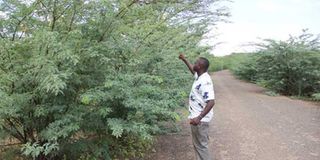
Prosopis Juliflora, popularly known as Mathenge. Kefri has launched a massive five-year project to manage the Mathenge weed in Turkana and West Pokot counties by putting it to good use. FILE PHOTO | NATION MEDIA GROUP

What you need to know:
- Herders are forced to migrate over long distances in search of pasture for their livestock as no vegetation regenerates in invaded areas.
Turkana County government is developing a plan to control, manage and sustainably utilise mathenge weed (Prosopis juliflora), which has invaded farms, grazing fields and river banks in the region.
The weed has also invaded water courses along Turkwel and Kerio rivers on the Western shores of Lake Turkana, Lokichoggio, Letea, Kakuma, Lokangai, Katilu, and Katilia, changing their ecology.
The plant was introduced in Turkana in 1979 by the national government in collaboration with the Norwegian Agency for Development Cooperation to tackle desertification in the region, where over 80 per cent of land mass is classified as semi-arid, and to also provide wood fuel.
However, conservationists and county officials now say the plant has caused food insecurity, water scarcity and loss of livelihoods. It has also been linked to the shrinking forest cover in the drought-prone county.
"Turkana has a fragile ecosystem, where the invasive shrub has colonised riverine regions and dominated rangelands. Herders are forced to migrate over long distances in search of pasture for their livestock as no vegetation regenerates in invaded areas," County Environment and Natural Resources Management Executive Leah Audan said.
The official noted that the devolved unit is developing a plan
in collaboration with the International Labour Organization, the Kenya Forestry Research Institute (KefriI), and the Kenya Forestry Service to fully reclaim the invaded agricultural land at an estimated cost of Sh30 million.
Head of Socio-Economics, Policy and Governance at Kefri, Dr Joram Kagombe, urged the county to utilise the institute’s existing draft plan, which includes value addition of Prosopis juliflora products for economic empowerment.
Dr Kagombe, who also serves as the focal person for Prosopis management, noted that Turkana is the most affected county by this invasive species, with Baringo, Garissa, and Tana Rivers also facing similar challenges.
Director of Natural Resource Management Clement Nadio highlighted that the Kerio and Turkwel riverine areas, critical wetlands and Turkana West rangelands are the worst hit.
He added that value-addition approaches anticipated by the plan are included in the current third-generation County Integrated Development Plan.
Chief Officer for Sports and Vocational Training Leah Losiru reiterated the readiness of vocational institutions to facilitate training on value addition to aid in Prosopis management.
She said Turkana’s vocational centers could prepare youths for green jobs by offering tailored programmes on charcoal briquette making and fodder generation from Prosopis seed pods.
Chief Officer for Agriculture Jane Rose Tioko welcomed the plan, saying it has potential to reclaim arable land lost to invasive species.
He added that the invasive weed hosts pests like aphids, which affect crop production, and tsetse flies, which affect livestock keeping.
County Environment, Natural Resources and Climate Change Chief Officer Joseph Ekalale pointed out that despite Mathenge being introduced to combat desertification due to its resilience, fast growth rate and its many uses for fodder, honey production, shade, windbreak, firewood, building poles, among other uses, it has become a biological threat to the ecosystem.
“The weed has been left unmanaged and has direct and indirect negative impacts to man and the environment, including colonisation and devastation of critical grazing land, farmlands and rangelands, blockage of roads, footpaths, human settlement, irrigation canals, river banks and water points, death of livestock through over-eating of pods (causing indigestion) and occasional tooth decay (due to high sugar content of pods) among others,” said Mr Ekalale.