Sh1.2bn debt of pain as human-wildlife conflict persists
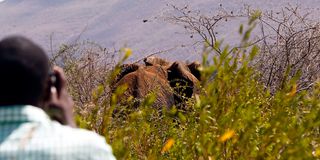
A farmer yells at an elephant that had invaded a farm at Kamukunji in Solai, Nakuru.

What you need to know:
- In the last two years alone, the Kenya Wildlife Service has recorded a staggering 26,641 cases of human-wildlife conflict across the country.
- The consequences have been severe: 255 lives lost, 725 people seriously injured, and over 5,200 livestock killed
Kenya's world-famous wildlife, a pillar of its global reputation and a bedrock of its tourism economy, is now at the heart of a deepening human tragedy that threatens the very foundation of conservation in East Africa.
In the last two years alone, the Kenya Wildlife Service (KWS) has recorded a staggering 26,641 cases of human-wildlife conflict across the country. The consequences have been severe: 255 lives lost, 725 people seriously injured, and over 5,200 livestock killed
These figures represent more than statistical data points; they signify a conservation crisis at a critical juncture.
KWS Director-General, Dr Erustus Kanga, revealed that these tragedies have led to broken families, devastated harvests, and children forced out of school, generating a compensation debt of Sh1.2 billion that the government still owes to victims. However, recent government data suggest the compensation crisis may be even more severe, with reports indicating Kenya faces a funding gap of up to Sh1.36 billion for human-wildlife conflict compensation.
The psychological and social impacts spread through rural communities where subsistence farming remains the primary livelihood strategy.
“That money can be put to better use if we enhance coexistence," Dr Kanga told delegates at the Second International Wildlife Scientific Conference in Naivasha, held under the theme "Innovation in Wildlife Science and Practice for Sustainable Biodiversity Conservation and Socio-Economic Development."
According to Dr Kanga, the situation has reached a critical point. "On average, 36 incidents occurred every single day of the past two years.”
Research indicates that elephants are responsible for 46.2 per cent of all conflicts, primarily due to crop raiding activities. The situation has become particularly dire in recent years, with crop raiding incidents more than doubling from 156 cases in 2020 to 363 cases by 2023, according to conservation organisation Big Life Foundation.
The cost is not borne by humans alone. During the same period, Kenya lost 911 wild animals to conflict, a number that chips away at already fragile wildlife populations. This represents a significant conservation concern as many of these species face multiple threats, including habitat loss, climate change, and poaching pressures.
The escalation of human-wildlife conflict is driven by a confluence of powerful forces. Kenya's human population has surged from eight million at independence in 1963 to over 55 million today. This expansion has led to farms, settlements, and infrastructure relentlessly encroaching on traditional wildlife rangelands and corridors. This population explosion has created unprecedented pressure on natural habitats. Wildlife corridors that once allowed free movement of animals between protected areas have been fragmented by agricultural expansion and infrastructure development. The result is increased contact between humans and wildlife, often with tragic consequences.
Climate change has further intensified the crisis. As droughts become more frequent and severe—with extreme events escalating since 2015—wildlife is forced to venture into human settlements in search of water and food, inevitably leading to dangerous encounters.
"Unless we address this crisis in the social contract between communities and conservation, the very foundation of Kenya's global reputation is at risk," warned Dr Kanga. "The big question is: can people and wildlife share landscapes not as rivals, but as friendly neighbours?"
Beyond its cultural and ecological value, Kenya's wildlife is a significant economic contributor that sustains numerous livelihoods. "This biodiversity is the backbone of our economy and culture. Yet here lies the paradox: the very wildlife heritage that sustains us is also in the middle of a growing conservation crisis," Dr Kanga said.
Pathways to co-existence
Despite the challenges, Dr Kanga and conservation experts emphasise that coexistence is achievable through deliberate, collaborative strategies. He called for securing and restoring wildlife migration corridors and ecological spaces that have been blocked by human settlement and infrastructure.
Technology is proving transformative in addressing these challenges. Dr Kanga cited GPS collars on elephants and lions, early warning systems, solar-powered fences (which have reduced conflict cases by over 90 per cent in some regions), and the use of drones for intelligence monitoring as examples of successful interventions.
He also called for empowering communities, which he described as "both victims and custodians of wildlife," to become protectors rather than adversaries. At the same time, he said scaling up conservancy models already working on 6.5 million hectares, supporting more than two million people across the country, was critical.
However, Dr Kanga cautioned that data and gadgets alone will not solve the problem. "No single actor can carry this burden alone. Government, private sector, international allies, researchers, and scientists must work together. Coexistence is not easy, but it is necessary."
However, Dr Kanga cautioned that data and gadgets alone won't solve the problem: "No single actor can carry this burden alone. Government, the private sector, international allies, researchers, and scientists must work together. Coexistence is not easy, but it is necessary."
Head of Public Service Felix Koskei, who attended the Naivasha conference, pledged stronger government support. He announced increased funding for wildlife research to help institutions like KWS deliver innovations that directly benefit Kenyans.
He also revealed plans to establish a wildlife regulator to boost competitiveness and accountability in the sector.
Recent government data show an increase in investment in compensation schemes, with allocations rising from Sh908 million in 2023 to Sh960 million in 2024, and a further allocation of Sh1.95 billion for 2025. Additionally, the ministry has resumed nationwide human-wildlife conflict claim verification drives and is piloting digital compensation mechanisms to address historical delays.