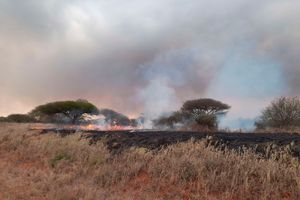
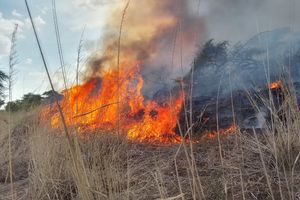
Raging fires transform Suba North's green hills into barren wasteland
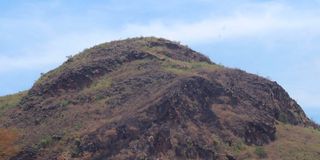
Part of Ruri Hills in Suba North, Homa Bay County on March 16, 2025.

What you need to know:
- The fires have destroyed an estimated 15,000 indigenous trees, disrupted wildlife corridors, and left entire hillsides vulnerable to the mudslides that killed four people in neighbouring areas last April.
The hills of Suba North, once cloaked in the lush green vegetation that gives distant mountains their characteristic blue hue, now bear ugly brown scars where uncontrolled fires have stripped away decades of forest growth. What began as routine land preparation by local farmers has escalated into an environmental crisis that threatens water security, wildlife habitats, and human safety across Homa Bay County's crucial watershed areas.
From January through March 2025, Lambwe region recorded its highest number of wildfire incidents in three years, with flames consuming over 2,000 acres of indigenous forest in the Ruri Hills water catchment area and extending into protected sections of Ruma National Park. The fires have destroyed an estimated 15,000 indigenous trees, disrupted wildlife corridors, and left entire hillsides vulnerable to the mudslides that killed four people in neighbouring areas last April.
The crisis stems from a perfect storm of traditional farming practices, climate change impacts, and inadequate enforcement of environmental regulations. During the dry season preceding March planting, farmers across Suba North routinely use fire to clear crop residue and prepare their fields. However, the practice has expanded beyond individual farms to consume vast stretches of government forest land that serves as the region's primary water catchment.
Maxwell Ochoo, a Lambwe resident and environmental advocate, explains that the fires typically begin with good intentions but quickly spiral out of control. "Some people just set the fire with the intention of cleaning their land alone, but it ends up consuming large parcels of land mostly beyond their boundaries," he says. The problem is compounded by increasingly dry conditions that make vegetation more combustible, allowing fires to spread rapidly across property lines and into protected areas.
The environmental consequences extend far beyond the immediate visual damage. The Ruri Hills serve as a critical water catchment for communities throughout Suba North, collecting and filtering rainwater that feeds local rivers and groundwater systems. When fires strip away the forest canopy and understory vegetation, the land loses its capacity to absorb and retain water, leading to increased surface runoff and reduced groundwater recharge. This process, known as watershed degradation, can reduce water availability for entire communities within just a few years.
Dr Sarah Kimani, a watershed management specialist at the University of Nairobi, explains that healthy forest ecosystems can absorb up to 200 millimeters of rainfall per hour, while degraded landscapes absorb less than 50 millimeters. "When you remove the vegetation cover, you're essentially turning the hillsides into concrete surfaces that shed water instead of absorbing it," she notes. This transformation not only reduces water security but also increases flood risk during heavy rains.
The fires have also disrupted critical wildlife habitats that support biodiversity across the broader Lake Victoria ecosystem. Ruma National Park, which borders the affected areas, provides refuge for endangered species including the roan antelope and Jackson's hartebeest. Park officials report that smoke from the fires has driven wildlife deeper into the park's interior, disrupting feeding patterns and breeding cycles during a crucial period for young animals.
Uninhabitable
Lambwe Central Location Chief Roseline Oguttu reports that her office has documented wildlife displacement but acknowledges that animals may seek refuge in human settlements as their natural habitats become uninhabitable. "We have not had cases of animals moving to homes yet, but it does not mean they will not because their habitat has already been destroyed," she warns. Such human-wildlife conflicts could pose serious risks to both communities and conservation efforts.
The human safety implications are equally concerning. Last April's mudslide in neighbouring Suba, which killed four people, provides a stark reminder of what can happen when hillside vegetation is removed. Without root systems to bind soil particles together, the steep slopes become unstable during heavy rains. Ochoo, who has studied the area's geological risks, warns that several affected hills have large boulders that could tumble down during mudslides, potentially devastating the communities below.
Geotechnical assessments following last year's tragedy revealed that human activities, including vegetation removal, had destabilised the soil structure on multiple hillsides. The combination of loose soil, steep slopes, and intense seasonal rainfall creates conditions ripe for catastrophic landslides that could affect hundreds of families living in the valleys below.
Some of the destructive practices stem from deeply rooted cultural beliefs about weather patterns and agricultural success. Jarongo Okumu, an elder from Kanyamwa Komungu village, recalls how community leaders once deliberately set fires on hillsides, believing that rising smoke would form clouds and bring rain. "Whenever the hill burnt, it would rain within a few weeks before farmers start planting," he explains. While many communities have abandoned these practices after environmental education campaigns, some individuals continue to believe in the traditional connection between fire and rainfall.
The persistence of these beliefs highlights the need for culturally sensitive environmental education that acknowledges traditional knowledge while promoting scientifically sound practices. Extension officers report that the most successful conservation programs combine respect for cultural traditions with practical demonstrations of sustainable farming techniques.
Climate change factors have intensified the fire risk significantly. Kenya Meteorological Department data shows that the region experienced temperatures 2-3 degrees Celsius above average during the critical January-March period, with rainfall 40 per cent below normal levels. These conditions create a tinderbox effect where even small fires can quickly escape control and consume vast areas.
Environmental officials acknowledge that enforcement efforts have been inadequate to address the scale of the problem. Homa Bay Ecosystem Conservator Sharon Cheluget admits that the Kenya Forest Service declared a fire season in January and February but relied primarily on community engagement rather than active fire prevention measures. "Most of the hills that were affected had shrubs, and we will continue to engage community members about environmental conservation," she says, though critics argue that engagement alone is insufficient without enforcement teeth.
The National Environment Management Authority has the legal power to impose fines of up to Sh2 million for environmental violations, but prosecution rates remain low due to limited monitoring capacity and weak coordination between agencies. Local administrators report that they lack the resources to patrol vast forest areas effectively, relying instead on community reports that often come too late to prevent damage.
Successful fire prevention programmes in other parts of Kenya offer potential models for Suba North. In Meru County, community forest associations have reduced wildfire incidents by 80 per cent through a combination of early warning systems, community fire brigades, and alternative livelihood programmes that reduce dependence on fire-based land clearing. These programmes typically cost Sh50,000-100,000 per square kilometer annually but save millions in forest restoration costs.
Environmental advocates are calling for immediate action before the situation deteriorates further. Lone Otieno, secretary-general of the County Civil Society Organisations Network, argues that agencies like Nema and KFS must move beyond awareness campaigns to implement concrete prevention measures. "Communities where frequent fire incidents are reported are prone to food shortages because such methods of clearing land can lead to reduced food production," she explains.
The economic costs of inaction are staggering. Forest restoration in degraded areas typically costs Sh200,000-500,000 per hectare, meaning that restoring the 2,000 acres already damaged could require Sh200-500 million. By contrast, prevention programmes cost a fraction of restoration expenses while preserving ecosystem services worth millions annually.
Moving forward, experts recommend a comprehensive approach that combines immediate fire suppression capabilities with long-term prevention strategies. This includes establishing community fire brigades with proper equipment and training, creating firebreaks around critical forest areas, promoting alternative land preparation methods, and implementing strict penalties for violations.
The window for action is rapidly closing. With the next dry season just months away, Suba North communities face the prospect of even more devastating fires unless decisive measures are taken. The choice is clear: invest in prevention now or pay the far higher costs of environmental restoration and human suffering later.
The transformation of Suba North's hills from green to brown serves as a stark reminder that environmental destruction can happen quickly, but restoration takes decades. For the sake of current and future generations, the time for half-measures has passed.