Sh166 billion funding gap threatens to sink SHA
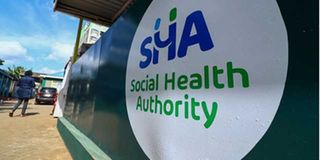
Social Health Authority (SHA) signage at Mutuini Hospital in Dagoretti South Sub-County, Nairobi, on August 27, 2025.

The Social Health Authority (SHA) was launched with a bold promise — that every Kenyan would have access to quality health.
The new healthcare system was expected to provide a comprehensive benefits package that included preventive services, emergency care and end-of-life palliative treatment.
But 18 months later, that promise is crumbling under a Sh166 billion deficit, dismal contribution rates and a healthcare system caught between political ambition and fiscal reality.
An analysis released yesterday by the Institute of Economic Affairs (IEA) laid bare the scale of the crisis, revealing a system struggling with sustainability, sufficiency and survival.
IEA Chief Executive Officer Mr Kwame Owino and the institute's Programmes Coordinator, Mr John Mutua, presented the findings.
The institute warned that the gap between what was promised and what can be delivered is widening by the month.
"The standard has to be that, with the comprehensive SHA benefit package, there should be enough money to sustain it," Mr Owino said.
At the heart of the crisis is a fundamental question: “Was the benefits package an achievable commitment or a political promise divorced from fiscal reality?”
Mr Owino said that Kenya does not have an actuarial calculation of how much is required to provide the benefits package that SHA has promised.
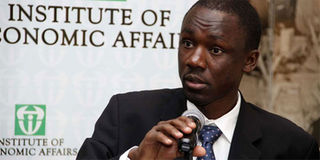
Institute of Economic Affairs CEO Kwame Owino at a past event.
"The money that is being collected is not enough. As a result, there is rationing of medical care. Fraud has also been reported in the system,” he said.
"We need to have a proper discussion on what was promised. Did we promise much more than what we can deliver? Money coming in cannot cover the promises being made. Many Kenyans are not getting treatment."
The figures tell a troubling story. While 29 million Kenyans have registered under SHA, only 4.9 million are actively contributing, a compliance rate of just 18 per cent. In the informal sector, where more than 80 per cent of Kenya's economy operates, the compliance rate sits at a mere four per cent — with fewer than a million people actively contributing.
The deficit cuts across all three of SHA's funds. The Social Health Insurance Fund (SHIF) has a budget-approved allocation of Sh81 billion for the 2025/26 financial year against a requirement of Sh101 billion, leaving a shortfall of Sh18 billion. The Primary Health Care Fund (PHC) received an allocation of Sh13.1 billion against a requirement of Sh61 billion. That leaves a deficit of Sh48 billion. The Emergency, Chronic and Critical Illness Fund is the worst hit, with an approved allocation of just Sh8 billion against a requirement of Sh107 billion. It has a huge deficit of Sh99 billion.
"For one to answer the question on whether the funds generated are sufficient, you will need a costing analysis as well as a fiscal analysis," Mr Mutua said. "We have gaps in terms of projected revenue vis-a-vis the cost of the gazetted benefits package."
The IEA analysis found that between January and October 2025, the average monthly collection for SHIF was Sh6.5 billion against a target of Sh8.3 billion. Every month, SHA falls short by Sh1.8 billion, a deficit that compounds over time.
The government has celebrated SHA's registration numbers, with 29 million Kenyans now in the system. But as the analysis shows that registration without contribution is merely a statistical achievement, not a financial one.
"This is what explains why the funds that are generated are not sufficient to run the authority, which obviously leads to a delay in payment to health facilities. This ultimately undermines services," Mr Mutua said.
The low compliance rates are not only administrative failures; they are existential threats to SHA's viability. With Kenya's poverty level at 40 per cent, incomes remain low, and there have been widespread complaints about the ability of individuals — especially those in the informal sector — to make their annual contributions.
"Whereas the law provides that the people in the informal sector pay once annually, the design perspective is good, but in practice, it is difficult to adhere to it because of the affordability concerns. Most Kenyans are not complying with regular payments on time. This is why the government is providing the ‘lipa pole pole’ (pay slowly) arrangement," Mr Mutua said.
The "lipa pole pole" flexible payment option allows informal sector contributors to spread their payments over time, rather than paying in a single lump sum.
However, Mr Owino warned that the structural imbalance runs deeper than payment flexibility can solve.
"If we have 80 per cent of the population is working in the informal sector, and the system relies heavily on people with regular income, then perhaps the balance is not available. The system is at risk of collapsing," he said.
The Primary Health Care (PHC) Fund faces its own challenges. Due to insufficient resources to adequately equip primary care facilities, patients are bypassing them and going directly to referral hospitals.
"PHC facilities should be the first point of contact when people are seeking healthcare. When patients skip primary care and go straight to referral hospitals for conditions that could have been managed at lower levels, it inflates claims for SHIF. Hospital payouts increase, draining the already insufficient SHIF pool faster,” Mr Mutua said.
On the other hand, he acknowledged that SHA got several things right on design perspective. The scheme is mandatory, which is critical for predictable resource mobilisation and ensuring no one is left behind. The benefits package is comprehensive, covering everything from preventive services to chronic disease management, emergency care and palliative care.
"From a design perspective, SHA got it right because they have to pool resources to be successful, and also on the benefit package, it is comprehensive compared to what other countries have," Mr Mutua said. "However, comprehensiveness comes with a price tag. The benefits package offered under SHA is not just comprehensive, it's expensive. Perhaps too expensive for Kenya's current fiscal reality."
These financing constraints are translating into real crises at the facility level. Healthcare providers across the country report chronic delays in reimbursements from SHA. Claims submitted months ago remain unpaid, creating a liquidity crunch that affects both public and private hospitals.
Some facilities have responded by limiting services covered under SHA, asking patients for illegal co-payments or, in extreme cases, opting out of the SHA network entirely.
"The question of efficiency is very clear and manifest in the fact that there is a delay because the funds that are generated are not enough," Mr Mutua said.
He added that without urgent interventions, stronger enforcement mechanisms, refined targeting tools, innovative financing sources, rationalised benefit packages, and political will to address the NHIF debt and funding gaps, SHA risks falling apart.
Follow our WhatsApp channel for breaking news updates and more stories like this.