Cancer patients frustrated as drugs shortages hit public hospitals
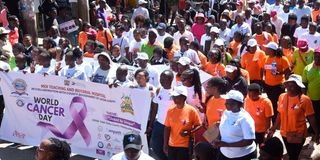
Participants from the Moi Teaching and Referral Hospital in Eldoret City, Uasin Gishu County, those from various private hospitals, and cancer survivors, during a procession in the City to mark this year's World Cancer Day on February 04, 2026.

Cancer patients receiving their medication at leading referral hospitals across the country have been frequently experiencing shortages following significant delays in procurement.
This situation forces them to choose between financially burdensome treatment options and the significant risk of an untreated illness.
Ms Esther Wanjiku, a stage 4 breast cancer patient, has learned not to expect much anymore. Since December last year, she has been unable to get her drugs from Kenyatta National Hospital, leaving her with a terrifying reality that her cancer cells could be multiplying unchecked while she waits.
"Since December last year, I have been unable to get my drugs," she says. "We were told that since it was the end of the year, they had not done procurement and that it would be done in January. Come January, no one was speaking to us. We are still waiting.”
Wanjiku's treatment regimen requires three critical medications: Herceptin, Anastrozole and Zoladex, which is administered every three months.
“I am afraid that for the two months that I have not been religiously following my treatment regimen, the cells could spread through my body, and it is just a matter of time,” Wanjiku said.
When she visited the hospital on Thursday, the news was the same as it had been for weeks. "I was told that the drugs had not been procured and we were instructed to go buy them at Texas Cancer Centre,"
At the private facility, Herceptin costs an average of Sh74,000 per month, Anastrozole Sh3,200, and Zoladex Sh28,000—a monthly bill that exceeds what most Kenyan families earn.
"I cannot afford these drugs. What I have done is, I normally share with my friend who buys for me. Until when am I going to depend on someone who also has their own battles to fight?” she asked.
Mr Paul Mwangi, a stage 4 pancreatic cancer patient, has been navigating this nightmare for three months. He requires regular octreotide injection 30mg, which is supposed to be available at KNH, but rarely is. "For three months now, I have been unable to get the injection," he said
While the Social Health Authority (SHA) covers the cost when he purchases from private facilities, the financial mechanics work against him.
"The good thing is that SHA pays for it, but if we buy from outside, it costs Sh80,000, yet we would get it at KNH at Sh53,000. The difference is too big that it depletes my card so fast when we buy from outside KNH. From July last year, I have not been able to get the injection, and the amount I pay outside has depleted my card."
For both Wanjiku and Mwangi, every day without medication is not just an inconvenience but also a death sentence. “Cancer cells don't pause because procurement officers haven't processed orders. They don't wait for budget allocations or supply chain logistics. They multiply, they spread, they kill,” she said.
Ms Prisca Githuka, chair of education and advocacy at Kenya Network of Cancer Organisations (KENCO) and herself a cancer survivor, says the country is joking with patients' lives.
"The cancer drug shortages in public health facilities in Kenya have become not just a supply problem but a matter of life and death for patients. Patients are missing drugs that are on the essential lists, other chemotherapy drugs and are being referred to private health facilities to buy drugs. Most of them cannot afford, consequently pushing treatable cancers into fatal outcomes." Ms Githuka said.
She adds: “The implications are staggering. Letrozole, a drug so fundamental to cancer treatment that it appears on the World Health Organisation's list of essential medicines, is unavailable in Kenyan public hospitals. Patients who could be effectively managing their disease with affordable medication are instead being sent on expensive wild goose chases to private facilities, or worse, simply going without.”
"These shortages are deepening inequality. Patients are being forced to delay treatment, borrow money, or abandon treatment, undermining the promise of universal health coverage. Access to cancer medicines is a right."
Kenya's cancer burden is growing. According to recent statistics by the Ministry of Health, cancer incidence rates are rising across the country, with breast, cervical, prostate, and oesophagal cancers leading the charge. The country records approximately 47,000 new cancer cases and 33,000 deaths annually.
According to a statement by the Kenyan Network of Cancer Organizations (KENCO), patients continue to face stock-outs in public facilities, unaffordable prices in private pharmacies, and growing fears about the availability of sub-standard or counterfeit cancer medicines in the market.
"This is a serious patient safety issue that requires urgent and coordinated action from the Ministry of Health, the Pharmacy and Poisons Board, KEMSA, and other regulatory agencies to ensure the availability of safe, effective, and affordable cancer medicines," says the statement.
"With the increased cancer incidences in Kenya, until drug shortages in public hospitals are addressed, Kenya's fight against cancer will remain incomplete and unjust. We call on the government of Kenya to treat cancer drug shortage as a national emergency,” Githuka said.
Her recommendations are clear and urgent: "The Ministry of Health must urgently fix procurement delays, guarantee consistent funding for oncology medicines, and strengthen supply chains in public hospitals. No Kenyan should die because life-saving cancer drugs are missing from public health facilities."
Dr Ouma Oluga, Principal Secretary for the State Department for Medical Services, Ministry of Health, said he was not aware of the shortage and that hospital heads have not informed him, and neither has he received any complaint from the doctors and patients.
“But we have been working around the clock to strengthen the supply chain. There are sometimes global supply bottlenecks because most of these cancer medicines are manufactured by a specific or even only one company. It has not been escalated for my attention, and even the hospitals have not told us these,” he said
“I’m at the KNH cancer centre, and Zalodex is available,” Dr Oluga said.
Follow our WhatsApp channel for breaking news updates and more stories like this.