Floods are killing more people across East Africa than any other climate disaster, a report released this week by the World Meteorological Organization shows. Floods accounted for more than half of reported events across the continent in 2025, and the global weatherman warns that the region is running out of time to prepare for more.
"Between March and May of 2024 at least 1.6 million people were affected, over 500 died and more than 410,000 were displaced across Kenya, Ethiopia, Tanzania, Burundi, Somalia and Uganda," the State of the Climate in Africa 2025 cites.
In Nairobi's Mathare informal settlement, Doreen Achieng watched water seep into her home overnight. Accustomed to occasional flooding, she mopped it up. But the water kept rising to about three metres.
A flooded Mathare River as it passes through Mathare Slums Gitathuru area.
Photo credit: File | Nation Media Group
Kenya bore the brunt of the region's catastrophe. On May 3, 2024, adverse impacts from the rains were documented in 45 out of the 47 counties, and the situation had degenerated into a humanitarian crisis. 478 people lost their lives, 238,763 households (1,432,578 people) were affected with over 117,336 households (704,016 people) displaced across the country.
"We were stuck in the water, but the men came to our rescue," Achieng recalls. Once the children were safe, she realised everything she owned had been swept away. Her old makeshift house, perched precariously on the riverbank, was lost during the flood.
Edward Okoth, another flood victim, took shelter in a displacement camp set up inside a primary school in Mathare. "Life was very difficult," he recalls. "The food was not enough for all of us. We were literally fighting for food."
The Kenya Meteorological Department had issued warnings. On April 13, the Department marked 43 of the country's 47 counties as areas at risk of continued heavy rainfall, with those living in and around riparian areas at the highest risk. However, early warning meant little without rapid government action.
Vehicles on a flooded road in Nairobi after heavy rains on March 6, 2026.
Photo credit: Nation Media Group
The destruction cut across every sector – 61 key roads, nearly 2,000 schools, and 62 health centres nationwide were damaged or destroyed. The government forwarded a supplementary budget of Sh11 billion to the National Assembly for approval just to manage immediate response. This was money for evacuation, rescue operations, and basic infrastructure repair, not recovery.
Agriculture, the backbone of Kenya's economy, took a massive hit. About 40,000 acres of cropland were destroyed, with far-reaching consequences for food security. In the Mwea Irrigation Scheme, the flooding of 2,000 acres resulted in losses to the tune of Sh60 million in lost crop. But losses extended far beyond a single irrigation scheme. Farmers in affected areas faced total crop failure and lost livelihoods overnight.
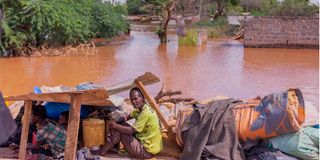
A man and his children, displaced by floods in Garissa County, take cover from the scorching sun in a makeshift shelter.
Photo credit: DPCS
Tanzania suffered alongside Kenya. The Tanzania Red Cross Society said at the time, "The presence of Hidaya Cyclone is expected to dominate and affect the weather patterns in the country including heavy rain and strong winds in some regions near Indian Ocean".
Then the rains hit. Floods wreaked havoc from January to May 2024, killing at least 155 people and leaving 236 injured. The country's food production capacity, which supplies the broader region, contracted sharply. As a result, the country reported a 30 per cent drop in food production.
"Ethiopia and Somalia faced flooding of similar scale. More than 560,000 people were affected by heavy rains and flooding in April and early May in several districts. Some 60,000 hectares of cropland were damaged, and nearly 3,000 livestock died in Ethiopia alone," according to the UN.
Disease followed the floodwaters. In Somalia, damage to water sources and other facilities exacerbated the cholera outbreak that had recorded at least 10,640 cases, including 120 deaths, across seven states, according to ReliefWeb.
Then, as if the rains weren't enough, Cyclones Hidaya and IALY hit the region in May, worsening the flooding and causing increased death and destruction in Tanzania and Kenya. Cyclones rarely reach this area, yet twice in a month, record-breaking Indian Ocean cyclones formed and affected the region. Cyclone IALY transformed from a storm to a cyclone in the south-west Indian Ocean basin less than 190 miles (305 kilometres) from Mombasa. It was the most northerly cyclone ever formed below the equator.
Locals at Chesongo, Baringo Central, on May 12, 2026 carry a footbridge that was swept away by floods hours after being commissioned.
Photo credit: File | Nation Media Group
"The African continent is warming faster than the global average, and the rate of warming across the continent since 1991 is substantially higher than in any of the previous 30-year periods. This isn't abstract climate science. Faster warming changes how moisture moves through the atmosphere," the WMO said in the State of Climate Report .
"East Africa has experienced strong precipitation variability, with intense wet spells and floods in many countries, but also a significant decrease in rainfall in the Horn of Africa, especially during the long rainy season from March to May. The rainfall patterns that generations of farmers learned to work with are breaking down. Some areas get torrential rain in concentrated periods. Others get drought. Often the same season brings both to different parts of the same country," the report continues.
Floodwaters sweep away a car in Mandera.
Photo credit: Pool
The 2024 crisis exposed serious gaps in Kenya's emergency response system. Kenya Red Cross Society (KRCS), typically the backbone of emergency response efforts, found itself stretched beyond capacity and issued public appeals for urgent additional support as the crisis intensified. Human Rights Watch criticised authorities for an initially slow and inadequate response to the unfolding flood disaster. In numerous affected areas, communities depended on their own resources and whatever external humanitarian aid they could access as local government response capacity buckled.
The cycle repeated itself barely a year later. In April 2025, at least 40 people died of flood-related causes in East African capitals Nairobi, Kinshasa, Kigali and Kampala since the beginning of the month, with 2,165 displaced in Tanzania.
The WMO says that only 40 percent of African countries have multi-hazard early warning systems, which are needed to save lives and livelihoods. Response systems need funding, coordination between national and county governments, pre-positioned emergency supplies, and trained personnel ready to deploy. The 2024 response showed Kenya lacks sufficient capacity in all these areas.
"There are some bright spots. There are encouraging signs that improved collaboration between meteorological services, disaster management agencies and local authorities, as well as advances in climate services like seasonal forecasts, is strengthening preparedness and response capabilities. But cooperation at this level remains inconsistent," WMO says.
The deeper challenge is infrastructure. Informal settlements in cities like Nairobi and Dar es Salaam house millions of people in high-risk locations. Poor drainage, inadequate sewage systems, and proximity to riverbanks make these areas death traps when heavy rain comes. Fixing this requires massive investment in urban planning and infrastructure that East African governments can barely afford.