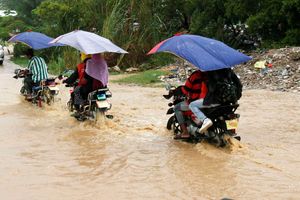
Scientists and environmental experts are warning that some of the country’s most populated and ecologically sensitive coastal zones face growing risks from flooding, erosion and saltwater intrusion. This comes as rising global sea levels, driven by climate change, are increasingly worsening seawater invasions along Kenya’s coastline.
A 2026 study, published in Frontiers in Marine Science journal, found that nearly a third of Kenya’s 640-kilometre coastline — equivalent to about 210km — is now classified as highly vulnerable to sea level rise. The Mombasa Island coastline and the Kilifi–Malindi corridor were identified among the areas most at risk.
The study titled, “Assessment of Coastal Vulnerability to Sea Level Rise: A Case Study of the Kenyan Coastline,” shows that sea levels along the Kenyan Coast are rising at an average rate of about three millimetres annually, exposing low-lying settlements, infrastructure, wetlands and freshwater sources to seawater invasion.
Researchers analysed more than 7,500 shoreline segments using satellite mapping and Geographic Information Systems (GIS), concluding that shoreline erosion, flooding and saltwater intrusion are accelerating along vulnerable sections of the Coast. The study also warned that all the heritage sites assessed along Kenya’s coastline fall within high-risk zones, raising concerns over the long-term survival of historical and cultural landmarks.
Scientists say rising ocean temperatures are a major contributor to the problem. According to the latest National Aeronautics and Space Administration (NASA) sea level monitoring data updated in April, global sea levels have risen by about 91 millimetres since 1993 due to melting glaciers and warming oceans.
NASA says that roughly two-thirds of the rise is now being caused by melting land ice, while warming seawater accounts for the remaining share through thermal expansion. In a January analysis, NASA reported that although global sea level rise temporarily slowed in 2025 due to La Niña rainfall patterns in South America, the long-term trend remains upward and continues to accelerate. La Niña naturally brings cooler ocean temperatures that temporarily slow down global sea level rise.
The agency noted that the annual rate of sea-level rise has more than doubled over the past three decades.
The findings mirror growing concerns along Kenya’s coast where communities in areas such as Lamu, Tana Delta, Kilifi, Mombasa and parts of Kwale have increasingly reported seawater intrusion into homes, farms, wells and mangrove ecosystems during high tides and storm surges.
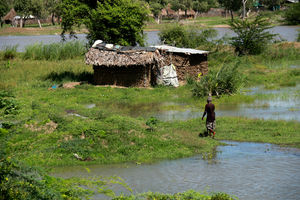
A trail of destruction at Tana River Lodge, which was once a popular luxury hotel built on Sand dunes at Kipini, Tana River County in this photo taken on May 13, 2026.
Photo credit: Kevin Odit | Nation
Dickson Mbuthia, an environmentalist, cites sea-level rise as part of the global coastal environmental risks attributed to climate change, which subsequently results in sinking coastal lands.
He says that apart from the fact that sea-level rise threatens people, ecosystems, and infrastructure directly; the situation also magnifies the impacts of coastal storms.
“Climate change and global warming is real. They cause sea level to rise. Remember that globally, we have glaciers and ice sheets, which melt at a high rate adding water to the ocean. This results in the volume of the ocean expanding every time the water warms,” said Mr Mbuthia.
He further explains that wave effects, river flows, and heavy rains also significantly increase the exposure of coastal communities, ecosystems, and economies to floods and other catastrophes.
According to Mr Mbuthia, water level changes increase coastal erosion, elevate groundwater levels, and cause saltwater intrusion. He stresses that elevated groundwater levels lead to increased rainfall runoff and compromised underground infrastructure, such as public utilities, septic systems, and structural foundations.
“Higher water levels also mean deadly and destructive storm surges, wave impacts, and rainwater are unable to drain away from homes and businesses, resulting in massive displacements,” he said.
Climate researcher Mohamed Dirie notes that coastal erosion, rising sea levels, and changing ocean behaviours have increased the frequency of floods, causing permanent shoreline recession in some areas.
The Lamu County Climate Change Chief Officer further explains that when the ocean floods areas, it often results in the intrusion of saltwater into local freshwater wells, forcing communities to face severe water shortages or consume contaminated, salty water.
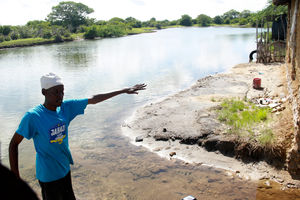
Omar Bakari Mohamed, a resident of Mokowe area in Lamu County, whose house has been marooned by the rising sea levels, in this photo taken on May 14, 2026.
Photo credit: Kevin Odit | Nation
Mr Dirie says coastal aquifers are always left in a delicate balance whereby fresh groundwater floats on top of denser, deeper saltwater. Once the balance is disturbed, saltwater intrudes inland, rendering wells unusable.
He confirmed that flooding and relocation in coastal areas is common, particularly for villages located in low-lying areas.
“There’s always increased flooding from rising sea levels and intensified storm surges. Climate change contributes to these through thermal expansion of seawater and more extreme weather events. In summary, both phenomena are consistent with documented impacts of climate change on coastal zones,” said Mr Dirie.
On mitigation measures, he said those living near oceans need to carry out nature-based solutions such as planting and restoring mangroves where there are none.
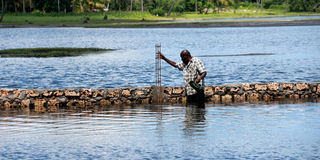
“The government has already made efforts to build seawalls to prevent water from reaching residential areas. Planned relocation is also important to prevent displacement scenarios,” said Mr Dirie.
A new report by the Kenya Meteorological Department now shows that sea levels along Kenya’s coastline are continually rising, with increasingly frequent episodes of unusually high tides.
The State of the Climate 2025 report notes that there were increased periods when the 2025 daily high waters approached or exceeded the climatological upper envelope, indicating elevated coastal water levels beyond normal.
While these changes may not always appear dramatic, the report says their cumulative effect is beginning to reshape coastal systems and expose weaknesses in infrastructure and livelihoods.
At the centre of this concern is the Port of Mombasa, a critical hub not only for Kenya but also for much of East and Central Africa. The report highlights a complex reality in that although higher water levels can support docking of large ships, they also create operational challenges when combined with harsh weather.
According to the report, “more frequent or prolonged exceedance of typical high-water levels can contribute to shoreline erosion, damage to coastal infrastructure, and flooding of low-lying areas.”
In a region where homes, roads, and businesses often sit just metres above sea level, scientists warn that the threat is becoming increasingly tangible.
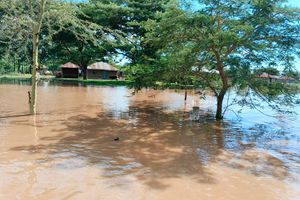
Part of the destruction caused by the rising sea levels at Kitangani in Mokowe, Lamu County in this photo taken on May 14, 2026.
Photo credit: Kevin Odit | Nation
Tourism, one of the Coast’s key economic pillars, is also coming under pressure as beachfront hotels and resorts face gradual degradation caused by shoreline erosion and advancing tides. For small-scale fishers, changing ocean patterns are making daily livelihoods increasingly risky.
Coastal ecosystems that traditionally act as natural buffers are also under pressure. Mangroves and seagrass beds depend on delicate balances of water levels and sediment flows to survive, but excessive or prolonged flood can destabilise these ecosystems.
Scientists warn that the weakening of mangroves and other coastal ecosystems could remove a critical line of defence against storms, flooding and erosion along Kenya’s vulnerable coastline.