'We can't wait for El Niño': The farmers turning threat into opportunity as others take cover
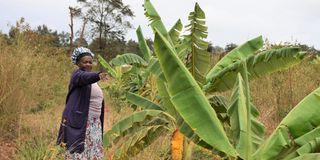
Esther Mbula shows a section of her farmland at Mukuku Village in Makueni County on September 9, 2026. She is among smallholder farmers in the region who have transformed their farming ventures by harvesting road runoff.

What you need to know:
- As many people take cover at the first sign of rainfall, Nzangi is among farmers who run in the opposite direction to unclog their rainwater harvesting systems in nearby earth roads.
Until three years ago, Rose Nzangi allowed her goats and sheep to roam her farmland at the peak of the dry spell in September. The annual practice, which occurs in Kitui, Machakos and Makueni counties, follows the harvesting of pigeon peas. Today, however, Nzangi cannot imagine allowing livestock to step on her six-acre farmland after she transformed it through aggressive terracing.
What used to be unproductive during the dry spell is now filled with assorted fruit trees, bananas, cassava and sweet potatoes. "We cannot imagine allowing livestock to roam the farmland because there is always something to harvest from January to January," she explained.
Also read: Here's how to prepare for the El nino rains
The smallholder farmer in Kyamavui Village is part of a growing number of farmers in Makueni County who have transformed their farming ventures through aggressive rainwater harvesting and terracing. They tap road runoff using mitre drains, direct the water into their farmlands and distribute it using terraces to support crops beyond the conventional rainy seasons.
As jitters grow over the country's preparedness for the anticipated enhanced El Niño rains predicted by the Meteorological Department, Nzangi is among peasant farmers looking forward to the deluge. "We cannot wait for the enhanced El Niño rains," she told a visiting Healthy Nation team as she oversaw the expansion of a terrace on her farmland.
As many people take cover at the first sign of rainfall, Nzangi is among farmers who run in the opposite direction to unclog their rainwater harvesting systems in nearby earth roads.
A key component of the mitre drains, which carry rainwater runoff away from the roadside, is a silt trough that allows debris and silt to settle before the water proceeds to the rest of the terrace. According to Michael Maluki, a Makueni County government official who is the face of the green roads for water programme, failure to collect the debris and silt in the silt trough clogs the mitre drains and terraces and compromises the utility of the rainwater harvesting system.
The civil engineer, came across the green roads model for the first time during a conference organised by MetaMeta, a non-governmental organisation that champions environment-friendly infrastructure for climate resilience. He found the model's simplicity and its promise in unlocking the potential of drylands irresistible. He has since made a big name for himself promoting the new way of building roads.
"When we shift our perspective on road runoff from a hazard to a valuable resource, we unlock the power of practical, locally-led climate-smart agricultural technology. Harvesting rainwater directly from rural roads allows communities to boost crop productivity, build drought resilience, and secure local food supplies," Maluki told Healthy Nation.
"A kilometre of a six-metre-wide earth road in drylands produces around 2,016,000 litres of water every rainy season. This water is enough to supply 40 average homesteads for a year. When it is not managed properly, however, road runoff degrades roads. It needs to be slowed, distributed and sunk in farmlands," said Maluki. For a decade, the green roads for water programme has proven to be a win-win for both the Makueni County government and communities.
According to Makueni Roads Executive Peter Mumo, the deliberate tapping of road runoff has significantly reduced the cost of maintaining the county's earth roads. "Makueni boasts of around 15,000 kilometres of classified earth roads, which are the lifeline of the county's economy. They link people to markets, schools and hospitals. Roads which work in harmony with water have significantly reduced the cost of their maintenance. Some of the earth roads go up to three rainy seasons without requiring maintenance thanks to the roads for water programme," he said.
The most noticeable impact of the roads for water programme is in controlled soil erosion, recharging underground aquifers and increasing agricultural production. Esther Mbula, for instance, has seen the productivity of her one-acre farmland in Mukuku Village grow three-fold after she tapped and directed runoff from a nearby road into the farmland.
To accelerate the uptake of the intervention and make the programme sustainable, Mumo has trained dozens of farmers across the county. They, in turn, train other farmers. The training focuses on proper terracing. "Our roads for water campaign insists that farmers should first plant the rain on their farmlands before planting their desired crops. This is the only way of guaranteed yields in the wake of erratic rainfall caused by climate change," said Maluki.
The pioneers of the green roads for water have become the biggest signposts for the impact of the programme. In the neighbouring Ngilani Village, Peter Nzioka has used terraces to rehabilitate a derelict parcel of land. It has become productive farmland that provides enough food for his family and enough fodder for his three cows throughout the year.
The father of four regrets the 25 years he "wasted" as a long-distance truck driver. "My pixie tangerines hit the market before the rain-fed ones mature and fetch higher prices because the farmland always has enough moisture throughout," he said.
For her part, Nzangi delights in the food security the agrarian revolution has helped her achieve. Looking back at her farming life, she cannot believe she once took bread for breakfast. "Today, I choose between bananas, cassava and sweet potatoes for breakfast," she said.
The biggest challenge facing the green roads innovation is budget constraints. Smallholder farmers decry the lack of funds and the technical knowledge required to set up proper terraces. To address the challenge, Makueni Governor Mutula Kilonzo Junior's administration has made it a rule that every road project has a component of extended mitre drains.
"Apart from sharing the green roads for water concept with other county governments, we have showcased it in forums we share regularly with roads agencies at the national government with a view to securing a buy-in. The national government would unlock immense agricultural production if the Kenya Roads Board embraces the green roads for water model," Mumo said.
[email protected]