The memories of the 2023–2024 El Niño rains are still painfully fresh for Ms Kadzo Nzai, 80.
The rains swept away her house in Ganahola, Mombasa, leaving her homeless. She eventually rebuilt, putting up a mud-walled house where she now lives with her children.
The predicted heavy rains come with the possibility that they will also claim the last remaining grave of her family, in a region that is already bearing the brunt of soil erosion that has destroyed homes.
Ms Nzai’s husband, who died in 2000, was buried near the house. Two of her sons were also buried there, but their graves have since been swept away by erosion. The remaining grave is marked with old tyres.
“We are worried. We don't know what to do. We have been told to leave because this is a flood-prone area, but where are we supposed to go?” Ms Nzai wondered.
She says more than 500 families once lived in the area, but many have since moved after their homes were destroyed by erosion.
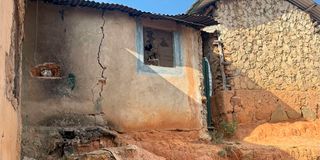
Her house now stands beside a deep gully. Cracks have appeared on the walls and ground, forcing the family to leave whenever it rains heavily.
“We are so scared, but we have nowhere to go. This is our home. We have buried our relatives here, and even their graves have been swept away. Only my husband's grave remains,” she said.
Houses belonging to Kadzo Nzai, in her 80s, have developed cracks due to soil erosion in Ganahola, Mombasa. Nzai, one of more than 500 residents living in the area, says she has nowhere to go despite warnings of impending El Niño rains.
Photo credit: Winnie Atieno| Nation Media Group
Recently, she watched one of her rental houses disappear into the earth. The house she occupies has deep cracks that widen after every storm.
“Any time now, it could fall. Every rainfall brings us closer to being buried alive. We don't sleep when the clouds gather. Rain means danger,” she said.
Her youngest son, Juma Masha, 64, was born in the village and has spent his entire life there. He says leaving is not an option because the family cannot afford to buy land elsewhere.
Instead, he wants the county government to intervene and construct gabions to protect the settlement.
“But we are not leaving, not today or tomorrow. Where will we go? We are too poor to buy land somewhere else,” Mr Masha said.
He added: “If the county government identifies alternative land for us, we will leave. But until then, we have nowhere to go.”
“We are scared of the El Niño rains, especially for our children, but what can we do? Poverty can force you to stay even when you know you are in danger. The county has engineers and environmental experts. Why can't they come and give us a solution?” he asked.
He pointed to a neighbouring Bangladesh village, where, he said, Chinese contractors working on a highway helped construct gabions to protect residents from erosion.
“After the gabions were put up, the people there became safer. We are asking for the same kind of intervention here,” he said.
More than 10 houses have been swept away in the area in the past year, according to residents. Families whose homes were destroyed have moved elsewhere along the Coast.
Barely a year ago, this was a road. Today, soil erosion has swept it away, leaving residents scrambling for space around the only remaining grave. Several homes have also been swallowed by the advancing erosion, forcing families to live in fear as El Niño rains approach. Despite the danger, poverty has left them with nowhere to go.
Photo credit: Winnie Atieno| Nation Media Group
The fears come as Kenya prepares for an El Niño-enhanced rainy season. The World Meteorological Organisation says the El Niño event is strengthening and is expected to increase the risk of flooding, damage to infrastructure and disruption of access to health and other essential services in parts of the Greater Horn of Africa.
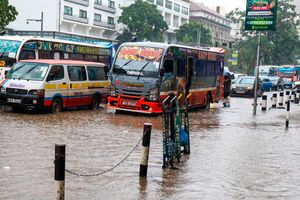
Mombasa is among the urban areas identified as being at high risk during the October-December rainy season, with the government warning of flooding, storm surges, coastal erosion, infrastructure damage and possible displacement.
Environmental expert Benson Wemali said the situation could deteriorate rapidly if heavy rains arrive before the county addresses the area's drainage and erosion problems.
“Erosion is already happening with the little rains. What will happen when the heavier rains come? It will be worse,” Mr Wemali said.
He said residents in vulnerable areas should have been mapped and warned early enough, while those living in areas at immediate risk should have been helped to relocate.
“If no action is taken, we should expect more destruction, displacement and possibly deaths. The people living there have nowhere to run to, so they will remain in their homes even when they know they are at risk,” he said.
Mr Wemali also blamed poor drainage and unplanned development for worsening flooding in parts of Mombasa.
He cited Mishomoroni, Ganahola, Moroto, Kwa Bulo, Vikwatani and Mwakirunge among areas facing environmental risks, including settlement in wetlands and mangrove areas and the effects of quarrying.
“Flooding does not just happen. It is made worse when drainage systems are blocked or when people build on waterways,” he said.
He warned that heavy rains could also contaminate water sources and increase the risk of waterborne diseases.
“Mombasa's drainage system was designed for a much smaller population. Many drainage lines have been blocked or built over. With more people and more construction, the system can no longer cope,” he said.
Mr Wemali called for a comprehensive review of Mombasa's drainage network, with new infrastructure designed around the city's current population and development patterns.
He also questioned the location of some public facilities in flood-prone areas, arguing that environmental assessments should guide where critical infrastructure is built. But the county government says it is preparing for the rains.
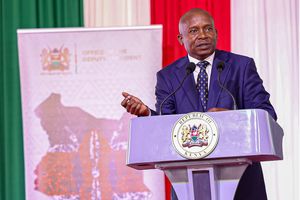
Speaking during a joint Mombasa County Disaster Preparedness Committee meeting on El Niño, Governor Abdulswamad Nassir said the county had mapped flood-prone areas and was clearing blocked drainage systems.
“We must start making plans now. Those living near the coastline should also consider vacating. We must be very cautious before disaster strikes,” he said on September 7.
Mombasa Governor Abdulswamad Shariff Nassir when he appeared before the Senate County Public Accounts Committee at Bunge Tower in Nairobi on June 4, 2026.
Photo credit: Dennis Onsongo | Nation Media Group
In its latest update, the World Meteorological Organization (WMO), a specialized agency of the United Nations that coordinates international work on weather, climate, water and related sciences, points to an “exceptionally high likelihood of nearly 100 per cent” that the El Niño conditions will persist through February 2027.
It is the first time a WMO update has been so unequivocal, reflecting an unusually strong agreement among global forecasting centres.
The scale of the phenomenon has raised concern around the world, as its effects threaten to ripple through food systems, livelihoods and economies, particularly in countries already vulnerable to climate shocks.
“El Niño is being supersized before our eyes. The science leaves no room for doubt: the planet is in uncharted waters, and those waters are heating up. Sea surface temperatures are rising, temperatures keep climbing, and the world is in the danger zone of extreme weather. The race now is between rising risks and our commitment to take climate action and protect people. We must win that race,” said UN Secretary-General António Guterres.
While many Kenyans often reduce the term El Niño to heavy rainfall, the impacts are more complicated and they are already being felt globally and in the country.
Hannah Kimani, assistant director, public weather services at the Kenya Meteorological Services Authority ( KMSA), said the phenomenon is contributing to dry conditions and potential crop failure in parts of the North Rift and western Kenya. Warmer-than-average temperatures associated with El Niño are further worsening conditions in some of these areas.
The heaviest impacts are expected during the October-November-December rainfall season, when El Niño can amplify rainfall across the country.
“When we say that most parts of the country are expected to receive above-normal rainfall, we mean that we are likely to receive over 125pc of their seasonal averages. During the season, main temperatures are expected to be warmer than average during that season.
"With higher probabilities over Kwale, Kilifi, Mombasa, Lamu, and parts of Tana River, Taita Taveta, and Garissa Counties. In the Western parts, the onset is expected to be from September and the rains are expected to continue up to January with the possibility of extending beyond that. Then, in the rest of the counties, we are expecting the rains to begin in the second to the fourth week of October.
A motorcyclist navigates a flooded road in Bombolulu area following heavy rains in Mombasa April 23, 2026.
Photo credit: Kevin Odit | Nation Media Group
"During this month, the month of September 2026, occasional rainfall is expected in most parts of Baringo, Bomet, Bungoma, Busia, Elgeyo Marakwet, Embu, Kakamega, Kericho, Kimani, Kilifi, Kisii and all these other counties. We are also expecting min temperatures to be warmer than average throughout the country. Scientific evidence indicates that the El Niño signal is strong and still intensifying. The Indian Ocean Dipole, which is another important driver, is currently neutral. Such a strong El Niño can substantially alter temperature and rainfall patterns across many parts of the world. increasing the likelihood of impacts including floods, drought, and extreme heat.
"However, the strength of an El Niño event alone does not determine how severe the impact will be in any individual country or region. Its effects vary according to the location and season and can be modified by other climate drivers, including conditions in the Indian and Atlantic oceans. That's why we keep mentioning El Nino and also the Indian Ocean Dipole, which are the main drivers that are likely to influence the season,” says Edward Muriuki, acting director, KMSA.
“As much as the El Niño signal is strong, I would like to reiterate that the expected rainfall conditions may not necessarily be like those of 1997/1998. Because during that period, which was among the strongest El Niño events, the Indian Ocean dipole was also very strong, but the case is not so currently, so that's why we are saying we may not reach those thresholds.”
For Kenya to receive high rainfall records, he explains, a positive IOD, combined with strong elemental conditions, enhances the possibility of above-average rainfall over most parts of the country during the October, November, December season.
The director, however, reiterated that the Met Office is keeping a close watch on its evolution and will provide advisories if conditions begin to shift.
Children play in stagnant rainwater at Ziwa la Ng'ombe area after heavy downpour in Mombasa on April 22, 2026.
Photo credit: Kevin Odit | Nation Media Group
The 1997–98 El Niño floods remain one of the country's most expensive climate disasters. Environment Cabinet Secretary Dr Deborah Barasa, speaking at the KMSA offices yesterday, said the
floods caused losses estimated at about 11 per cent of Kenya's GDP, with transport infrastructure accounting for a large share of the damage.
“The stakes are economic as well as human. Weather and climate extremes impose a long-term cost estimated at about 2.4 per cent of Kenya’s GDP every year. Timely, accurate early warnings can substantially reduce those impacts,” she said.
The CS noted that the heavy rains, as many are fearing, could come with a range of hazards from flooding and landslides to severe storms, strong winds and rising lake levels, with the potential to disrupt lives, livelihoods and infrastructure.
The bigger question, however, is whether this warning is being matched with preparedness on the ground. How much money has been set aside for preparedness? How prepared are the counties? What has been done to clear drainage systems, strengthen roads and bridges, protect communities living in areas prone to landslides and prepare health facilities for a possible surge in climate-related emergencies?
Senator Dan Maanzo, during Senate proceedings, questioned the level of preparedness, warning that communities could soon be left to fend for themselves if the government does not act.
“I want to caution that they will soon be on their own when El Niño comes,” he said, calling on the government to properly utilise emergency funds. I challenge the government to do something. They need to utilise the emergency funds properly so that we do not get in trouble. It is so sad that I have not seen any serious preparation. The last time we saw a serious El Niño was in 1997. We have seen what happened to other countries in the past, such as Nepal. I am afraid we might be there soon. Sadly, I have not seen any serious preparation on the part of Nairobi County. The last time, the governor said that the city is built on a flat space and there is nothing that he can do.
We need to see the disclosed budget for the preparation,” he said.
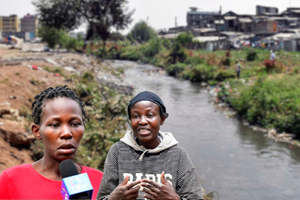
In Mathare, some of the residents who suffered during the 2023/2024 El Niño-influenced rainfall say they are still waiting on the government to come to their rescue.