When the rains come hard, the pattern is familiar. Homes along riverbanks fill with water before anyone can move their belongings. Roads become rivers of their own. Families are displaced, sometimes overnight, and every flooding season carries the risk of losing someone. It has become almost expected, a cycle Kenyans brace for rather than one they believe they can change.
But experts working on the ground say that belief is wrong. There is a lot within ordinary people's control, they argue, from something as small as where you throw a plastic bottle to something as demanding as organising your community to clean out a drainage channel before the rains arrive.
The trash problem starts small and ends in a flood
Dr Ahmed Idris, Secretary General of the Kenya Red Cross Society, points to a habit so common it barely registers as dangerous: littering.
"There is a really bad culture around these plastic bottles, dropping them around at different places," he says. "When the rains fall, those same bottles wash into drainage trenches and clog them. Water that should flow through the city instead pools, and pooled water is what eventually surges into homes and sweeps away everything in its path."
Dr Idris and other experts argue this is a fixable problem, not only through behaviour change, but also by installing enough bins along streets because cities that do that tend to see less of this kind of blockage, since people are more likely to use a bin that's actually there than to carry trash home.
The knowledge that gets ignored
Edwin Kabugi, an urban designer and environmentalist, argues that Kenya's flood response keeps overlooking a resource that already exists: the people who live through the floods. Communities that keep records of past flooding, and who talk openly about what they lived through, build a kind of institutional memory that helps them adapt before the next disaster hits.
"If a similar amount of water comes again, we are not going to suffer the way we suffered last time," he says.
That knowledge rarely makes it into official planning. Kabugi describes how governments and institutions tend to impose top-down rules rather than working with the local groups that already hold detailed, block-by-block data on where flooding hits hardest. In Nairobi's riparian settlements, including Mathare, grassroots groups have taken on this work directly, mapping which homes flood and how badly, sometimes without any formal equipment.
"If one were to say that their house has been flooded, you go to a map and look at where the house is, and you'll be able to tell this was the extent of the floods. You don't need remote sensing or satellite mapping to get that information," Kabugi explains.
Clearing drains is not just the government's job, but it isn't only residents' either
Dr Idris is direct about where responsibility for drainage sits: not entirely with county governments, and not entirely with residents either. Clogged drains cause floods regardless of who is supposed to maintain them, which is why he argues communities need to take on some of the physical work themselves rather than waiting for authorities to act.
"There are some people who are blocking off water from coming to their houses by moving away the drainage channels, but then they're diverting that water to other individuals, especially downstream," he says. In practice, this means the burden of flooding often lands hardest on low-income households, who don't have the resources that wealthier residents use to divert water away from their own property.
When the warning comes, moving fast matters more than anything else
Kenya's flood-prone areas are not blindsided when disaster strikes. Authorities issue warnings, curfews follow forecasts of heavy rainfall, and evacuation orders go out to at-risk neighbourhoods. The problem, Dr Idris says, is what happens after the warning.
"When people are given information in areas that traditionally flood, to move to safer grounds because the waters will come, people still wait for the waters to come and they then get trapped," he says.
Early warning only saves lives if people act on it before the water arrives, not after. The same hesitation shows up on the road. Dr Idris says drivers routinely underestimate what floodwater can do to a vehicle, a mistake that has cost lives in past flooding seasons.
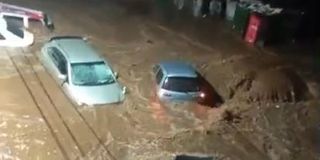
"A number of people in the last flooding period died because drivers took the risk of crossing waters. Vehicles were swept away," he says.
It's a widely cited road safety figure, used by disaster agencies elsewhere too, that as little as one foot of moving water is enough to carry off a car.
The danger doesn't end when the water recedes
Floodwater brings risks that outlast the flood itself. Sewage lines can mix with drinking water sources during flooding, which is why treating water before drinking it becomes critical to avoiding outbreaks of typhoid, cholera, and dysentery in the weeks that follow. Standing water left behind also becomes a breeding ground for mosquitoes, raising the risk of malaria, particularly for children and pregnant women, who are advised to sleep under treated nets during and after flooding.
Livestock face their own risks. Flooding conditions can contribute to the spread of diseases like foot and mouth disease among animals, and farmers are advised to watch their herds closely in the aftermath and report signs of illness quickly, before an outbreak spreads through a herd or a neighbourhood.
Turning excess water into something useful
None of this means heavy rainfall has to be purely destructive. Experts point to water harvesting as one of the more practical responses available to ordinary households, a way to bank the excess for the dry seasons that inevitably follow. Tree planting serves a similar purpose over a longer timeline. Mature trees provide shade, but they also anchor soil in place, reducing the erosion and mudslides that come with the next heavy rain.
None of this erases the losses Kenyans have already lived through. But it does mean the next flood doesn't have to look exactly like the last one, provided the warnings are heeded, the drains are cleared before the rains start, and the knowledge already held by the people who've survived past floods gets a seat at the table before the water rises again.