11 weeks on, clinical officers' strike still grips eight counties as patients pay the price
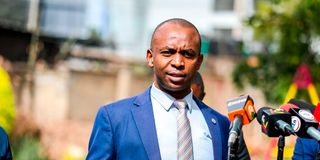
Kenya Union of Clinical Officers Chairman Peterson Wachira at a past event.

What you need to know:
- Machakos, Makueni, Trans Nzoia, Uasin Gishu, Kakamega, Vihiga, Homa Bay and Nairobi have yet to call off industrial action. In Machakos, clinical officers are only partially on strike.
Clinical officers in eight counties are still on strike, more than 11 weeks after the Kenya Union of Clinical Officers (KUCO) called a nationwide strike that took effect at midnight on July 20.
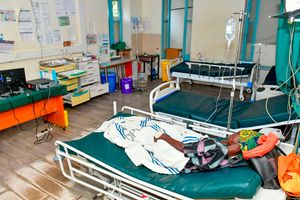
Patients are bearing the brunt, with reduced services, a reported rise in maternal and newborn deaths in some areas, and revenue losses for county governments, according to the union.
Data from KUCO Chairperson Peterson Wachira shows that Machakos, Makueni, Trans Nzoia, Uasin Gishu, Kakamega, Vihiga, Homa Bay and Nairobi have yet to call off industrial action. In Machakos, clinical officers are only partially on strike.
"In Makueni, level 3 facilities are not operating. Level 4 and 5 hospitals are running on 114 contract staff, and the union says maternal and neonatal deaths have risen," said Wachira.
Seven counties have also yet to sign the Collective Bargaining Agreement (CBA), including Mandera, Marsabit, Kakamega, Isiolo, Baringo, Uasin Gishu and Wajir.
The union announced that the strike would proceed in all 47 counties after the Ministry of Health and county governments allegedly failed to address its grievances despite a 21-day demand notice and a 14-day strike notice.
The strike notice, dated July 6, accused the national and county governments of failing to honour agreements reached earlier this year and to resolve long-standing grievances.
At the centre of the dispute is the implementation of the CBA, along with salary adjustments and promotions, failure of counties to implement career guidelines, and failure of counties to issue letters to universal health coverage staff transitioning them from contracts to permanent and pensionable terms. Officers in Taita Taveta, for example, said promotions remained a major concern for those stagnating in their current grades.
KUCO has also insisted that the issues are national in nature and should be negotiated centrally, arguing that splitting talks into county-level discussions would delay resolution. The pattern is a familiar one for the union.
KUCO Secretary-General George Gibore has said that after each strike ends with a signed return-to-work formula, the employer negates their responsibility to implement it.
By day 43, the strike had paralysed outpatient clinics, maternity units and diagnostic services in all 47 counties, and a simultaneous nurses' strike had left public hospital wards largely deserted. Wachira told Nation that clinical officers cover most outpatient services from level 2 to level 6 facilities, as well as much specialised care, including most anaesthesia.
Several counties have since signed return-to-work formulas, among them Mombasa, Kilifi, Nandi, Kajiado, Kericho, Bungoma, Narok, Kisii and Nyamira. In Busia, the agreement came on day 68 of the industrial action.
"If you are to go to surgery and have anaesthesia before the surgery is performed, you have a 98 per cent chance that the person administering it is a clinical officer. If you have a problem with your eyes, around 96 per cent of people you are going to see are clinical officers," said Wachira in an earlier interview.
In Nairobi, KUCO reports reduced maternal and newborn care in public hospitals. The decline in services has pushed patients towards private facilities, and the number of people seeking care has fallen.
"In Homa Bay, hospitals are overwhelmed. Level 3 facilities in two sub-county hospitals have stopped performing caesarean sections. Outpatient numbers have dropped, and the referral hospital is handling only emergencies," said Wachira.
"Trans Nzoia faced a crisis in which inpatient services stopped working. The county has since hired locum clinicians, who are currently working, but specialised clinicians are still absent from facilities. The KUCO branch in the county is due to hold a press conference tomorrow on the signing of a return-to-work formula," added Wachira.
In Kakamega, the strike has caused revenue losses, according to the union. The union said it was still collecting data from Uasin Gishu, while information from Vihiga could not be accessed. In Machakos, the partial strike has had no notable impact.
Wachira directly blamed the Ministry of Public Service for the ongoing strike. He explained that the enhanced risk allowance, which increases from Sh3,000 to Sh5,000 this financial year and Sh7,000 next under the February 2026 CBA, has not been paid because Public Service Principal Secretary Professor Jane
Imbunya has not updated the payroll code.
Despite a letter sent by the Council of Governors on August 21 requesting the PS to adjust the HRiS-Ke code so counties could implement the agreement, no action has been taken.
"The letter that went there has never even been marked to the staff who are supposed to revise that code," Wachira stated, warning that the union will picket at the PS's offices within two weeks if the issue is not resolved.