12 villages, no toilets: Trans Nzoia’s sanitation emergency
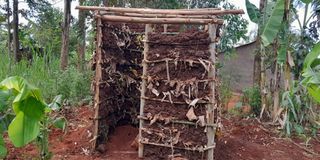
A newly-constructed latrine in Keiyo Ward, Trans Nzoia County. Most families there cannot afford toilets due to high poverty levels.

What you need to know:
With maize plantations currently dense, families relieve themselves there despite the stigma and loss of dignity.
Hundreds of families in rural Trans Nzoia County lack toilets, driving open defecation and exposing communities to preventable diseases.
County officials have identified Keiyo Ward as the worst affected area, where at least 12 villages are classified as high risk due to widespread open defecation, low latrine coverage, and poor sanitation.
The situation is dire in rural areas, especially in squatter camps in Endebess Sub-county. Many casual workers on the Agricultural Development Corporation farm share latrines, increasing disease risk.
“Some families live in camp-like houses, most without toilets. We try to sensitise them to curb diseases triggered by poor hygiene,” said Stephen Kisongochi, county health promoter, Endebess Health Unit.
Other affected areas include Rongai, Khalwenge, and Budalangi, where high poverty levels force locals into makeshift houses and manyattas.
“Some of us live in deplorable conditions. We know toilets are a priority, but people can’t afford to build them. They share or use forests and shrubs,” said Joseph Simiyu, an Endebess resident.
With maize plantations currently dense, families relieve themselves there despite the stigma and loss of dignity.
In response, the Department of Public Health is ramping up community sensitisation and supporting modern toilet construction even as officials warn that poor sanitation fuels bilharzia, intestinal worms, and other water-borne infections.
The county government is working with partners including the Water, Sanitation, and Hygiene Alliance Kenya and the African Medical and Research Foundation to promote hygiene and help households build latrines.
County Public Health Coordinator, Dr Norbert Musundi, said the campaign targets schools, households, and marketplaces through Community Health Promoters (CHPs) and other public health stakeholders.
“We have used puppetry in schools, CHPs in villages, and community champions such as boda boda leaders, traders, and faith groups. They are trained to help spread the message,” Dr Musundi said.
Public health officers have visited more than 380 schools to ensure adequate sanitation facilities, including toilets and handwashing stations. Learners have also been educated on hygiene practices, water borne diseases, and the health risks associated with poor sanitation.
Dr Musundi noted that every household in Keiyo is now being encouraged to construct a toilet as latrine coverage remains critically low in several rural areas.
“Through Community Led Total Sanitation, we expect to declare those villages open defecation free by the end of this month. Already, latrine use has improved and cases of diseases have gone down,” he said.
Health and Sanitation Executive Christopher Lorot said the county is working closely with development partners and local leaders to tackle diseases linked to poor hygiene and sanitation.
He cited bilharzia, jigger infestations, and intestinal worms as key health concerns affecting vulnerable communities.
According to Lorot, Keiyo Ward currently records a bilharzia prevalence rate of about two per cent. He said the county has recommended the procurement of praziquantel tablets to support treatment and regular screening programmes.
He praised partners including AMREF Health Africa, Global Health Alliance Kenya, End Fund, and the African Institute for Health Development for supporting mass drug administration campaigns, community sensitisation, and behaviour change initiatives.
"There is a close link between water, sanitation, hygiene, and diseases. Without safe water, we cannot succeed," said Lorot.
Despite this progress, some communities continue to grapple with extreme poverty and poor living conditions.
In the poverty-stricken villages of Luhome and Khalwenge, jigger infestation remains widespread, affecting both children and adults and leaving many residents struggling with pain, disability, and social stigma.
County Secretary Truphosa Amere described the situation as alarming and pledged increased county funding to combat the infestation.
"This is a very desperate situation, and as a county government we are working to restore people's dignity. We are going to allocate funds to fight jigger infestation in our county," she said.
Kisongochi, a CPH, highlighted the pressure facing residents in densely populated settlements, revealing that some families have been forced to build houses on the graves of their relatives due to land shortages.
"Some of the houses you are seeing here were built on top of graves because there is no space for the growing population," he said.
Kisongochi added that health workers have launched a campaign to educate residents on proper soil disinfection before smearing mud walled houses, as part of efforts to improve hygiene and reduce disease transmission.