A miracle named Blessing and survival against childhood cancer
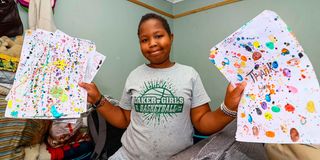
Blessing Mugure holds up some of her art pieces at her home in Kahawa West, Nairobi, on September 23, 2025.

The morning sun filters through the window of a single small room in Kahawa West, illuminating dust motes dancing in the air. Inside, Mary Mugure is preparing breakfast on a two-cooker burner, its base elevated by 22-litre jerrycans. Her four-year-old daughter plays quietly on the floor, a picture of innocent normalcy. It is here that we meet 12-year-old Tabitha Blessing, Mary’s firstborn daughter. She is healthy, composed, and warm. When greeted with a “how are you?” she responds with a quiet, confident smile, “I’m blessed.”
Just four years ago, at the age of eight, Blessing was a ghost of her current self, a shell consumed by a mysterious illness that threatened to extinguish her light and shatter her mother’s world. Her story begins like that of any other child.
“My daughter led a normal life until around 2021 when she started having persistent headaches, swollen feet and hands, and tonsils,” recalls Mary, her voice steady but her eyes betraying the memory of a pain so deep it has left permanent marks.
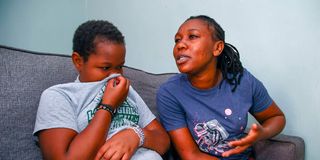
Blessing Mugure and her mother Mary Wairimu Mugure at their home in Kahawa West, Nairobi, on September 23, 2025.
Naturally, she took her daughter to Kiambu Hospital. The diagnosis was not anything alarming, just arthritis and Tuberculosis (TB). Six months of medication yielded no improvement. Hope led them to Kenyatta University Teaching, Referral and Research Hospital, but the cycle repeated, another five months of misdiagnosis and treatment for arthritis, TB, and pneumonia. Each day, Mary watched her daughter’s health deteriorate, the vibrant child fading before her eyes. A desperate trip to Mathari Hospital offered no answers. They were adrift in a sea of uncertainty.
“I now resorted to prayers. I tried several churches, made multiple goat sacrifices, but nothing was working out. My little Blessing was getting worse by the day,” she intimates.
When divine intervention seemed silent, she turned to her family, seeking answers in her lineage. Had her parents, who died when she was young, succumbed to a similar strange illness? The response was a wound that cut deeper than the disease,” Mary recounts, balancing tears.
“My aunties, uncles, and my only sibling turned their back on me. They said the history of strange diseases with no cure do not come from their lineage. They deserted me.”
Alone and terrified, Mary took one day at a time. Then, one evening, the unthinkable happened. Blessing lost consciousness and could not move.
“I was working as a waiter then and Blessing had stopped going to school because of her frail health,” Mary recalls. “When she fainted, I didn’t know what to do. I was reluctant to take her to the hospital because, judging from my past experiences, we were not going to get a solution. But a neighbour convinced me to take her to Thika Level Five Hospital.”
It was there that the bombshell dropped. After a series of tests, the doctors called Mary aside. “They told me Blessing had leukaemia — a cancer of the blood,” she says, the memory still raw. “Prior to this, I didn’t know that young children could get cancer and I also didn’t know that cancer was curable. So, in that instant, my world was crumbling.”
The hospital in Thika gently guided Mary toward acceptance and referred them to Kenyatta National Hospital (KNH) for chemotherapy. For two and a half years, Kenyatta became Blessing’s home. But the hospital stay was a crucible of suffering for Mary. In her deepest moment of need, Blessing’s father abandoned them, coldly stating that “there is no cancer in his lineage”.
“I felt depressed and lonely,” Mary offers, her voice thick with regret. “And for a while, I deserted Blessing in the hospital. I was overwhelmed and alone with no family or friends to turn to, and at the same time, I was taking care of my other daughter who was just months old.”
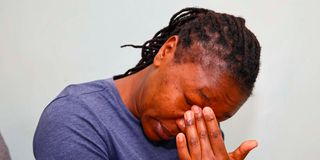
Mary Wairimu Mugure at their home in Kahawa West, Nairobi, on September 23, 2025.
It was at this absolute nadir, when a mother’s spirit was broken, that a lifeline appeared in the form of Julian Maina from the charity, Hope for Cancer Kids.
“In Blessing’s case, I was called by the social workers, nurses, and the doctor who was attending to Blessing,” Julian recalls. “At the point that they were calling me, it was not only because of money but because Mama Blessing, Mary, had abandoned Blessing in the hospital. She was no longer visiting her daughter yet on the other hand, Blessing kept telling the medical staff that she wanted her mother.”
Julian’s first call to Mary was not about bills, but about a child longing for her mother.
“She told me her story and she was almost giving up, nobody was supporting her. She was in pain and she really cried on that phone call,” Julian recounts. “I think I understood her because when I listened to her, she was barely holding it together. Like, ‘I don’t have food to eat, I have a small child. I don’t even have the money to go to the hospital. And now you want to come and see Blessing every day’.”
Julian offered not just empathy, but a profound challenge and a promise. “I think the one thing I said to her was, ‘Do not do to her what everyone has done to you. This is your child and you never know how long you have with her. So give it your best’.” Hope for Cancer Kids assured Mary they would finance her transport to the hospital.
“We became like a family to them,” Julian smiles.
Beyond emotional support and practical aid like paying for the National Health Insurance Fund (NHIF), the organisation provided something equally vital: a sense of purpose and a means to contribute to her own survival. In the wards of KNH, specifically in Ward 1E for children without a parent to stay with them, Blessing discovered an extraordinary talent.
“Blessing is an artist,” Julian explains with palpable pride. “She learned how to crochet scarves while at the ward and she is also very good in colouring and art things.”
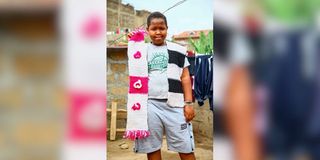
Blessing Mugure poses with some of her handmade scarfs in Kahawa West, Nairobi, on September 23, 2025.
Every Thursday afternoon, Hope for Cancer Kids holds an art class where children can simply be kids. “We allow them to just express themselves through art.”
This creativity became a crucial part of Blessing’s therapy and her financial lifeline. The organisation frames the children’s artwork and sells it at auctions and events. The proceeds are split: 70 percent goes to clearing hospital bills, initially through NHIF and now through the Social Health Authority (SHA), while 30 percent is deposited directly into the child’s hospital account.
“Blessing has really benefited,” says Julian.
“On more than four occasions, we have sold her art and given her 30 percent of the proceeds. That money, when SHA is clearing a bill of, say, Sh500,000, it will clear a portion. The money from her art is used to top up the remaining balance. She is super talented and her work is reflective of a very creative and bright mind.”
In November 2024, Blessing underwent her final chemotherapy session and was discharged, attending regular clinics until March 2025. Her progress has been nothing short of remarkable.
Dr Godfrey Wadu, a clinical officer specialising in oncology who has walked with Blessing since April 2022, confirms this.
“Blessing's progress has been impressive, and we are glad that she is no longer in chemotherapy. However, we still recommend a bone marrow transplant before we can give a final status on the cancer. She has had two relapses, so a bone marrow transplant is a top priority.”
Dr Wadu explains that leukaemia is the commonest childhood cancer, affecting about 30 percent of children annually. The cost of the life-saving transplant Blessing needs is a staggering Sh6 million.
“Her family is currently fundraising, and as soon as they have the funds, we will do a referral to India because we do not do the transplants locally.” For now, her condition is managed with Mercaptopurine, a drug that costs Sh2,500 for a month’s supply.
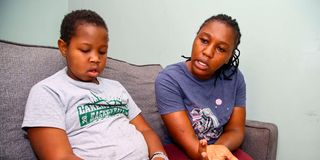
Blessing Mugure and her mother Mary Wairimu Mugure at their home in Kahawa West, Nairobi, on September 23, 2025.
Medically, Blessing’s survival is a mystery that borders on the divine. Julian from Hope for Cancer Kids calls her a “miracle”. She was declared “end of life” over a year ago, and the window for a bone marrow transplant elapsed. “But her body is really fighting,” Julian marvels. “If you saw Blessing in the hospital, she looked sick. I was surprised when we came to visit them here. She looks very fine. She’s better now than when she was in hospital.”
Today, Blessing, who has been out of school for almost five years, is filled with excitement at the prospect of resuming classes in Grade 5 this coming January. In the meantime, she crochets scarves and paints, the skills she honed in Ward 1E now a testament to her strength and a practical tool for her future.
Her story is a story of a mother who refused to be defeated, a community that stepped in when family stepped out, and a little girl whose name is her destiny. In a small room in Kahawa West, surrounded by the art she created to save her own life, Tabitha Blessing is not just a cancer survivor but a vibrant, living canvas of courage, taking one day at a time, truly blessed.